
You wake up and it looks as though someone placed a sheet of frosted glass over the center of your vision. Objects are dimmed, tinted, slightly smaller than they should be. The ophthalmologist calls it central serous retinopathy. Classical Chinese medicine has a longer diagnosis: your Liver has been overriding your Spleen, and the accumulated fluid in your macula is what that looks like from the inside.
The Condition Stress Built
Central serous chorioretinopathy (CSC / CSCR) is one of the more diagnostically memorable conditions in ophthalmology — and one of the most revealing. It strikes a strikingly specific demographic: young to middle-aged men in high-pressure occupations. The mechanism is well characterized: the choroidal vasculature becomes hyperpermeabile, fluid leaks through breaks in the retinal pigment epithelium, and a blister of subretinal fluid forms directly beneath the macula. The result is the classic presentation — a central visual disturbance that makes the world look like it’s been viewed through a shallow pool of water.
What drives the choroidal hyperpermeability? The evidence points firmly at the stress axis. Elevated cortisol — whether from psychological stress, Type A personality dynamics, or external corticosteroid exposure — is the most consistent precipitating factor in the clinical literature. It is, in this sense, the stress response made structurally visible in the eye.
Classical Chinese medicine named this pattern centuries before anyone had measured a cortisol level.
Central serous retinopathy warrants ophthalmologic confirmation and monitoring. Monthly OCT evaluation is standard care. Many acute episodes resolve spontaneously within three to four months; this article addresses the constitutional terrain in which they occur, not the acute monitoring protocol.
視瞻有色 — The Classical Name for What You’re Seeing
視瞻有色 — Shì Zhān Yǒu Sè — “Tinted or coloured vision when looking.”
This classical designation for central visual disturbance — color shift, diminution, and the sense of looking through a medium — maps closely onto the CSR presentation as we would recognize it today. The classical clinicians who documented it did not have OCT machines, but they had centuries of pattern recognition, and they consistently traced this presentation to a single axis:
肝木乘土 — Gān Mù Chéng Tǔ — “Wood overacts on Earth.”
This is the foundational principle for understanding why CSR belongs to the Liver-Spleen system. In Five-Phase logic, Liver belongs to Wood and governs the free flow of Qi throughout the body. Spleen belongs to Earth and governs the transformation and transport of fluids — it is, in the classical model, the body’s primary fluid-management organ. When the Liver Qi is constrained by stress, frustration, overwork, or suppressed emotion, Wood fails to regulate itself and begins to exert excessive controlling pressure on the Earth phase. Spleen’s transport function falters. The fluid that should be continuously transformed and moved begins to accumulate — and in the pattern of CSR, it accumulates specifically at the macular center.
Three Patterns, One Axis
The Liver-Spleen axis generates more than one variant in the CSR presentation. A precise formula requires distinguishing which pattern — or combination of patterns — is most active.
Water-damp invading upward (Shuǐ Shī Shàng Fàn, 水湿上泛) is the primary Spleen-deficiency picture. When the Spleen’s Earth-axis transport capacity is insufficient — from overwork, poor dietary habits, prolonged worry, or constitutional tendency — dampness accumulates below and eventually ascends to the most refined sensory structures: the eyes, and within the eye, the fovea. The subretinal fluid in CSR is, in this framing, the clinically visible form of Spleen-damp that has escaped the channels upward. The herbal category here is Spleen-tonifying, dampness-draining herbs that restore the downward-clearing function of the Earth axis: bitter and sweet-warm herbs that fortify the Spleen’s motive force while actively opening the exit channels for accumulated damp.
Liver Qi constraint with Wood overacting on Earth (Gān Qì Yù Jié, Mù Chéng Tǔ, 肝气郁结,木乘土) is the stress-primary picture — and the most characteristic CSR pattern. Chronic occupational pressure, a driven temperament that holds frustration inside, or the compressed emotional landscape of someone who always keeps going: these create Liver Qi constraint. The constrained Liver, unable to regulate its own expansion, pushes into the Spleen, disrupting the very transport function that should be clearing the fluid the choroid keeps leaking. The herbal category for this pattern combines Liver-Qi-smoothing and Qi-moving herbs with Spleen-fortifying support and Blood-nourishing herbs that address the Liver’s underlying depletion. This formula family does not simply drain the damp — it removes the pressure that creates it.
Liver-Kidney deficiency (Gān Shèn Kuī Xū, 肝肾亏虚) is the recurrent-CSR pattern. The patient who has had multiple episodes, who is moving into the fourth or fifth decade, whose visual recovery between episodes is no longer complete: the constitutional reserve — the Liver-Kidney Yin and Essence that anchor all metabolic and sensory function — has been eroded. The damp-accumulation is now occurring against a background of deficiency rather than simple constraint. The herbal category adds Yin-nourishing and Essence-building herbs directed at the Liver-Kidney root, woven into the damp-resolving base. Without this layer, the pattern recurs — because what the eye is expressing is no longer just a stress event but a constitutional depletion.
Three Illustrative Herbs
The formula for CSR is assembled through the intake process. These three herbs illustrate the herbal logic at the core of this pattern family — not as a complete formula, but as a window into the classical reasoning.
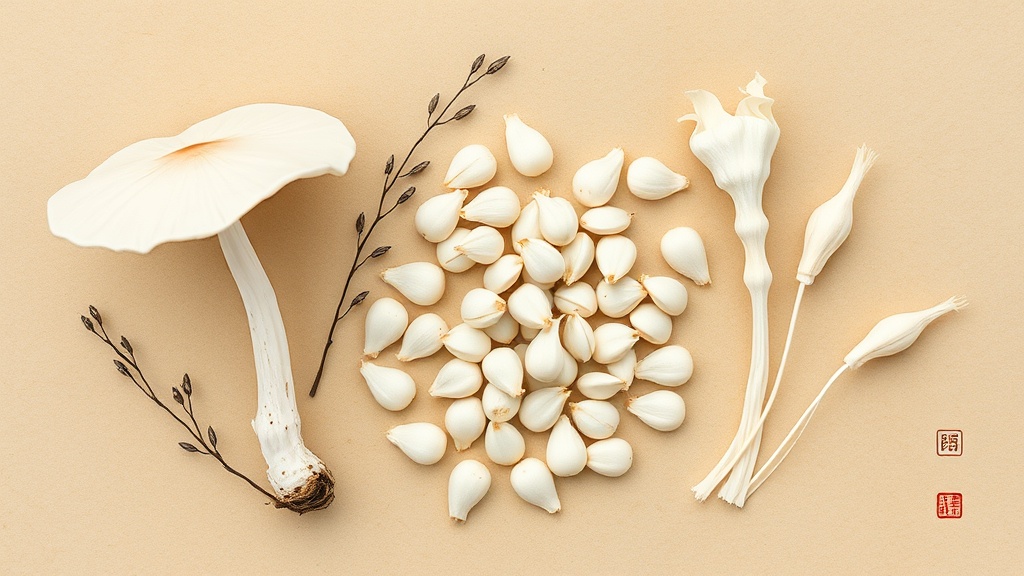
- Fu Ling (Fú Líng, 茯苓) — poria cocos mushroom — is the primary Spleen-draining, damp-transforming herb for the macular fluid pattern. Its classical function is sweet and bland, leaching dampness gently downward through the Earth axis while simultaneously tonifying the Spleen Qi. Crucially, it also calms the Shen — the spirit-vitality that the Heart houses and the Liver’s constraint disrupts. In the stress-driven CSR patient, the combination of damp-draining action and spirit-calming quality makes Fu Ling a near-universal component: it addresses both the product of the Liver-Spleen disruption and its emotional driver in a single herb.
- Chai Hu (Chái Hú, 柴胡) — bupleurum root — is the quintessential Liver-Qi-smoothing herb and the classical envoy for the Wood-Earth harmonizing pattern. Its ascending, dispersing quality lifts the Liver constraint that is pressing on Spleen’s function, opening the channel through which Qi can move freely again. Where the Spleen-draining herbs address the product of the Wood-Earth disruption, Chai Hu addresses the cause — the Liver stagnation itself. It is the herb that breaks the feedback loop between stress and fluid accumulation.
- Yi Yi Ren (Yì Yǐ Rén, 薏苡仁) — coix seed / Job’s tears / pearl barley — drains dampness downward through the Earth channel, supports the resolution of inflammatory damp accumulation, and is gentle enough to be classified as a food in the classical materia medica. It illustrates the diet-medicine continuum: the same grain that appears in therapeutic cooking also appears in classical damp-draining formulas at pharmacological concentration. For the CSR patient learning that their macula is sitting in a pocket of fluid, Yi Yi Ren offers a useful education in what the classical practitioner means by “damp” — not an abstraction, but a physical accumulation of fluid that properly directed Earth-axis herbs can help the body clear downward.
The Functional Medicine Layer
The classical herbal formula addresses the constitutional root — the Liver-Spleen axis, the damp accumulation, and the stress driver. Functional medicine adds a parallel layer of support operating through different but complementary mechanisms.
Cortisol-modulating botanical adaptogens are the FM complement to the Liver-smoothing Chinese herbs. The HPA-axis dysregulation that drives choroidal hyperpermeability in CSR responds to this category in ways that are increasingly well characterized — and for the stress-dominant presentation, this layer is clinically relevant regardless of whether one reads it as adaptogenic regulation or as Liver-Qi-smoothing by another name.
Carotenoid antioxidant category provides RPE mitochondrial protection. The retinal pigment epithelium, already under metabolic stress from the subretinal fluid environment, benefits from antioxidant support in the carotenoid family — the same pigment chemistry concentrated in healthy macular tissue under normal conditions.
Phospholipid-class neural support targets foveal photoreceptor outer-segment membrane integrity during the subretinal fluid episode, when the physical separation of photoreceptors from the RPE nutrient supply creates both metabolic and structural vulnerability.
Essential fatty acid category supports choroidal and retinal anti-inflammatory action and may contribute to the resolution of the hyperpermeability environment.
Probiotic category addresses the gut-eye-adrenal axis — systemic inflammation reduction that feeds back on both the stress response and the choroidal inflammatory milieu.
A Note on Corticosteroids
If corticosteroids are part of the clinical picture — oral prednisone, inhaled steroids for asthma, topical skin applications, nasal sprays, or intra-articular injections — their relationship to CSR is direct and recognized in the ophthalmologic literature. Corticosteroid exposure impairs the same Spleen-transport-analog function that the classical physician reads as Earth-axis deficiency: fluid handling becomes dysregulated, and the choroid responds accordingly.
Reducing or eliminating corticosteroid exposure, where clinically appropriate and guided by the prescribing physician, is a primary lever in the CSR picture — not a secondary consideration. The Spleen-strengthening herbal category directly addresses the damp accumulation that steroid-impaired fluid transport creates, but it works most efficiently when the corticosteroid load is being simultaneously addressed from the medical side.
What the Monitoring Arc Looks Like
Acute CSR frequently resolves on its own within three to four months, and the standard ophthalmologic recommendation is watchful waiting with monthly OCT monitoring during this window. Herbal medicine fits naturally into this period: it addresses the constitutional terrain rather than competing with the spontaneous resolution process, and it begins building the Liver-Spleen correction that reduces the likelihood of recurrence.
If subretinal fluid persists beyond four months, referral to a retina specialist for photodynamic therapy (PDT) or threshold laser evaluation is appropriate. Herbal medicine does not substitute for this escalation — it addresses terrain, not fluid in a macula that has exceeded its spontaneous-resolution window. The two conversations are not in conflict; they operate at different levels of the clinical picture.
The specific formula — the classical base, the modification for whether the dominant pattern is Spleen-damp, Liver-Qi-constraint, or Liver-Kidney deficiency — emerges from the intake. What you read here is the map of the territory; the formula is drawn from your individual ground.
A stress-pattern in the eye is still a stress-pattern in the body
Central serous retinopathy does not begin in the eye. It begins in the Liver-Spleen axis — in the stress, the drive, and the cortisol that the classical practitioner reads in the pulse and the tongue, long before the OCT reveals the fluid. The herbal formula for CSR is not an eye formula. It is a pattern formula for the terrain that let this happen.
Explore the eye health framework or the macular conditions pillar — or move directly to the intake process when you’re ready.
A note on these statements
These statements have not been evaluated by the Food and Drug Administration. These products are not intended to diagnose, treat, cure, or prevent any disease. Classical Chinese herbal medicine and functional medicine supplements are offered as part of a pattern-based intake process, not as treatments for diagnosed medical conditions.