Chamber X
The Eight Principles.
Before the organ. Before the formula. Four pairs that locate every disease in the body. Interior or exterior. Hot or cold. Full or empty. Yin or yang.
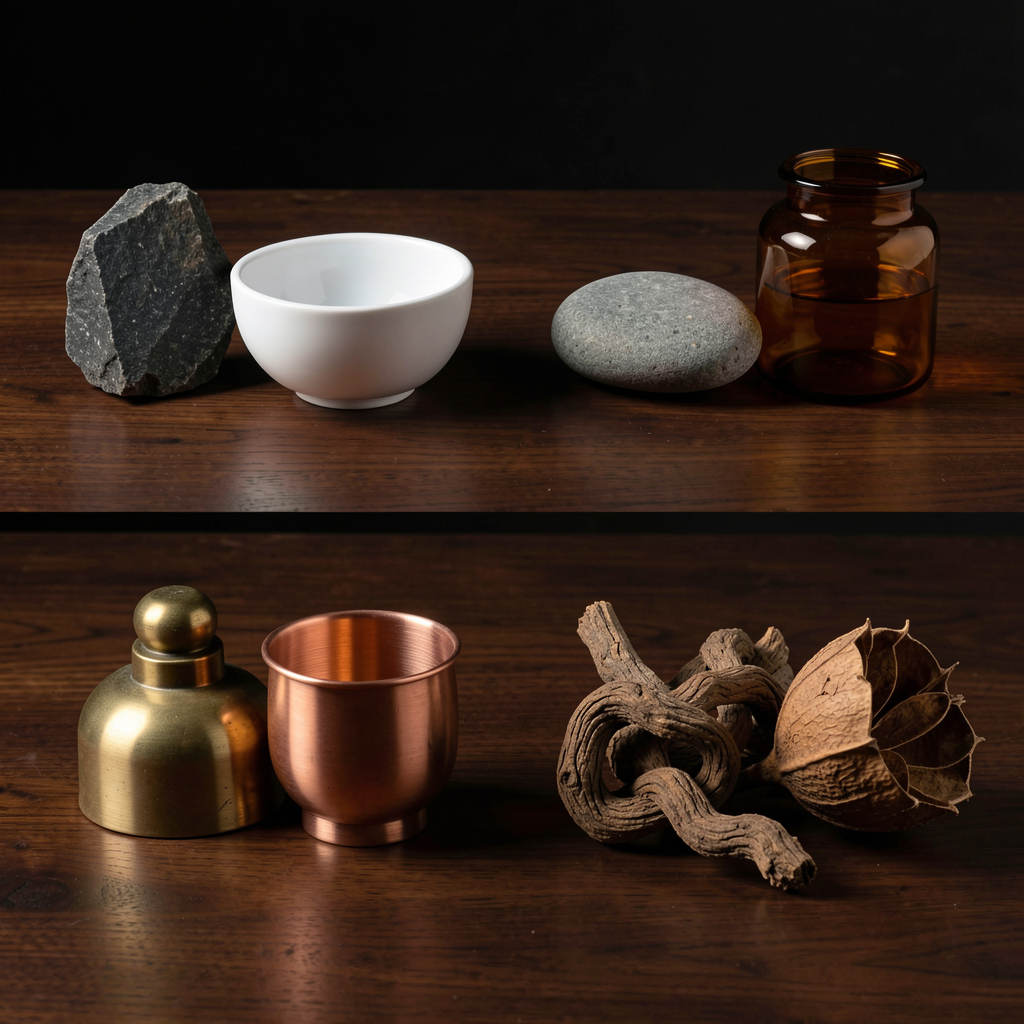
The map comes before the territory. The eight principles are the map.
The first question is not which disease.
Modern medicine's first question is diagnostic: which disease does this patient have? The classical practitioner's first question is different: where is this disease, and what is the body doing about it? That shift — from naming to locating — is the foundation of the Eight Principles framework. Before you identify the organ pattern, before you select the formula architecture, before you reach for any of the vocabulary introduced in the earlier chambers, you orient yourself along four axes. Together those axes tell you everything you need to know to begin.
The Eight Principles are four pairs: Interior and Exterior, Cold and Heat, Deficiency and Excess, and — organizing all four — Yin and Yang. They are not a checklist. They are a coordinate system. Every clinical presentation can be mapped onto them. Two patients with identical Western diagnoses will often occupy different coordinates on this map, which is why the same diagnosis requires different treatments in classical medicine. The map is not the disease. The map is the person.
Modern medicine asks: which disease? Classical medicine asks: which direction? Different question. Better answer.
Interior and Exterior: where is the disease?
The first pair locates the disease in the body's layers. Exterior patterns — Tai Yang in the Shang Han Lun's language — are diseases at the surface: the channels, the skin, the Wei Qi defensive layer. The body is still fighting outward. There is aversion to cold, floating pulse, stiffness in the neck and shoulders. The disease has not yet penetrated. Correct treatment at this stage resolves the pattern before it can move deeper.
Interior patterns are diseases that have moved past the surface into the organ networks and the fundamental substances. The pulse is deeper. The symptoms are systemic. The body's fight has shifted from the exterior to the interior. Whether the disease arrived from outside and was driven inward by incorrect treatment, cold exposure, or constitutional weakness — or whether it was generated internally from overwork, diet, emotion, or depletion — by the time it is interior, the treatment must address the interior. You cannot expel from the surface what is no longer there.
The clinical significance: treatments that release the exterior (diaphoretics, surface-opening formulas) are contraindicated when the disease is already interior. Treatments that tonify and consolidate the interior are contraindicated when the disease is still at the surface. Getting this wrong does not fail to help. It actively drives the disease deeper, or traps the pathogen inside when it could have been expelled. The Exterior/Interior distinction is not optional.
You cannot sweat out what is already in the organs. You cannot tonify your way out of an active pathogen at the surface. Location determines strategy.
Cold and Heat: what is the nature of the pathology?
The second pair identifies the thermal character of the disease — not the patient's body temperature, but the functional quality of the pathological process. Cold patterns are characterized by slowing, constriction, pallor, preference for warmth, thin clear discharges, slow or sunken pulse, and a tongue that is pale with a white coating. Heat patterns present as acceleration, expansion, redness, preference for cold, thick yellow discharges, rapid pulse, and a red tongue with a yellow coating.
This distinction has enormous therapeutic consequences. Cold contracts and slows; it is treated with warming, moving, dispersing herbs and formulas. Heat inflames and consumes; it is treated with cooling, clearing, draining approaches. Applying a warming formula to a heat pattern accelerates the pathology. Applying a cooling formula to a cold pattern deepens the constriction. Both errors make the patient worse, sometimes dramatically. In clinical practice, the Cold/Heat distinction is the axis most commonly misread by practitioners treating with a standard formula rather than a pattern-differentiated one — because the presenting symptom (pain, fatigue, digestive disturbance) looks the same in both, while the treatment direction is opposite.
The additional complexity: Cold and Heat can coexist in the same patient — Cold in the lower burner, Heat in the upper; Cold in the Spleen, Heat in the Stomach. The Eight Principles are not a simple sorting system. They are a language for describing the body's actual state, which is frequently mixed, layered, and contradictory. The formula must address the complexity, not reduce it.
Two patients. Both exhausted. One runs cold and craves heat. One runs hot and cannot sleep. Opposite patterns. Opposite treatments. Same complaint on the intake form.
Deficiency and Excess: whose problem is it?
The third pair is the most clinically consequential — and the most frequently misapplied. Excess patterns are defined by the presence of something that should not be there: an external pathogen (wind, cold, damp, heat), an internal accumulation (phlegm, blood stasis, food stagnation, Liver Qi stagnation). The body's fundamental resources are adequate; the problem is the intruder or the obstruction. Correct treatment drains, disperses, resolves, moves — it removes the excess.
Deficiency patterns are defined by the absence of something that should be present: insufficient Qi, Blood, Yin, or Yang. The body lacks the resources required to maintain normal function. Correct treatment tonifies, nourishes, supplements — it restores what is missing. Attempting to drain or disperse a deficiency pattern is an act of clinical violence. You are depleting a system that is already running on reserves. The patient may briefly feel a symptomatic shift — and then crash harder than before. This is one of the most common failures in herbal medicine when practiced without classical diagnostic grounding.
The compounding factor: deficiency and excess coexist constantly in chronic disease. Long-term Liver Qi stagnation (excess) depletes Liver Blood (deficiency) over time. Long-term Spleen Qi deficiency (deficiency) generates phlegm and damp accumulation (excess). The pattern is both deficient and excess simultaneously, and the formula must address both — in the right proportion, in the right sequence, with the correct emphasis. This is why pattern differentiation requires training, and why a standardized formula cannot do what a custom formula can.
Draining a deficiency is not aggressive treatment. It is the wrong treatment. The body keeps accounts. You cannot drain what is not there.
Yin and Yang: the organizing pair.
The fourth pair is not a separate axis — it is the meta-organizer that synthesizes the first three. Interior, Cold, and Deficiency cluster together as Yin presentations. Exterior, Heat, and Excess cluster together as Yang presentations. A patient who presents with interior location, cold nature, and deficiency character is in a Yin pattern. The tongue will be pale, the pulse deep and weak, the clinical picture one of systemic withdrawal and exhaustion. A patient who presents with exterior or interior location, heat nature, and excess character is in a Yang pattern. The tongue will be red, the pulse rapid or wiry, the clinical picture one of activation, inflammation, and accumulation.
This is why Yin and Yang in classical medicine are not decorative philosophy. They are the top-level clinical categories, and the distinction determines the entire direction of treatment. A Yin pattern requires Yang-supporting, warming, nourishing approaches. A Yang pattern requires Yin-preserving, clearing, resolving approaches. The eight words — interior, exterior, cold, heat, deficiency, excess, yin, yang — encode the entire range of clinical possibility in classical Chinese medicine. Every pattern that has ever been documented, every formula ever formulated, every case Zhang Zhongjing recorded in the Shang Han Lun, falls somewhere in this map. The map came first. The territory has been confirming it for two thousand years.
Interior or exterior. Hot or cold. Full or empty. Yin or yang. That is the whole map. The whole map is enough.
Modern medicine asks: which disease? Classical medicine asks: which direction? Different question. Better answer.
Interior or exterior. Hot or cold. Full or empty. Yin or yang. The whole map is enough.
Two patients. Both exhausted. One runs cold. One runs hot. Opposite treatments. Same intake form.
Eight principles. Four pairs. Every disease located before the formula is written. This is what classical diagnosis looks like when it works.