Chamber VII
Yin and Yang.
The dialectic underneath everything. Not a symbol. A clinical tool.
What the wellness industry declawed, the classics kept sharp.
The symbol became a decoration. The system remained.

The taijitu — the black and white circle with the fish-eye dots — has appeared on bumper stickers, yoga studios, and corporate balance initiatives for fifty years. In that time, the clinical meaning was stripped out and replaced with "balance" as a vague aspiration. Yin and Yang, in the popular rendering, are opposites in harmony. Soft and hard. Passive and active. Dark and light. The wellness industry turned them into a personality test.
In the classical texts, Yin and Yang are a diagnostic engine. They answer a single, precise question: in this patient, at this moment, is there too much of something, or too little? And is the something that is too much or too little — Yin, or Yang?
Balance is not a destination. It is a dynamic. The system keeps returning to it — if the system is given what it needs.
The four clinical states.
Every disease pattern in classical Chinese medicine resolves, at the deepest level, into one of four states: excess Yang, deficient Yang, excess Yin, deficient Yin. The eight parameters of classical diagnosis — interior/exterior, cold/hot, deficiency/excess, Yin/Yang — map onto each other, and the Yin/Yang axis is the master axis beneath all of them.
| State | Temperature | Onset | Timing | Danger level |
|---|---|---|---|---|
| Excess Yang | High fever | Acute | Worse daytime | Acute, short |
| Deficient Yin | Low-grade, chronic | Slow | Worse at night | Persistent |
| Excess Yin | Severe cold | Acute | Worst at night | Acute, intense |
| Deficient Yang | Chronic cold | Slow | Worse throughout | Less severe — more dangerous |
Why does Deficient Yang feel cold but less severely than Excess Yin? Because Excess Yin has real cold invading; Deficient Yang is simply running out of warmth. Less intense — but the resource is depleting. Any deficiency pattern is more serious than any excess pattern. An excess means the body is fighting something. A deficiency means the body is losing what it fights with.
The paradox the classics resolved.
Yang rises. Yin descends. The textbook says so. But sunlight — the most Yang thing — shines down. Earth — the most Yin thing — is below, and immobile. How does Yang come down? How does Yin go up? If Yin and Yang are simply opposites, the cycle does not work.
The ICEAM resolution: in isolation, Yang rises and Yin descends — like separated magnets. But together, they reverse. Yang is drawn downward into Yin, the way magnets reverse when they approach each other. Yang warms the cold wet earth — fluids heat up — steam rises. That vapor is Yin ascending. It cools at altitude, condenses into cloud, and eventually falls as rain — Yang descending, carried by the weight of water. The cycle is mutual. Fire descends via water. Water ascends via fire. They are not opposites. They are phases in each other's generation.
Yin cannot rise on its own — only through infusion of Yang. Yang cannot descend on its own — only through the weight of Yin. Neither exists without the other. Neither moves without the other.
Ming Men: fire within water.
The Ming Men 命門 — the Gate of Life — is the fire contained within the Kidney's water. It is the warmth that circulates through all fluids in the body: the warmth in the blood, the metabolic heat that sustains organ function, the vitality that modern medicine approximates as basal metabolic rate and immunological tone. The Kidney stores it. The Heart generates it. Over decades of life, it depletes.
What we call Kidney Yang is, in the classical model, Heart fire that has descended and warmed the Kidney water. The warmth in your blood is not produced by the blood — it is the fire of the Heart, carried by the fluids, distributed by the Kidney's governing function. When the Ming Men weakens, everything cools: digestion slows, fluids stagnate, vitality dims. The Kidney is the bank. The Ming Men is the interest rate. Classical herbal medicine nourishes the root — not the symptom — because treating the symptom without addressing the Ming Men is withdrawing from an account that is already running short.
The golden rule.
The ICEAM school holds a single overriding principle that the classical literature returns to repeatedly: at the root, it is always deficiency.
Every excessive pattern, left untreated, eventually depletes the body's resources and becomes a deficiency pattern. The acute presentation is excess — the body fighting, mobilizing, resisting. But every second of fighting consumes the body's capital. Excessive damp-cold invasion forces the body to allocate dry-heat Yang to resist it. Every second of resistance depletes that Yang. The chronic result, after the acute invasion resolves, is Yang deficiency with residual damp — a deficiency pattern where an excess pattern once was.
This is why the classical doctors said that the physician who treats only what they can see will always be one step behind the disease. The acute picture is the symptom. The chronic direction is the pattern. The root is almost always something the body has begun to run out of — long before the symptom appeared.
At the root, it is always deficiency. The classics knew this. Modern medicine is still learning to look that deep.
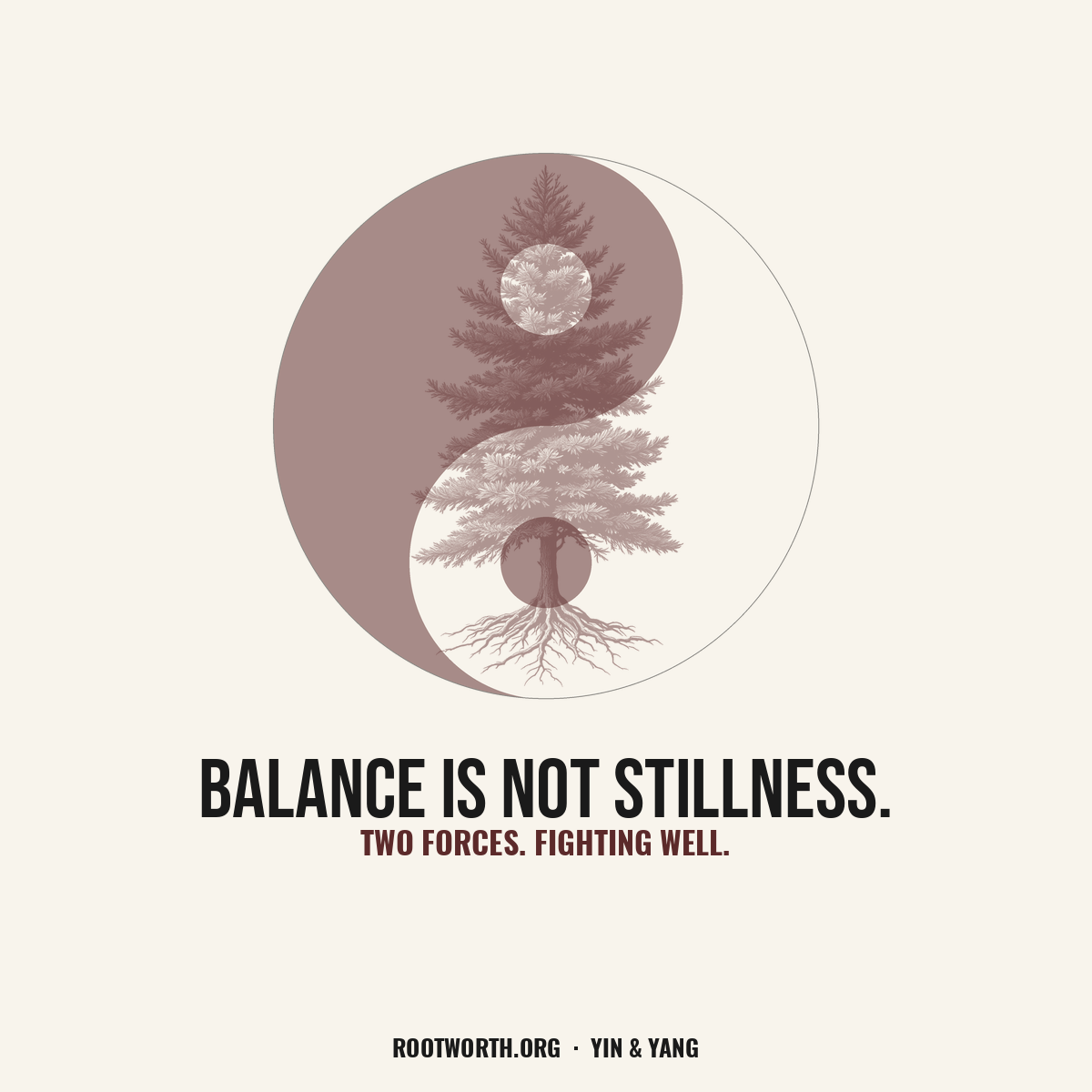
Balance is not stillness. It is two forces fighting well.
The wellness industry turned a dialectic into a logo. We kept the argument.
Nothing is only yin. Nothing is only yang. The body moves between. That is the point.
What moves is not opposed. What moves is in dialogue.
The Su Wen opens with this premise and never abandons it. Every subsequent teaching — the five phases, the six conformations, the organ network — is an elaboration of one idea: the body is a dynamic relationship between complementary forces, and disease is what happens when that relationship is interrupted. The treatment restores the relationship.