Cataracts
The lens is not failing in isolation. Classical Chinese medicine reads the slow clouding of the crystalline lens as the surface expression of a constitutional process — and addresses the root.
A cataract is an opacity of the crystalline lens — the transparent structure inside the eye that focuses light onto the retina. As the lens proteins cross-link and aggregate, the lens that was once clear becomes progressively clouded, and vision dims as though the world is being seen through a fogged or frosted window. In Western medicine, the condition name describes the structural endpoint. The classical Chinese framework asks a different question: what failure in the body's governing systems allowed this to happen?
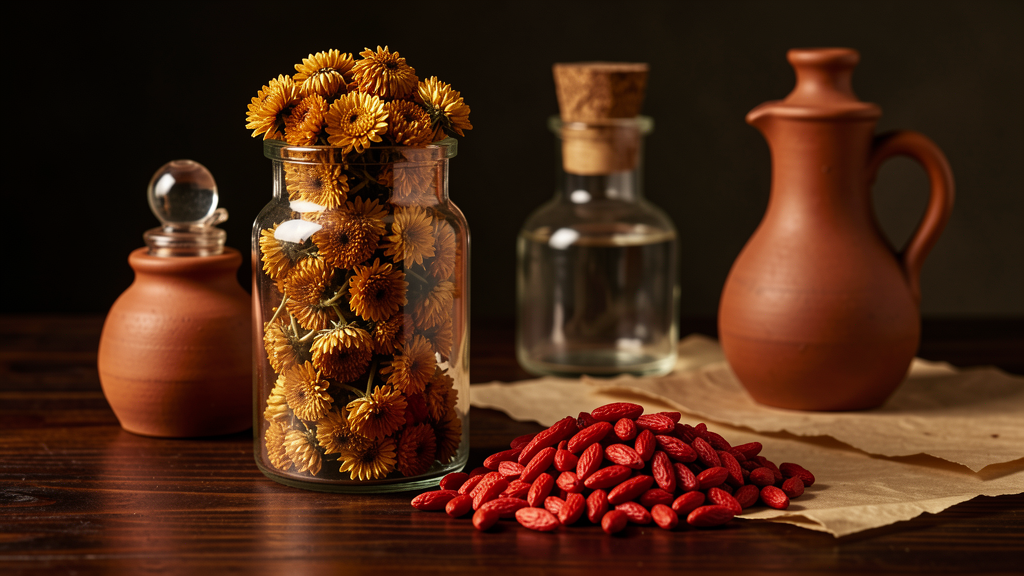
肝腎陰精虛。 Liver-Kidney Yin and Jing deficiency — the constitutional throughline beneath age-related lens failure.
In the classical reading, the eye is nourished by two inseparable supply systems. The Liver governs the blood supply — the Qi and Blood that must continuously circulate to keep every clear structure of the eye moistened and metabolically alive. The Kidney stores the Jing — the deep constitutional substance, partly inherited, partly accumulated and spent over a lifetime — that provides the substrate the Liver draws from. When Kidney Jing and Liver Yin begin to decline with age, the lens is one of the first clear structures to lose its nourishment. Without adequate Yin fluid circulating through it, the lens begins to desiccate; its proteins aggregate; the window slowly clouds.
A second mechanism runs in parallel. The Spleen governs transformation and transportation — the metabolic engine that processes food into usable Qi and Blood and distributes that nourishment through the body. When the Spleen is impaired, it fails to fully transform what it receives. Instead of clear, nutritive fluid, turbid metabolic byproduct — called turbid Phlegm or Damp in the classical language — accumulates in the body's structures. The lens is a fluid-mediated structure. Turbid Qi obstructing what the classical literature called the Water Wheel — the pupil-lens-aqueous-vitreous axis — is one of the classical mechanisms for cataract formation. The Western correlate is direct: lens protein glycation, oxidative modification of crystallin proteins, and the accumulation of metabolic debris in the lens cytoplasm are the biochemical signature of this turbid obstruction.
These two mechanisms often coexist in the same patient. The underlying deficiency — the failing nourishment — creates the conditions in which the turbid accumulation takes hold. They are not competing diagnoses; they are the root and the accumulation it enables.
What Western medicine has measured — and what the classical framework explains.
Nuclear sclerosis — the hardening and yellowing of the central lens nucleus with age — is the most common form of cataract. In Western terms it is driven by the progressive cross-linking of crystallin proteins (alpha, beta, and gamma-crystallin), the loss of chaperone function in those proteins, and the accumulation of oxidative modification products — including advanced glycation end-products (AGEs) — that aggregate into light-scattering structures.
The Western risk factor list maps precisely onto the classical pattern diagnosis:
- Age — Kidney Jing declines with age; the constitutional substrate that moistens the lens dwindles over decades. This is not pathology — it is the classical lifecycle. What varies is how fast, and why.
- Diabetes / hyperglycemia — the classical Xiao Ke (消渴, wasting-and-thirsting) pattern; Spleen failing to transform grain Qi → glucose remains in excess → polyol pathway activation → sorbitol accumulates in the lens → osmotic damage and protein aggregation. A direct Spleen failure mechanism producing a specific form of lens toxicity.
- Chronic UV exposure — external pathogenic Heat and Dryness penetrating the clear fluid structures of the eye; Yin deficiency creates insufficient fluid-cooling to buffer this incoming oxidative load.
- Corticosteroid use — chronic steroid use depletes Kidney-Adrenal Yin in the classical framework; posterior subcapsular cataracts are the characteristic lens finding in long-term steroid users — a consistent pattern that classical observation and Western pharmacology describe from different angles.
- Smoking — generates turbid Heat and depletes Lung Yin; oxidative load from combustion products directly damages lens protein and Yin fluid.
- Family history — constitutional Jing inheritance; what a patient's constitutional reserve looks like at the start shapes how early and how rapidly lens deficiency will manifest.
久病入絡。 Chronic disease enters the collaterals — metabolic damage solidifies into lens protein cross-linking.
This classical statement — 久病入絡, chronic disease enters the fine collaterals — describes what Western pathology confirms: that long-standing metabolic processes (chronic hyperglycemia, oxidative accumulation, UV damage accumulated over years) do not merely irritate the lens. They chemically alter its protein architecture. The cross-linking is structural. The turbid accumulation has solidified. This is why cataract is a condition addressed at the constitutional level, in the years before surgical thresholds are reached — because the Chinese herbal framework is designed to act on the terrain and chemistry that produced the structural change, not to reverse structural change already locked in place.
The classical pattern stack — reading the lens through the whole person.
The lens does not opacify in four identical ways in four identical people. The classical framework identifies distinct pattern configurations, each requiring a different formula architecture:
Pattern identification — four classical configurations →
This section is provided as clinical reference material. Pattern identification is distinct from disease diagnosis. All formula references below represent classical pattern-based herbal support, not treatment of any disease condition.
| Pattern | Clinical signature | Western correlate | Formula direction |
|---|---|---|---|
| Liver-Kidney Yin / Jing Deficiency 肝腎陰精虛 |
Gradual vision dimming in an older patient; dryness throughout the body (eyes, skin, throat); fatigue in the afternoon and evening; low back weakness; possibly tinnitus; thin, slightly dry tongue; thin or slightly deep pulse | Age-related nuclear sclerosis; reduced aqueous-lens fluid exchange; crystallin protein desiccation and early aggregation | Generate and nourish: Liu Wei Di Huang Wan base; Ming Mu Di Huang Wan; add Gou Qi Zi, Nu Zhen Zi, Han Lian Cao for stronger Yin-Jing nourishment; Ju Hua to direct to the eye |
| Damp Turbidity / Turbid Phlegm obstructing the Water Wheel 痰濁蒙蔽 |
Blurred or foggy vision more prominent than actual opacity would predict; digestive heaviness; tendency toward loose stools or bloating; fatigue after eating; body heaviness; pale or swollen tongue with white coating; slippery pulse | Lens protein glycation and polyol-pathway accumulation; aqueous humor metabolic debris accumulation; early cortical cataract (spoke-like opacities) in younger diabetic patients | Transform and dry: Er Chen Tang framework (Chen Pi, Ban Xia, Fu Ling); add Yi Yi Ren to leach Damp; Shi Chang Pu to open the orifice and clear the Water Wheel; combine with Spleen Qi support (Si Jun Zi Tang elements) |
| Spleen Qi Deficiency 脾氣虛 |
Low energy; loose stools; poor appetite; underweight or tissue wasting; the turbid fluid is accumulating because the Spleen cannot transport it away; tongue pale with thin white coat; pulse soft and slightly weak | Compromised delivery of crystallin-protective nutrients through impaired metabolic absorption; reduced glutathione turnover in the lens; poor antioxidant substrate supply | Fortify and restore: Si Jun Zi Tang base; Dang Shen, Bai Zhu, Fu Ling, Gan Cao; add Sheng Ma to lift clear Qi; Ge Gen to move Qi to the upper body and eye |
| Stomach Heat contributing to glycation-oxidative damage 胃熱 |
Diabetic or pre-diabetic patient with strong appetite, thirst, and heat; gum inflammation; tendency toward excess; red tongue with yellow coat; rapid pulse; prominent in the diabetic cataract picture | Chronic hyperglycemia → sorbitol accumulation in lens → osmotic stress → posterior subcapsular cataract; oxidative modification of crystallin proteins by reactive carbonyl species | Clear and cool: Huang Lian (黄連) to clear Stomach-Heart fire; Zhi Mu + Shi Gao to clear Stomach Heat; combine with Kidney Yin to address the underlying deficiency that lets the Heat rise unchecked; consider Yu Nu Jian base |
In most patients with age-related cataract, two or more of these patterns coexist. The Yin deficiency and the turbid accumulation are often inseparable — the deficiency creates the metabolic environment in which turbidity accumulates. The experienced practitioner reads the primary pattern, the secondary pattern, and their relative weight, then constructs the formula to address them in sequence. The sequence matters as much as the individual herbs.
The four blood actions — how the formula is built.
Every cataract formula is constructed from some combination of the four classical actions on blood and fluid. For the cataract picture, the relevant actions are:
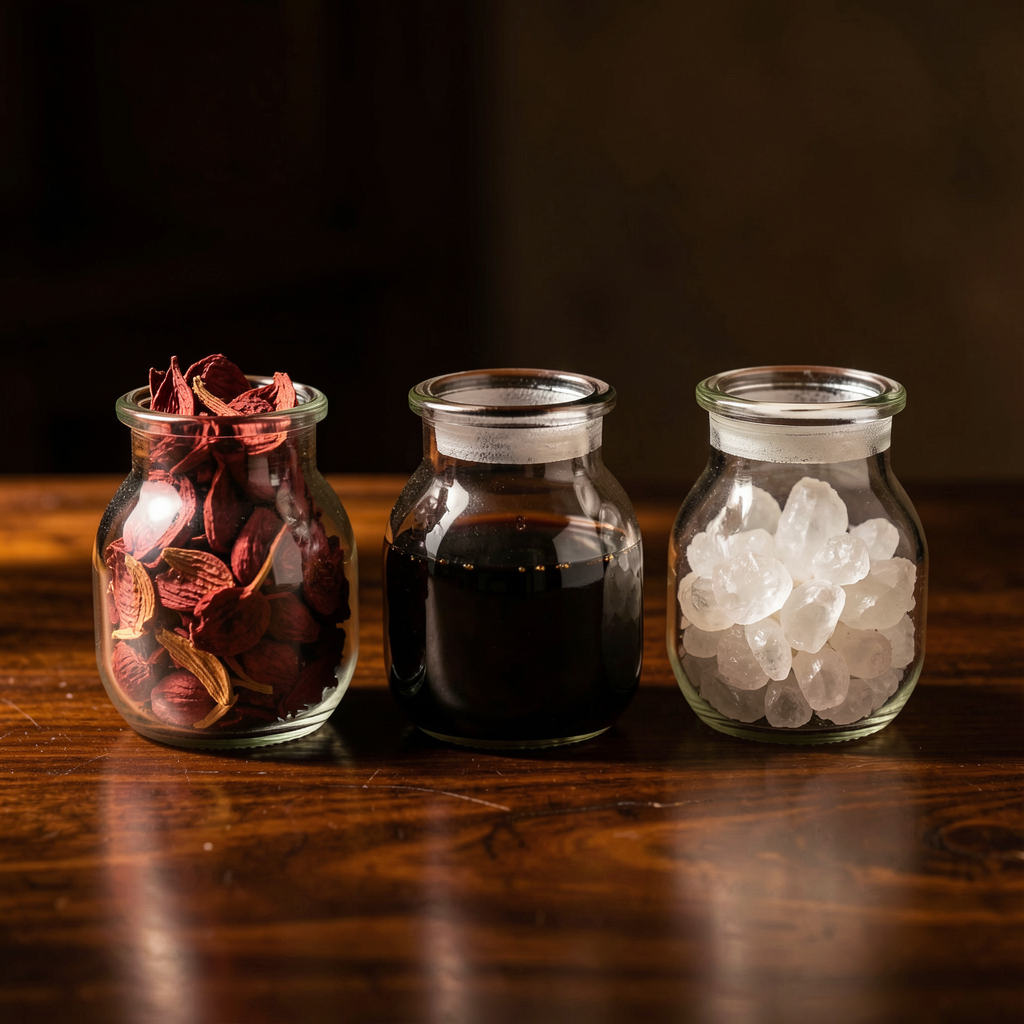
GENERATE + COOL — nourish Yin fluid and clear the deficiency heat environment. The lens requires continuous Yin fluid nourishment to maintain its protein architecture. The primary generation-and-cooling herbs for cataracts: Liu Wei Di Huang Wan (*Liù Wèi Dì Huáng Wán*, 六味地黄丸) provides the base — Shu Di Huang (prepared Rehmannia), Shan Yao (Chinese yam), Shan Zhu Yu, plus three draining herbs that keep the tonics from becoming cloying. Sheng Di Huang (*Shēng Dì Huáng*, 生地黄) — raw Rehmannia, which simultaneously nourishes Yin fluid and cools the blood; it reduces the oxidative-heat environment in which crystallin protein damage accelerates. Ju Hua (*Jú Huā*, 菊花) — the classical eye herb; clears Liver heat, directs herbal action to the eye, and functions in the classical literature as the primary single herb for brightening the vision and dispersing superficial eye obstructions. Gou Qi Zi (*Gǒu Qǐ Zǐ*, 枸杞子 / wolfberry) — nourishes Liver and Kidney Yin specifically, with a classical affinity for the eye and the visual apparatus.
TRANSFORM PHLEGM/DAMP — resolve the turbid obstruction of the Water Wheel. This is specific to the cataract picture and distinguishes it from most retinal conditions. The turbid Phlegm mechanism requires active transformation — not just nourishment, but the clearing of what has accumulated. The classical framework for this: Er Chen Tang (*Èr Chén Tāng*, 二陈汤) elements — Chen Pi (陈皮, aged tangerine peel) to move Qi and dry Damp; Ban Xia (半夏, pinellia) to transform Phlegm; Fu Ling (茯苓, poria) to leach Damp through urination and strengthen the Spleen that is producing the Damp. Shi Chang Pu (*Shí Chāng Pú*, 石菖蒲) — opens orifices and clears turbid Phlegm from the clear sensory structures; the classical reference herb for restoring sensory clarity when turbidity has obstructed the clear openings of the body.
MOVE blood — address the glycation-stasis layer in diabetic cataracts. When the cataract sits on a foundation of chronic hyperglycemia and vascular compromise, the formula requires blood-moving chemistry alongside the nourishing and transforming action. Dan Shen (*Dān Shēn*, 丹参) — moves blood through the Liver and heart channels without depleting it; laboratory-documented effects on platelet aggregation and microvascular circulation; relevant to the small-vessel stasis of diabetic lens metabolism. San Qi (*Sān Qī*, 三七) — simultaneously moves blood and stops bleeding; the essential herb when blood stasis and glycation-related micro-vessel damage coexist. Chuan Xiong (*Chuān Xiōng*, 川芎) — the cephalic blood-mover; active in the vessels of the head and upper body, including the ocular micro-circulation.
GENERATE — Spleen Qi to rebuild the delivery infrastructure. Si Jun Zi Tang (*Sì Jūn Zǐ Tāng*, 四君子汤) elements as the foundation when Spleen Qi deficiency is a primary or contributing pattern: Dang Shen (党参), Bai Zhu (白术), Fu Ling (茯苓), Zhi Gan Cao (炙甘草). These herbs rebuild the transformative function that allows the tonifying herbs to be absorbed and delivered to the lens.
Representative formulas for the cataract picture.
- Ming Mu Di Huang Wan (*Míng Mù Dì Huáng Wán*, 明目地黄丸) — "Brighten Vision Rehmannia Pill." The foundational classical formula for age-related visual dimming from Liver-Kidney Yin deficiency; adds Dang Gui, Bai Shao, Ju Hua, Shi Jue Ming to the Liu Wei base; specifically targets the eye.
- Liu Wei Di Huang Wan (*Liù Wèi Dì Huáng Wán*, 六味地黄丸) — Kidney Yin base when the constitional deficiency is the primary driver; used as a substrate onto which eye-specific modifications are layered.
- Qi Ju Di Huang Wan (*Qǐ Jú Dì Huáng Wán*, 杞菊地黄丸) — Liu Wei plus Gou Qi Zi and Ju Hua; specifically designed for the Liver-Kidney-Eye axis; appropriate for early-stage age-related cataract with a clear Yin deficiency picture.
- Shi Jue Ming San (*Shí Jué Míng Sǎn*, 石决明散) — Shi Jue Ming (abalone shell) to anchor floating Liver Yang and cool Liver heat contributing to the opacity; useful when the cataract has a component of Liver fire rising to the eye.
- Er Chen Tang combined with Si Jun Zi Tang (*Èr Chén Tāng* + *Sì Jūn Zǐ Tāng*) — for the turbid Phlegm pattern with Spleen Qi deficiency; transforms the turbid while strengthening the organ that is producing it; base structure for the non-elderly diabetic cataract.
- Yu Nu Jian (*Yù Nǚ Jiān*, 玉女煎) — for Stomach Heat with Yin deficiency; the diabetic-pattern cataract with marked heat signs, thirst, and elevated appetite; clears while nourishing.
一人一方。 One person, one formula.
The combination lock — why the same diagnosis presents differently.
Two patients both have age-related nuclear sclerosis at the same grade on the LOCS III lens opacity scale. Same Western diagnosis. Same surgical timeline offered. Different combination lock entirely.

The first patient is seventy-two, slender, with decades of careful living, chronic low-grade dryness throughout her body, tinnitus that has worsened in her sixties, and a tongue that is pale and slightly dry at the center. Her eyes tire quickly. She wakes at three or four in the morning. Her classical picture is Liver-Kidney Yin and Jing deficiency — the constitutional substrate has been slowly declining, and the lens is losing the Yin fluid that keeps it flexible and clear. Her combination lock turns through Kidney Yin nourishment first, then Liver Blood support, with classical eye herbs directing the formula to its target. She does not need Phlegm transformation; adding those herbs to her constitution would dry what is already dry.
The second patient is fifty-eight, heavier, with a twenty-year history of poorly controlled Type 2 diabetes, chronic digestive bloating, fatigue after eating, and a tongue that is pale, swollen, and coated with a thick white layer. His cataract is cortical — spoke-like opacities at the periphery — and has progressed faster than his ophthalmologist expected for his age. His classical picture is Spleen Qi deficiency with turbid Phlegm accumulation — the metabolic failure of transformation producing the biochemical debris that is clouding his lens. His combination lock turns through Spleen restoration and Phlegm transformation first; adding cloying Yin tonics to this constitution would thicken the obstruction rather than clear it. His formula architecture and her formula architecture have almost no herbs in common, even though they carry the same Western diagnosis.
The Western supplement aisle offers lutein and zeaxanthin — nutritional averages for an averaged population. For the first patient, the limiting factor is not dietary lutein. It is the constitutional Yin deficiency that means she cannot absorb, distribute, and deploy whatever lutein she does ingest effectively. For the second patient, the limiting factor is a metabolic failure that is actively producing the opacity chemistry regardless of what antioxidants he ingests.
The classical framework reads the lock before it offers the key.
Clinical framing — what herbal support can and cannot address.
Phacoemulsification with intraocular lens implantation (IOL) is the definitive Western treatment for visually significant cataract. When lens opacity reaches the threshold where it substantially impairs daily function, surgery is safe, fast, and highly effective. The classical herbal framework does not replace the surgical indication.
What the classical framework addresses is the constitutional substrate — the terrain in which the lens opacified, and in which whatever remaining lens tissue and surrounding ocular structures will continue to operate after surgery. Specifically:
- Pre-surgical constitutional support: For patients awaiting surgery, classical herbal support addresses the pattern underlying the cataract — the Yin deficiency, the turbid obstruction, the Spleen failure — with the aim of supporting the body's overall regulatory state. In clinical experience, patients who arrive at surgery with a stronger constitutional picture tend to have smoother recoveries and healthier baseline retinal and optic-nerve function post-operatively.
- Slowing the rate of progression before surgical thresholds are reached: For patients with early to moderate lens opacity who are not yet surgical candidates, the rate of further opacification is not fixed. The constitutional terrain in which lens protein cross-linking accelerates — the deficiency and turbid accumulation — is modifiable by herbal support. The classical approach does not promise reversal of structural opacity that is already established; it addresses the mechanism that is producing further opacification.
- The concurrent retinal picture: Cataract frequently coexists with AMD, diabetic retinopathy, glaucoma, or other retinal conditions. A critical clinical note: when concurrent retinal disease is present, ophthalmology generally recommends addressing the retinal condition — including anti-VEGF injections for wet AMD — before proceeding with cataract surgery, because the cataract must be removed before the retina can be fully evaluated and retinal surgery can be performed if needed. For patients in this situation, herbal support for the retinal pattern takes priority in formula design, with the lens substrate addressed as a secondary concern. The formula serves the retina first.
Classical herbal medicine is not a strategy for avoiding necessary surgery. It is a strategy for ensuring the constitutional ground is as well-prepared as possible — before, during, and after the surgical process.
For the patient working with the surgical timeline.
Most patients with a cataract diagnosis receive a surgical referral or a "watch and wait" recommendation. The watch-and-wait period — the months or years between diagnosis and the point at which opacity reaches surgical threshold — is where constitutional herbal support has the most to contribute. This is not a gap to fill with a lutein supplement. It is a window in which the underlying pattern that produced the opacity can be addressed at the root.
Real medicine does not wait for the structure to fail completely and then remove it. Real medicine works in the space between the diagnosis and the crisis — on the constitutional ground that determines whether the threshold arrives next year or in five years, and whether the remaining ocular structures are in the best possible state when it does.
If you have been told to watch and wait, this is the window. The classical framework is designed for exactly this space.
How the intake works for cataract support.
The online intake asks for your full clinical picture: your ophthalmologist's most recent lens opacity grading if available, whether your cataract is nuclear, cortical, or posterior subcapsular, any concurrent retinal diagnosis, current medications including any prescribed eye drops and supplements, and the full constitutional history — digestion, sleep, energy patterns, how the body has changed over years.
For cataract-presenting patients, the intake specifically asks about: the character of the visual change (dimming, glare, color shift, halos), whether you have diabetes or a history of steroid use, and whether your ophthalmologist has said anything about the rate of progression. These details locate your presentation within the classical pattern framework and determine whether the formula is built around Yin nourishment, Phlegm transformation, Spleen support, or some ratio of all three.
Michael reads every intake personally and designs the formula accordingly. The formula arrives with an explanation of what pattern it is addressing and what you might observe as a response signal.
Understand the framework before you begin.
The Chambers are a free patient education library — the methodology behind every Rootworth formula. Reading them before or alongside your intake helps you understand what the classical assessment is seeing, why individualized formulas outperform generic protocols, and how each layer of treatment connects to the next.
A note on these statements.
Rootworth herbal preparations are dietary supplements. These statements have not been evaluated by the Food and Drug Administration. These products are not intended to diagnose, treat, cure, or prevent any disease. Classical Chinese medicine pattern assessment — the identification of constitutional patterns such as Liver-Kidney Yin deficiency, Spleen Qi insufficiency, or turbid Phlegm obstruction — is distinct from the diagnosis and treatment of disease as defined under United States federal law. Individual results vary. Classical herbal support for cataract is intended to address constitutional patterns, not to reverse established lens opacity or substitute for surgically indicated cataract removal. Always continue your ophthalmologist's care alongside any herbal support program. If you have been advised that surgery is indicated, follow your ophthalmologist's recommendation.