Fertility & Reproductive Health
Custom herbal formulas for the classical patterns underlying fertility — because the diagnosis names the failure, and the pattern reads the terrain that produced it.
Classical Chinese medicine holds a precise and ancient proposition about reproduction: it is not a mechanical event that the body either executes or fails to execute. It is the visible expression of constitutional depth — the moment where the deepest reserves the body holds are tested. When those reserves are adequate, the cycle runs cleanly, conception occurs, and pregnancy is sustained. When they are depleted, obstructed, or both, the reproductive system is the first to reflect it.
The foundational classical statement is three characters: 腎主生殖 — Shèn zhǔ shēngzhí — the Kidney governs reproduction. This is not a metaphor. It is the organizing clinical principle for every fertility condition in the classical framework. The Kidney stores *Jing* (精), the constitutional essence — the substance that determines the quality of the egg, the architecture of the sperm, the hormone-signaling capacity of the ovary, and the body's capacity to sustain a pregnancy once it occurs. Kidney Jing is what is depleted by age, by overwork, by chronic illness, by years of running a body past its reserves. When it is depleted, the reproductive system reads the depletion accurately and responds accordingly.
Two extraordinary vessels complete the classical anatomy of fertility. 衝任二脈 — the *Chōng Mài* (Conception Vessel) and *Rèn Mài* (Sea of Blood) — are the two channels that govern the uterus, the menstrual cycle, and the hormonal rhythm that makes pregnancy possible. The *Chōng Mài* is the Sea of Blood: it fills with blood each cycle, building the endometrial lining, sustaining the follicle, preparing the uterine environment for implantation. The *Rèn Mài* is the channel through which the body's Yin essence — the cooling, nourishing, fluid reserve — is drawn into the reproductive cycle. When these two vessels are disharmonized, every phase of the menstrual cycle is disrupted.
Above the vessels, the classical substance that governs the timing of it all is 天癸 — *Tiān Guǐ*, heavenly water — the neuroendocrine signaling essence that ripens at puberty, governs the cycle through the reproductive years, and declines with age. The classical counterpart to the FSH/LH/estrogen/progesterone axis. When Tiān Guǐ is adequate and the Kidney Jing that produces it is sufficient, the cycle is regular and ovulation is reliable. When Tiān Guǐ is disrupted, the hormonal signaling that drives follicular development, ovulation, and the luteal phase becomes erratic — producing the anovulation, irregular cycles, and hormonal dysregulation that reproductive endocrinology documents in precise biochemical detail but rarely addresses at the constitutional source.
This is why two thousand years of practitioners observed that the same fertility failure — anovulation, thin endometrium, recurrent loss — could arise from entirely different roots, require entirely different formulas, and respond at entirely different rates. The diagnosis names the structure that has failed. The pattern reads the person whose constitutional terrain produced the failure. The formula addresses the terrain.
女子以血為本。
Nǚzǐ yǐ xuè wéi běn.
For women, Blood is the root.
The blood and inflammation engine — how fertility conditions arise.
Reproductive medicine has mapped the biochemistry of fertility failure in extraordinary detail. Across almost every major diagnosis — PCOS, endometriosis, diminished ovarian reserve, recurrent miscarriage, thin endometrium, luteal phase defect — the same story emerges at the molecular level: blood is not reaching where it needs to go, inflammation is damaging the tissue blood is meant to sustain, or the hormonal signaling that Blood and Yin generate has fallen below the threshold the cycle requires.
Consider the conditions from this angle:
- Diminished ovarian reserve / low AMH — follicular blood supply to the granulosa cells, which produce estrogen and support oocyte development, declines as the ovarian cortex ages or is damaged. The FSH rise that marks DOR is the pituitary's compensatory signal to a follicular pool that is not responding adequately. Classical reading: Kidney Jing and Yin deficiency — the constitutional substrate of follicular development is depleted.
- PCOS — at the metabolic level, insulin resistance drives hyperandrogenism and suppresses SHBG. At the vascular level, androgen excess creates a pro-inflammatory ovarian environment in which follicles fail to mature and ovulate. At the fluid-metabolism level: Phlegm and Dampness accumulate in the ovaries when the Spleen's transformative capacity is chronically insufficient. These are the same pathology from different angles.
- Endometriosis — retrograde menstrual tissue implants, evades immune clearance, and drives a chronic local inflammatory response. Prostaglandin and cytokine production in the endometriotic lesions impairs fallopian tube function, disrupts the uterine environment, and creates adhesions that mechanically obstruct the reproductive tract. Classical reading: long-standing Blood stasis that has entered the uterine collaterals — 久病入絡.
- Thin endometrium — inadequate endometrial Blood supply, impaired progesterone response, or insufficient estrogen-driven proliferative response all produce an endometrial lining that cannot sustain implantation. Classical reading: Liver Blood deficiency failing to fill the Chong Mai; the Sea of Blood is empty.
- Recurrent miscarriage — implantation-site vascular insufficiency, impaired trophoblast invasion, luteal phase progesterone inadequacy, or immunological rejection of the embryo. Classical reading: Kidney Qi's holding function — its capacity to anchor and sustain what has been received — is insufficient. 腎不固胎: the Kidney fails to secure the fetus.
- Male factor infertility — oxidative stress from chronic inflammation damages sperm DNA integrity, reduces motility, and distorts morphology. The testicular microcirculation, like the ovarian, depends on Blood supply and Blood quality. Classical reading: Kidney Jing deficiency with possible Damp-Heat in the lower jiao.
These are all blood, inflammation, and constitutional reserve stories. The treatment question — whether asked by a reproductive endocrinologist or a classical Chinese herbalist — is: can we support the Blood supply, control the inflammation, correct the hormonal signaling deficit, and address the constitutional root that produced this terrain? The frameworks differ in their diagnostic lens and their therapeutic tools. They converge on the same body.
The classical statements that predict the condition — the bridge between frameworks.
The classical literature did not have ultrasound, AMH assays, or hysteroscopes. What it had was two thousand years of clinical observation organized into aphorisms that function as compressed physiological rules. Each statement names a relationship between an organ system and a physiological process. Each relationship, when it fails, produces a recognizable pattern of findings that Western reproductive medicine now documents with laboratory precision.
The classical mechanism table — for practitioners →
This section is provided as clinical reference. The statements below are classical Chinese medical aphorisms and their corresponding pattern mechanisms — not disease claims. All formula directions represent classical pattern-based support, not treatment of diagnosed disease conditions.
| Classical statement | Mechanism when the statement fails | Western finding it produces | Formula direction |
|---|---|---|---|
| 腎主生殖 Shèn zhǔ shēngzhí Kidney governs reproduction |
Kidney Jing depletes with age, overwork, chronic stress, or constitutional insufficiency → ovarian reserve declines; oocyte DNA repair capacity diminishes; hormonal feedback loops weaken | Elevated FSH, low AMH, poor embryo quality, age-related infertility, DOR | Zuo Gui Wan (Kidney Yin/Jing), You Gui Wan (Kidney Yang), Er Xian Tang (dual deficiency / POI) |
| 天癸 Tiān Guǐ Heavenly water governs the cycle |
Tiān Guǐ is the neuroendocrine signaling essence; disruption of the Kidney Jing that generates it → irregular, absent, or anovulatory signaling at the HPO axis | Anovulation, irregular cycles, post-pill amenorrhea, PCOS hormonal dysregulation, LH surge failure | Jia Wei Xiao Yao San, Er Xian Tang, You Gui Wan; formula phased to cycle timing |
| 肝藏血 Gān cáng xuè Liver stores Blood |
Liver Blood deficiency → insufficient Blood to fill the Chong Mai → thin endometrium, poor follicular nourishment, luteal phase insufficiency; Liver Qi stagnation → impaired uterine Blood flow → dysmenorrhea, irregular cycles; Qi stagnation converting to Heat → pelvic inflammation | Thin endometrium (<7mm), luteal phase defect, PMS, dysmenorrhea, endometriosis-associated inflammation, fibroids | Jia Wei Xiao Yao San (Qi stagnation + Heat), Si Wu Tang base (Blood building), Gui Zhi Fu Ling Wan (stasis) |
| 脾主運化 Pí zhǔ yùnhuà Spleen governs transformation and transportation |
Spleen Qi fails to produce Blood from food essence → thin endometrium; fails to transform fluids → Phlegm-Damp accumulates in the lower jiao → follicular cysts, anovulation, metabolic features of PCOS | PCOS (Earth-type), anovulation, implantation failure, endometrial receptivity failure, insulin resistance | Cang Fu Dao Tan Wan (Phlegm-Damp), Bu Zhong Yi Qi Tang (Spleen Qi), Si Jun Zi Tang base |
| 衝任不調 Chōng Rèn bù tiáo Chong and Ren are not harmonized |
Sea of Blood insufficient → endometrium cannot build; or Sea of Blood stasis-filled → lining present but unreceptive; Ren Qi insufficient → Yin fluids fail to support the follicular environment | Thin endometrium, fibroids distorting the uterine cavity, recurrent implantation failure, unexplained infertility | Gui Zhi Fu Ling Wan (stasis clearing), Wen Jing Tang (deficient Cold + stasis), Zuo Gui Wan (Yin building) |
| 腎不固胎 Shèn bù gù tāi Kidney fails to secure the fetus |
Kidney Qi's holding and consolidating function is insufficient → trophoblast invasion inadequate → progesterone support fails → early pregnancy loss; Spleen Qi co-deficiency fails to hold Blood in vessels during implantation | Recurrent miscarriage, threatened abortion, luteal phase progesterone insufficiency, biochemical pregnancy loss | Shou Tai Wan (secure the fetus — primary formula), You Gui Wan (Kidney Yang support), modified for each phase |
| 久病入絡 Jiǔ bìng rù luò Chronic disease enters the collaterals |
Long-standing Qi stagnation → Blood stasis accumulates in the uterine and pelvic collaterals → fixed, adherent, inflammatory lesions; immune evasion and chronic local inflammation destroy follicular and uterine function | Endometriosis, pelvic adhesions, tubal obstruction, fibroids (Blood stasis type), adenomyosis | Gui Zhi Fu Ling Wan, Xue Fu Zhu Yu Tang, Shao Fu Zhu Yu Tang (lower jiao focus); sustained Blood-moving treatment required |
These are not poetic descriptions. Each statement is a falsifiable clinical prediction. When the Kidney fails to govern reproduction, the downstream biochemistry — FSH elevation, AMH decline, follicular arrest, poor embryo morphology — follows a predictable trajectory. When the Spleen fails to transform fluids, the Phlegm-Damp accumulation in the ovarian tissue produces the cystic morphology and metabolic dysregulation that reproductive endocrinology photographs on ultrasound. The classical practitioner named the mechanism. The Western laboratory measures its consequences.
Herbs are chemistry — four actions on Blood for fertility.
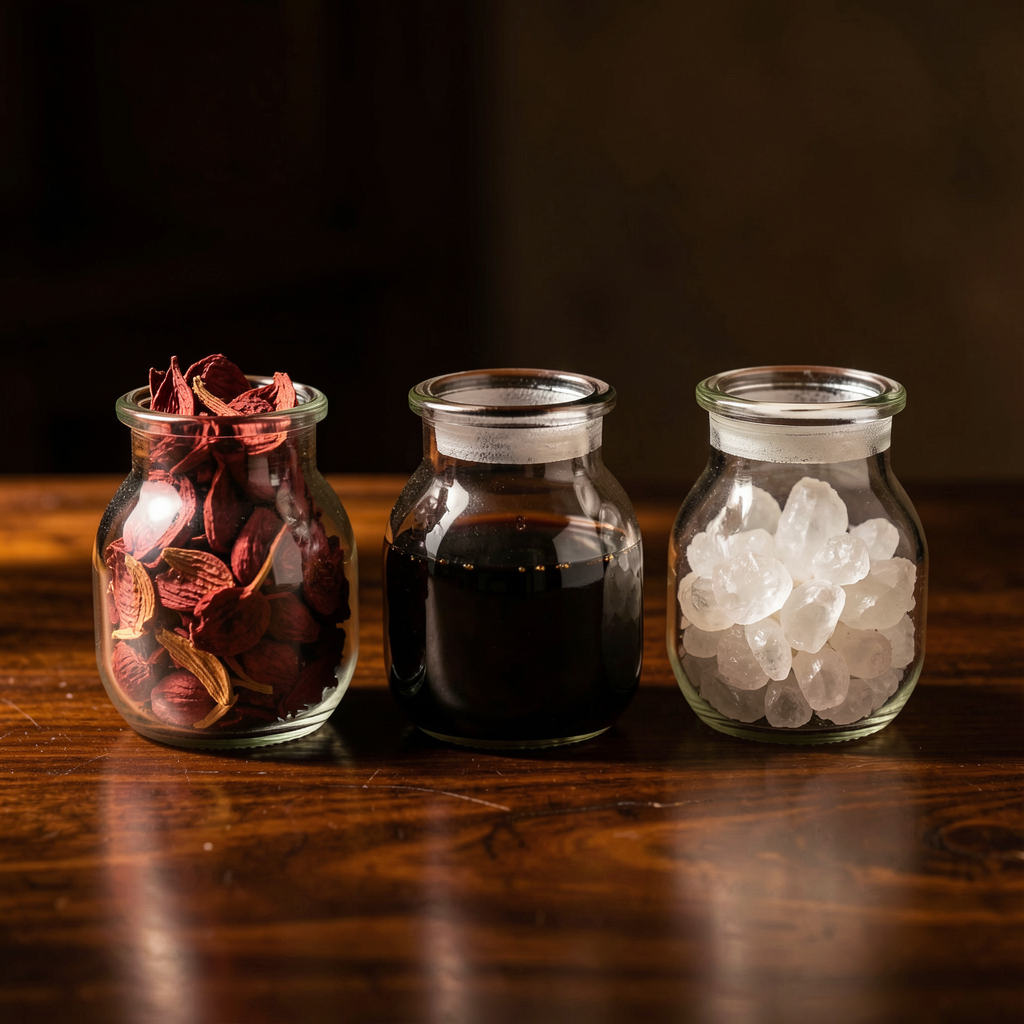
The reproductive system is, at every level, a blood and fluid system. The follicle is vascularized. The endometrium is built from Blood. The corpus luteum is a secretory structure sustained by blood flow. The hormones that govern every phase of the cycle are synthesized, transported, and metabolized in the blood. Herbal formulas are chemical interventions in that system. The mechanisms are real, measurable, and increasingly studied in peer-reviewed endocrinology and reproductive medicine literature.
Classical Chinese herbal medicine describes four fundamental actions on Blood. Every fertility formula is built from some combination of these four, chosen and proportioned for the specific pattern and the specific phase of the cycle in the specific person:
GENERATE Blood — build the constitutional substrate: nourish the follicle, build the endometrial lining, provide the material foundation of reproductive health. This is the deepest layer — the root from which everything else is grown.
- Shu Di Huang (*Shú Dì Huáng*, 熟地黄 / Prepared Rehmannia) — the primary Blood and Jing building herb; nourishes the Kidney Yin that supports follicular development and endometrial proliferation
- Dang Gui (*Dāng Guī*, 当归 / Angelica sinensis) — generates and moves Blood simultaneously; the cornerstone of every classical female formula
- E Jiao (*É Jiāo*, 阿胶 / Donkey-hide Gelatin) — generates Blood and prevents uterine bleeding; classical for supporting the luteal phase and early pregnancy
- He Shou Wu (*Hé Shǒu Wū*, 何首乌 / Polygonum multiflorum) — nourishes Liver Blood and Kidney Jing; egg quality and constitutional reserve
- Gou Qi Zi (*Gǒu Qǐ Zǐ*, 枸杞子 / Lycium berry) and Tu Si Zi (*Tú Sī Zǐ*, 菟丝子 / Cuscuta) — Kidney Jing tonics with specific affinity for reproductive tissue; both appear in the classical fertility formula Wu Zi Yan Zong Wan
COOL Blood — clear inflammatory heat, reduce vascular reactivity, protect the follicular and uterine environment from inflammatory damage. Fertility depends on a specific thermal environment — excess heat is hostile to implantation and follicular development.
- Sheng Di Huang (*Shēng Dì Huáng*, 生地黄 / Raw Rehmannia) — the primary Blood-cooling and Yin-generating herb; clears the empty heat that Yin deficiency generates around the follicular phase
- Mu Dan Pi (*Mǔ Dān Pí*, 牡丹皮 / Moutan Bark) — cools Blood stasis; the inflammation-clearing component of Gui Zhi Fu Ling Wan; key in endometriosis patterns
- Chi Shao (*Chì Sháo*, 赤芍 / Red Peony Root) — cools Blood and moves stasis simultaneously; anti-inflammatory in the pelvic vascular bed
MOVE Blood — resolve stasis, activate pelvic microcirculation, dissolve the structural accumulations that obstruct reproductive function. Endometriosis, fibroids, and tubal adhesions are all classical Blood stasis conditions. Blood that does not move accumulates into fixed lesions.
- Tao Ren + Hong Hua (*Táo Rén* 桃仁 + *Hóng Huā* 红花, Peach Kernel + Carthamus) — the classical pair for resolving pelvic Blood stasis; the core of Tao Hong Si Wu Tang and Xue Fu Zhu Yu Tang
- Yan Hu Suo (*Yán Hú Suǒ*, 延胡索 / Corydalis) — moves Blood and Qi; the primary classical analgesic for dysmenorrhea; reduces prostaglandin-driven uterine cramping
- Dan Shen (*Dān Shēn*, 丹参 / Salvia miltiorrhiza) — moves Blood in the Liver and Heart channels; supports uterine microcirculation; laboratory-documented effects on endometrial blood flow
- Gui Zhi (*Guì Zhī*, 桂枝 / Cinnamon Twig) — warms and moves; the channel-opening component in Gui Zhi Fu Ling Wan; improves pelvic circulation in cold-stagnation presentations
WARM Blood — activate Kidney Yang, support the luteal phase, sustain the corpus luteum, maintain the uterine temperature environment that early implantation requires. Kidney Yang deficiency is the cold-pattern infertility substrate — low basal body temperature, weak luteal rise, cold hands and feet, low libido, frequent urination.
- Ai Ye (*Ài Yè*, 艾叶 / Mugwort) — warm the Bao Gong (uterine palace); the classical herb for cold-uterus infertility; warms the channel without drying
- Fu Zi (*Fù Zǐ*, 附子 / Aconite) — the strongest Kidney Yang warming herb; used in significant Yang deficiency with cold limbs and absent luteal phase temperature rise
- Xu Duan (*Xù Duàn*, 续断 / Teasel Root) — warms the Kidney, consolidates the fetus; appears in Shou Tai Wan for its dual action of warming and securing
- Ba Ji Tian (*Bā Jǐ Tiān*, 巴戟天 / Morinda Root) — warms Kidney Yang specifically for the lower jiao reproductive substrate; male and female Yang tonification
Representative classical formulas that deploy these four actions in different fertility contexts:
- Wu Zi Yan Zong Wan (*Wǔ Zǐ Yǎn Zōng Wán*, 五子衍宗丸, Five-Seed Fertility Pill) — the classical Kidney Jing formula; primarily for male factor but applicable to Jing deficiency presentations in either sex
- Shou Tai Wan (*Shòu Tāi Wán*, 寿胎丸, Secure the Fetus Pill) — the primary recurrent miscarriage formula; Kidney Qi consolidation and Blood nourishment
- Gui Zhi Fu Ling Wan (*Guì Zhī Fú Líng Wán*, 桂枝茯苓丸) — Blood stasis dissolving in the lower jiao; the foundational endometriosis and fibroid formula; moves without depleting
- Wen Jing Tang (*Wēn Jīng Tāng*, 温经汤, Warm the Menses Decoction) — warms the Chong Mai; addresses cold uterus with deficient cold plus mild stasis; classical for scanty painful periods with cold lower abdomen
- You Gui Wan (*Yòu Guī Wán*, 右归丸, Restore the Right Kidney) — Kidney Yang replenishment; luteal phase support, cold anovulation, Yang-deficient male factor
- Zuo Gui Wan (*Zuǒ Guī Wán*, 左归丸, Restore the Left Kidney) — Kidney Yin and Jing replenishment; DOR, poor egg quality, elevated FSH; follicular phase support
- Er Xian Tang (*Èr Xiān Tāng*, 二仙汤, Two Immortals Decoction) — simultaneous Yin and Yang deficiency; premature ovarian insufficiency, perimenopause, dual-deficiency infertility
- Jia Wei Xiao Yao San (*Jiā Wèi Xiāo Yáo Sǎn*, 加味逍遥散) — Liver Qi stagnation with Heat; the most common modern female pattern underlying cycle irregularity, PMS, and stress-responsive infertility
一人一方。 One person, one formula.
These formulas are starting architectures. In practice, every formula is modified herb by herb based on the intake reading — the specific phase of the cycle, the constitutional temperature, the Spleen's capacity to absorb cloying tonics, the secondary patterns that sit beneath the primary one. The formula adjusts each month as the pattern shifts. This is classical formula modification. It is a dynamic clinical process, not a product decision.
The combination lock — same Western label, different constitutional key.
Two women sit across from a reproductive endocrinologist on the same day. Both are told they have unexplained infertility. Both leave with the same protocol: timed intercourse with monitoring, possible Clomid, discussion of IUI.
Behind those two diagnoses are two entirely different classical pictures. Two combination locks with different tumbler configurations. Turning the wrong key will not open either lock.
The first woman is thirty-four. She is cold. Her hands are always cold. Her basal body temperature chart is flat — no clear temperature rise after ovulation, or a rise that begins two days late and falls within ten days. Her periods are light and pale, her lower abdomen is chronically cold to her own touch, she wakes to urinate once or twice nightly, and her energy is lowest in the afternoon. Her tongue is pale. Her pulse is deep and thin. The classical picture is Kidney Yang deficiency — the warming, activating force that drives ovulation and sustains the luteal phase is insufficient. Her combination lock turns: warm the Kidney Yang, support the corpus luteum, warm the Bao Gong. Formula architecture: You Gui Wan base with Ai Ye, Ba Ji Tian, cycle-phased with Zuo Gui Wan in the follicular phase to nourish the Yin that the Yang needs to express from.

The second woman is thirty-one. She is not cold. She runs warm. Her periods are heavy, dark, and clotted. She has PMS — irritability, breast tenderness, headaches — that begins ten days before her period. She is a high-performing professional who has been under sustained career pressure for six years. Her sleep is disrupted in the early morning hours. Her tongue is slightly red at the edges. Her pulse is wiry. The classical picture is Liver Qi stagnation converting to Heat, sitting on top of a secondary Blood stasis. Her combination lock turns differently: first move the Liver Qi, clear the Heat, activate the pelvic Blood circulation — and only then consider whether constitutional building is needed beneath. Adding warming Kidney Yang tonics to a woman whose Liver Qi is constrained and already generating heat would be like adding fuel to an already-hot system. The lock is different. The formula must be different.
Same Western label. Opposite constitutions. Opposite formulas. The combination lock principle is why a protocol that works brilliantly for one patient fails completely for another patient with the identical diagnosis — and why statistical averages obscure the most important clinical variable, which is the specific person standing in front of the practitioner.
Why digestion comes first — and why this matters for every hormone supplement you take.
Li Dong-yuan — the twelfth-century physician who wrote the foundational text on Spleen and Stomach medicine, the Pi Wei Lun — made an argument that most modern fertility protocols ignore completely:
脾胃者,後天之本。
Pí wèi zhě, hòutiān zhī běn.
The Spleen and Stomach are the root of post-natal life.
脾主運化 — the Spleen governs transformation and transportation — means precisely this: the Spleen extracts the nutritive essence from food and transforms it into Blood, Qi, and the raw materials from which the reproductive system is built and maintained. When the Spleen's transformative function is impaired, everything downstream is underfunded: the Blood the Liver stores, the Jing the Kidney holds, the endometrium the Chong Mai fills, the egg quality the follicle produces.
This has a direct practical implication most fertility patients never encounter: if the Spleen's transformative function is compromised, the supplements you are taking are not being transformed and delivered to the tissues that need them. The CoQ10, the DHEA, the NAC, the melatonin — all of these require a functioning digestive-absorptive system to be processed, converted into bioavailable forms, and delivered through the circulation to the ovarian cortex and uterine endometrium where they are intended to act.
If a patient has chronic bloating, loose stools, low appetite, easy fatigue after eating, or food sensitivities — these are Spleen Qi deficiency signs in the classical framework. They are also markers of compromised gut absorption. Layering DHEA and CoQ10 onto a compromised Spleen is like watering a garden through a broken irrigation system. Much of it does not reach the root.
The classical approach addresses the delivery infrastructure before or alongside the deeper tonification. The Spleen-supporting herbs — Dang Shen (*Dǎng Shēn*, 党参), Bai Zhu (*Bái Zhú*, 白术), Fu Ling (*Fú Líng*, 茯苓), Yi Yi Ren (*Yì Yǐ Rén*, 薏苡仁) — build the transformative capacity that allows the deeper tonifying herbs and all nutritional supplements to reach their intended tissues. A dense, cloying Kidney Yin tonic like Shu Di Huang or a Jing builder like He Shou Wu may be the right formula for the right patient — and still require Spleen support in the formulation to prevent the tonic from creating digestive stagnation before it reaches the depth it is intended for.
The functional medicine framing is direct: gut integrity precedes everything downstream. Before loading antioxidants, hormonal precursors, or mitochondrial support, you assess whether the absorption and delivery system is actually working. The classical framework called this Spleen Qi deficiency. Functional medicine calls it impaired enterohepatic circulation and compromised gut absorption. The mechanism is the same; the sequencing rule is identical.
The functional medicine complement — five spheres of the fertility terrain.
Classical Chinese herbal medicine addresses the constitutional root: the inherited pattern, the accumulated depletion, the obstruction that has built over years. Functional medicine maps the upstream terrain drivers — the environmental, dietary, toxicological, epigenetic, and metabolic factors that created the conditions in which the pattern developed. Together, they address different layers of the same system.
The five-sphere functional medicine framework maps directly onto the classical organ-system structure for fertility:
- Water sphere — Kidney / Adrenal / HPA axis: Constitutional Jing depletion expresses clinically as HPA dysregulation, cortisol asymmetry, and adrenal insufficiency patterns. Elevated cortisol suppresses GnRH pulsatility — the most upstream disruption of the reproductive hormonal cascade. DOR, age-related infertility, and constitutional depletion all sit here. FM assessment: 4-point salivary cortisol curve, DHEA-S, adrenal stress index. Classical: Kidney Yin or Yang formulas — Zuo Gui Wan, You Gui Wan, Er Xian Tang.
- Wood sphere — Liver / Hepatic / Methylation: The Liver governs estrogen metabolism; Liver Qi stagnation and Blood stasis produce estrogen dominance and impaired hepatic detoxification of estrogen metabolites — the biochemical substrate of endometriosis and fibroids. Wood-type PCOS is driven by androgen excess and impaired hepatic clearance rather than Spleen-Damp accumulation. FM assessment: urinary estrogen metabolites (2-OH vs. 4-OH vs. 16-OH ratios), MTHFR methylation status, liver phase I/II detox markers. Classical: Gui Zhi Fu Ling Wan, Xue Fu Zhu Yu Tang, Jia Wei Xiao Yao San.
- Fire sphere — Thyroid / Mitochondrial: Mitochondrial energy production drives follicular maturation and early embryo development — the first cell divisions after fertilization are almost entirely mitochondrial-energy-dependent. Subclinical hypothyroidism (TSH >2.5 in fertility context) suppresses basal metabolic rate, reduces ovarian blood flow, and impairs luteal phase adequacy. Classical Fire sphere correlates with Heart-Kidney axis integrity and Kidney Yang warming function. FM assessment: full thyroid panel (TSH, fT3, fT4, TPO Ab, TgAb), organic acids for mitochondrial function markers, CoQ10 and carnitine levels. Classical: warming formulas — You Gui Wan, Wen Jing Tang, Er Xian Tang.
- Earth sphere — Spleen / Insulin / Metabolic: PCOS Earth-type is the Spleen-Damp-Phlegm presentation: anovulation, ovarian cysts on ultrasound, weight dysregulation, and insulin resistance are all expressions of the Spleen's failure to transform and transport. Hyperinsulinemia drives LH hypersecretion and ovarian androgen production — the exact pathophysiology of the most common form of PCOS. FM assessment: fasting insulin, HOMA-IR, 2-hour glucose tolerance test, hs-CRP, inflammatory cytokine panel. Classical: Cang Fu Dao Tan Wan, Ban Xia Hou Po Tang, Spleen-supporting bases.
- Metal sphere — Gut / Immune / Inflammatory: Gut dysbiosis drives systemic inflammation and immune dysregulation at the level of endometrial receptivity and embryo immunotolerance. Endometriosis, recurrent implantation failure, and recurrent miscarriage all have immune dysregulation components — the uterine natural killer cell environment, regulatory T-cell balance, and cytokine milieu that determine whether an embryo is held or rejected. The classical counterpart is Phlegm-Heat and Damp-Heat in the lower jiao. FM assessment: comprehensive gut microbiome panel, secretory IgA, zonulin (gut permeability), NK cell activity, Th1/Th2 cytokine ratio. Classical: Blood-cooling and stasis-moving herbs — Mu Dan Pi, Chi Shao, Gui Zhi Fu Ling Wan.
The five spheres do not map one-to-one onto the classical organ systems in a rigid equivalence. They are parallel frameworks that address different aspects of the same constitutional terrain. A patient presenting with endometriosis may have findings in the Wood sphere (estrogen metabolism), the Metal sphere (immune dysregulation and gut inflammation), and the classical Blood stasis pattern — all simultaneously. The combined framework allows the practitioner to address the molecular terrain and the constitutional root in the same clinical relationship.
Fifteen years of specialization in classical fertility medicine.
Michael Woodworth has spent more than fifteen years in post-graduate specialized herbal study, with sustained clinical focus on the fertility and reproductive health spectrum — from the complex presentations of endometriosis and diminished ovarian reserve to recurrent miscarriage, male factor, and IVF support. This is not a general-practice interest. It is a specific clinical domain entered because the conditions that populate it are precisely the conditions that a constitutional herbal framework is positioned to address at a depth that reproductive endocrinology — operating at the level of mechanical intervention — cannot reach.
The clinical observations that inform every formula design now — the understanding of how quickly the Kidney Yin responds versus the Yang, how to sequence Blood-moving herbs alongside constitutional tonification so that the movement does not deplete, how to time formula modifications across the menstrual cycle to address the specific organ system active in each phase — emerged from years of watching patterns respond and learning where the framework can move the constitutional needle and where it cannot.
The minimum effective treatment window for most fertility presentations is three months. Egg quality reflects the ninety days of follicular development preceding ovulation. Sperm parameters reflect the full seventy-four-day spermatogenesis cycle. Endometrial receptivity patterns take time to shift when the Spleen and Chong Mai are being rebuilt. The formula is a sustained clinical intervention, not a one-cycle protocol. Patients who commit to the treatment window consistently see outcomes that those who approach it as a short-term intervention do not.
Breaking free of the $15,000-per-cycle default.
A single IVF cycle at a US fertility clinic runs $15,000 to $25,000. That is a single attempt. Failed cycles — and many cycles fail — mean another $15,000 to $25,000. Medication costs layered on top. Time off work. Travel to clinics that may not be geographically accessible. The emotional and physical toll of retrieval, transfer, and loss, repeated.
The thing that is almost never addressed in that process is the constitutional terrain — what in this person's inherited constitution, this person's life history of depletion and stress and loss, this person's current pattern of Blood and Jing and Qi, created the substrate in which reproduction is failing. IVF overrides the terrain. It does not change it. The same ovarian reserve that produced poor-quality embryos in cycle one will produce the same quality in cycle two unless the constitutional substrate shifts. The same uterine environment that failed implantation last cycle has not changed unless the pattern driving it has been addressed.
This is not an argument against IVF. It is an argument for what IVF does not do and cannot be designed to do — because it is not a constitutional medicine. It is a mechanical intervention in a system whose terrain it does not read.
Custom classical herbal medicine addresses that terrain. Not as an alternative that competes with reproductive endocrinology, but as the constitutional preparation and ongoing support that makes the terrain more favorable — whether the goal is natural conception or IVF success. The two approaches are not in conflict. They operate at different levels of the same system.
The intake is online. The formula ships. You do not need to be in San Diego. You do not need to spend $15,000 before you have addressed what is driving the failure at the constitutional level. You deserve a practitioner who reads the pattern, not just the protocol.
How the intake works for fertility.
The online intake asks for the full clinical picture: your diagnosis or presenting concern, any reproductive endocrinology workup you have completed (labs including AMH, FSH, E2, AFC; ultrasound findings; semen analysis if applicable; hysteroscopy or laparoscopy findings if relevant), current medications and supplements, and the complete menstrual history from the beginning — cycle length, flow quality and quantity, color, pain pattern, premenstrual symptoms, intermenstrual spotting — because every phase of the menstrual cycle is a diagnostic instrument in the classical framework.
For fertility specifically, the intake should include: how long you have been trying to conceive, any prior pregnancies or losses, any prior fertility treatments and the body's response to them, your partner's sperm analysis if male factor is part of the picture, and any systemic conditions present alongside the fertility concern. The pattern producing the fertility presentation always sits inside a larger constitutional picture that includes sleep, digestion, energy patterns across the day, temperature sensitivity, and the quality of recovery from physical and emotional stress. Fertility conditions rarely present in isolation. They are, in almost every case, the local expression of a systemic constitutional pattern.
Michael reads every intake personally. He works the intake against the classical framework — the Eight Principles (*Bā Gāng*, 八綱), the Five Phase sphere map, and the Six Syndrome patterning of the extraordinary vessel axis — identifies the primary and secondary patterns, designs the formula, and maps what each formula modification is intended to accomplish. Which phase of the cycle it addresses, what signals will indicate the pattern is responding, and what the expected trajectory looks like over the months ahead. That clinical map accompanies your first formula.
One intake. Classical herbs. Functional medicine complements. Lifestyle. No specialist markup.
Most patients navigating fertility end up with a fragmented care team: a reproductive endocrinologist managing the IVF protocol, a naturopath ordering supplements, and perhaps a nutritionist for lifestyle. Each consultation carries its own cost. Each practitioner interprets the picture through their own lens. Nobody is reading the constitutional pattern underneath all of it.
Rootworth works differently. The fertility intake includes a dedicated functional medicine complement section. Based on the same Eight Principles and Five Phase pattern assessment that drives the herbal formula, Michael provides targeted functional medicine supplement recommendations — Ubiquinol dosing by pattern, DHEA guidance calibrated to whether androgen pathways are up- or down-regulated, inositol for the Earth sphere insulin pattern, NAC for the Wood sphere GSH depletion, Royal Jelly for Water sphere adrenal depletion, Natto-Serrazimes for the Blood stasis of endometriosis or fibroids. These are not generic fertility supplement stacks. They are the functional medicine correlate of the constitutional pattern identified in the intake.
You do not need a naturopath to order labs and charge a consultation fee to tell you which supplements to take. You do not need an MD to authorize a protocol that is available to you as a dietary supplement. What you need is a practitioner who can read the Eight Principles pattern in your intake and identify which sphere is the root — and which supplements will move that sphere most efficiently. That is exactly what the fertility intake produces.
Alongside the herbal formula and the functional medicine complement, every fertility intake includes lifestyle recommendations calibrated to the pattern: hydration targets (Water sphere patients need 3 liters per day; it is not optional), sleep timing and depth (LH secretion peaks during deep REM sleep — sleep deficit in a male partner is a direct semen quality intervention point), dietary guidance by sphere, and movement guidance by constitutional type. These are not standard handouts. They are pattern-derived.
Rootworth clients also receive access to the clinic's curated OB/GYN fertility information and reproductive health resources — the same clinical context a patient would discuss with a reproductive specialist, organized for the lay reader. The goal is an informed patient who understands the terrain, the timeline, and the treatment logic — not someone waiting passively for a formula to arrive.
Conditions we address through classical pattern assessment.
The following conditions are among the presentations we commonly support through custom herbal formula design. Each condition page describes the specific classical pattern underlying the Western diagnosis, the blood and inflammatory mechanisms in Western reproductive medicine terms, and how the four blood actions are deployed in formula construction for that presentation:
- Polycystic Ovarian Syndrome (PCOS) — Phlegm-Damp obstruction, Kidney deficiency, insulin resistance; Earth-type and Wood-type presentations
- Endometriosis — Blood stasis penetrating the uterine collaterals; 久病入絡 as the governing pattern; sustained Blood-moving treatment
- Diminished Ovarian Reserve / Low AMH / Poor Egg Quality — Kidney Yin and Jing deficiency; constitutional replenishment over a sustained treatment window
- Recurrent Pregnancy Loss — Kidney Qi's failing holding function; Shou Tai Wan as the foundational formula; pattern must be addressed before the next conception attempt
- Male Factor Infertility — Kidney Jing and Yang deficiency; Wu Zi Yan Zong Wan; seventy-four-day spermatogenesis treatment window
- Uterine Fibroids — Blood stasis accumulation; Gui Zhi Fu Ling Wan base; constitutional and stasis patterns addressed in sequence
- Dysmenorrhea & Painful Periods — cold uterus, Blood stasis, or Liver Qi stagnation driving prostaglandin excess; Wen Jing Tang, Xiao Yao San, Shao Fu Zhu Yu Tang by pattern
- IVF Herbal Support — constitutional preparation before retrieval; endometrial lining support before transfer; Kidney Yin support during stimulation; post-retrieval recovery
- Fertility Case Histories — de-identified illustrative cases from clinical practice
Understand the framework before you begin.
The Chambers are a free patient education library — the methodology behind every Rootworth formula. Reading them before or alongside your intake helps you understand what the classical assessment is seeing, why individualized formulas outperform generic protocols, and how each layer of treatment connects to the next.
From the Journal
- The Fertile Terrain — How classical herbal medicine reads what lab panels miss.
- Before You Plant — Preparing the preconception terrain with classical formulas.
- The Cycle Speaks — Classical Chinese herbal medicine for PMS and PMDD.
A note on these statements.
Rootworth herbal preparations are dietary supplements. These statements have not been evaluated by the Food and Drug Administration. These products are not intended to diagnose, treat, cure, or prevent any disease. Classical Chinese medicine pattern assessment — the identification of constitutional patterns such as Kidney Jing deficiency, Liver Qi stagnation, Spleen Qi insufficiency, or Blood stasis — is distinct from the diagnosis and treatment of disease as defined under United States federal law. Individual results vary. All formula descriptions on this page represent classical Chinese medical pattern-based support; they do not constitute claims that any Rootworth formula will produce specific clinical outcomes in a specific individual. The phrase "may support" and similar language reflects the appropriate register for dietary supplement statements. Always continue care with your reproductive endocrinologist, OB/GYN, or other treating physician alongside any herbal support program.
- Begin intake — read the process and start your formula
- Case histories — de-identified clinical illustrations from fertility practice
- About — the practitioner's credentials and clinical scope
- Classical training — why this practice holds the conditions it does
- Chambers — the methodology underneath the formula
- Journal — Fertility — ongoing articles on fertility patterns, herbs, and case notes