Chamber VIII
Qi, Blood, Body Fluids.
The three rivers the body runs on. Pattern reading begins here.

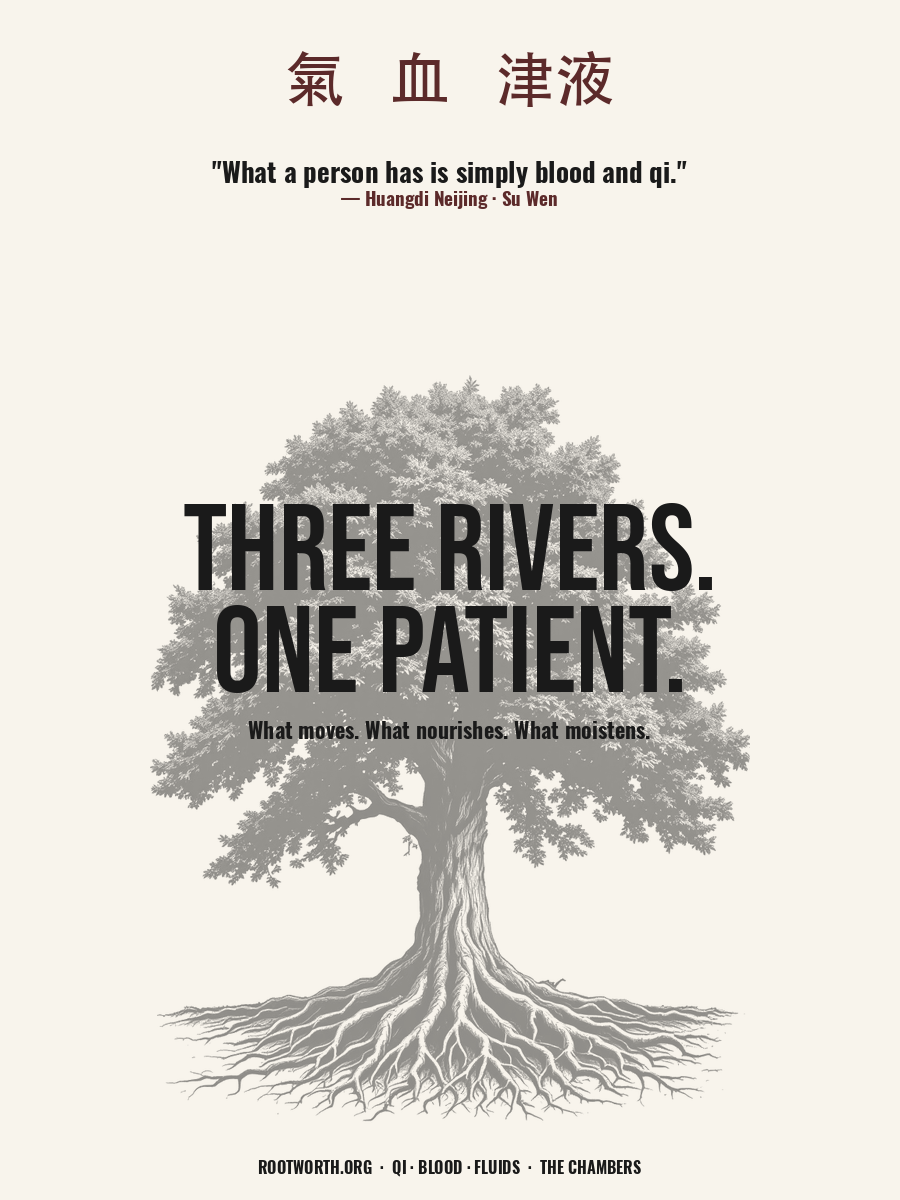
Three rivers. One patient.
Western medicine knows what the body is made of. Classical medicine reads what it runs on.
Proteins. Lipids. Carbohydrates. Minerals. Electrolytes. Modern biochemistry has catalogued the body's constituents with extraordinary precision. It knows what is there. What it has a harder time measuring is what is moving — and how.
Classical Chinese medicine differentiates three fundamental substances: Qi 氣, Blood 血, and Body Fluids 津液. These are not the same as the biochemical catalogue. They are functional categories — descriptions of what the body needs to move, nourish, and moisten itself. And when one is deficient, stagnant, or in excess, the pattern is readable before the lab value changes.
The lab reads what was. The pattern reads what is moving toward.
Qi 氣 — the mover.
Qi is the body's animating force. It warms. It moves. It transforms. It holds organs in place. It defends the body against external factors. When Qi is deficient, the body is tired, cold, and slow to recover. When Qi is stagnant — not moving freely — the result is pain, distension, emotional frustration, and the accumulation of what should have been dispersed.
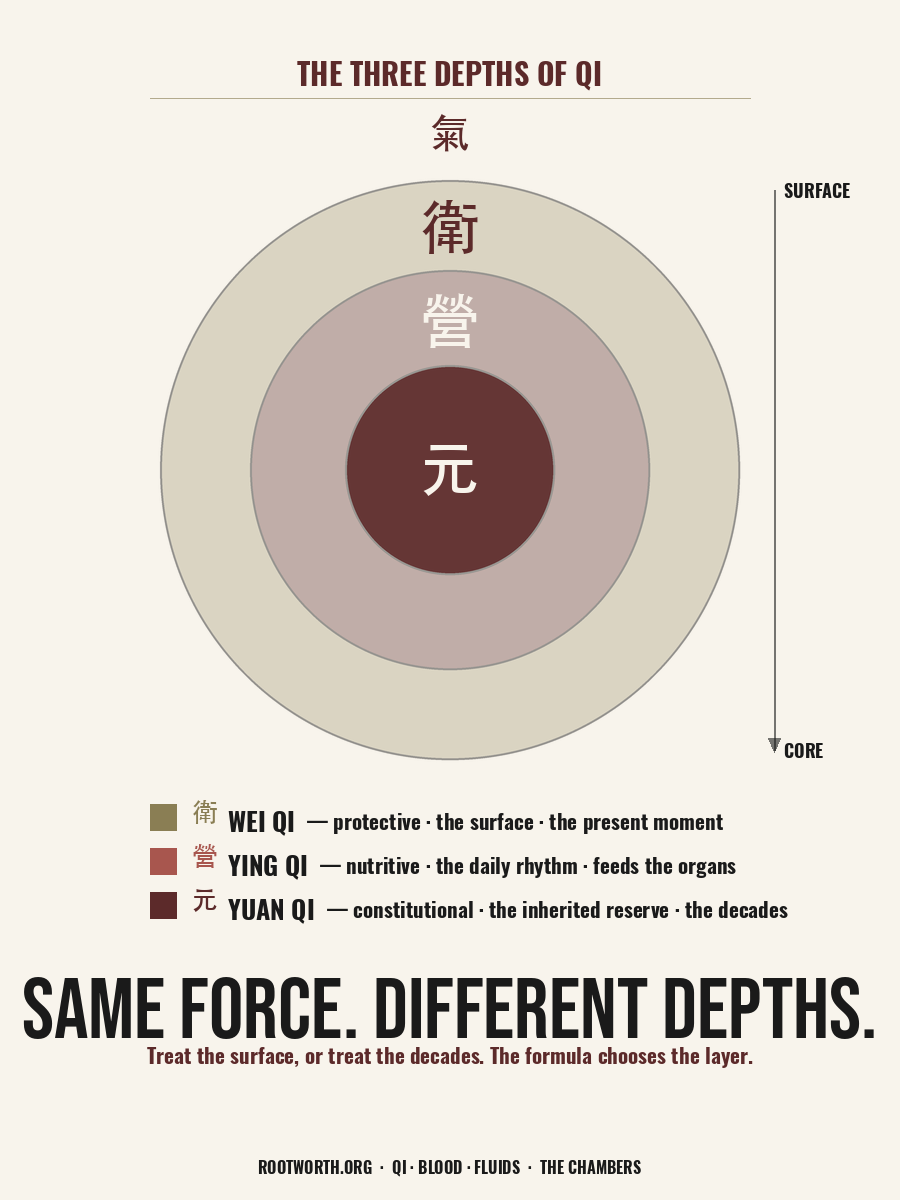
The classical tradition identifies layers of Qi that are clinically distinct. Yuan Qi — the constitutional Qi, the inherited reserve — is "the musical score you want to play." Wei Qi — the protective Qi — is the body's first defense, the temperament that radiates before words are spoken. Ying Qi — the nutritive Qi — is the rhythm-keeper, the daily sustaining force that keeps the organs fed from the food and drink taken in. These are not separate substances. They are the same force read at different depths and different timescales. Treating Wei Qi addresses the surface and the present moment. Treating Yuan Qi addresses the constitution and the decades.
This is why depth is the practitioner's first question, not the last. A cold caught this week and a vitality that has been declining for a decade can present with the same word — "tired" — but they live at different layers. Wei-level depletion answers quickly: strengthen the surface defense and the body recovers in days. Yuan-level depletion answers slowly: the inherited reserve is rebuilt over months and years, never overnight. A formula aimed at the wrong depth is not wrong about the substance — it is wrong about how deep the problem sits, and the body will tell you so by failing to respond.
Same force. Different depths. Treat the surface, or treat the decades — the formula chooses the layer.
Blood 血 — the nourisher.
Blood in classical Chinese medicine overlaps with Western blood — but carries a larger functional load. Classical Blood nourishes the organs, anchors the Spirit (the Shen that lives in the Heart), moistens the sinews, and provides the material substrate that Qi moves through. Where Qi is the mover, Blood is what gives movement substance and direction. Without Blood, Qi has nowhere to go and nothing to carry. Without Qi, Blood cannot move and will stagnate.
Blood deficiency shows up in ways a complete blood count often misses entirely: poor memory, pale or absent menstruation, dry skin, night-time anxiety without external cause, a tongue that is pale and thin. A CBC can be entirely normal while classical Blood deficiency produces daily symptoms. The clinical resolution is to nourish the Blood — with herbs, with food, with a change in what the body is being asked to burn through.
There is a classical rule that carries great clinical weight: Yū xuè bù qù, xīn xuè bù shēng 瘀血不去,新血不生 — when stagnant blood is not expelled, new blood cannot be engendered. Many conditions of Blood deficiency have stagnation as the hidden root. You cannot fill a blocked vessel. The formula must first move what is stuck before it can build what is depleted.
When stagnant blood is not expelled, new blood cannot be engendered. — Classical principle. Still the clinical checkpoint for every Blood deficiency case.
Body Fluids 津液 — the moistener.
Body Fluids are the thinner (jin 津) and thicker (ye 液) fluids of the body — saliva, synovial fluid, cerebrospinal fluid, tears, the fluid that lubricates joints and moistens the brain. They are produced from food and water, transformed by the Spleen, distributed by the Lung, and governed in their deepest form by the Kidney.
Fluid deficiency shows up as dryness in every form: dry throat, dry eyes, dry skin, a tongue with cracks and no coating. In the classical reading, the Lung is often the entry point — the umbrella organ, the first to interface with the external environment, the first to show deficiency when the air is too dry, the stress too chronic, or the Kidney's fluid governance has begun to fail. Ling Shu Chapter 40 specifies that the Lung alone receives the purest form of celestial Qi, making it both the most protected and the most exposed of the organs. What passes through the Lung is the body's first contact with the world. What depletes there is the first loss the body registers.
The cycle that runs through all three.
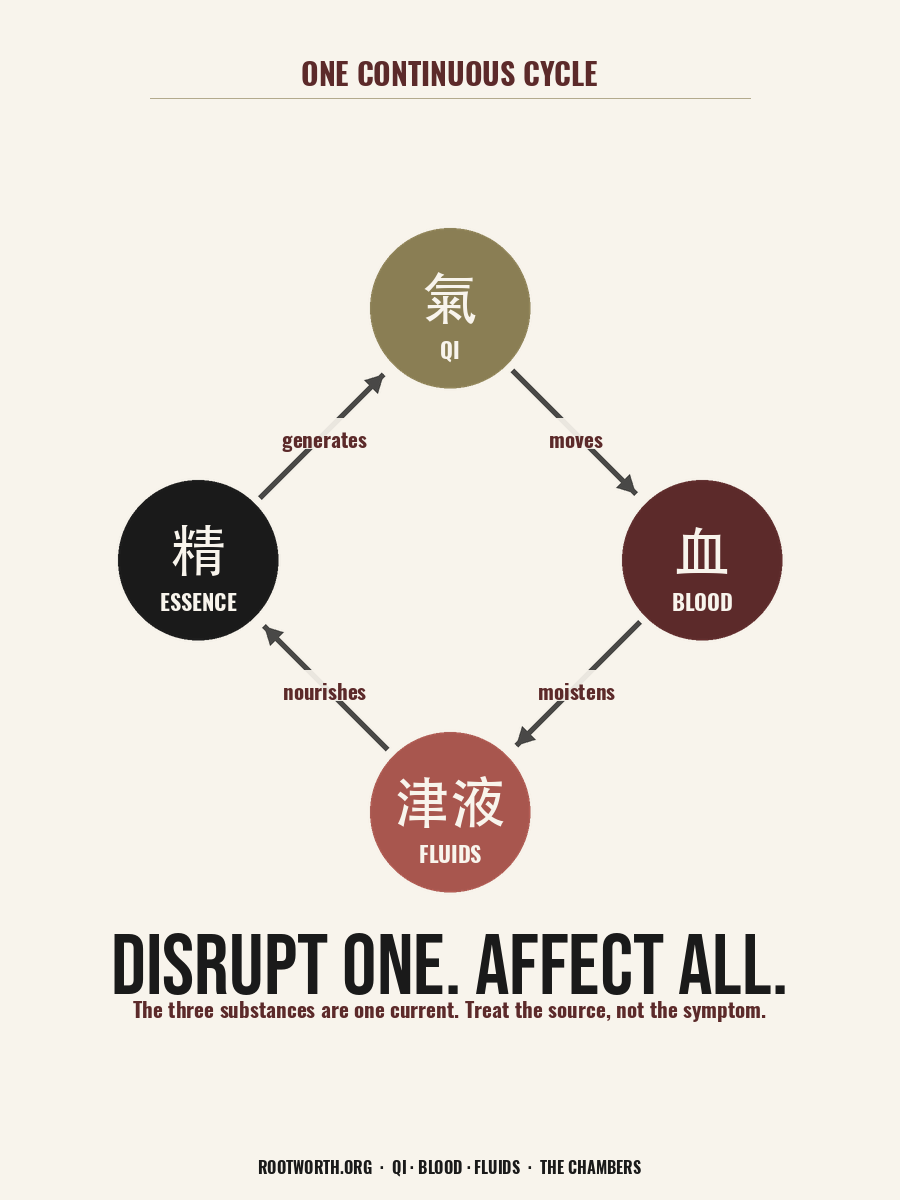
Qi moves Blood. Blood moistens the generation of Fluids. Fluids, in their thicker form, nourish the marrow and the brain — which generates the constitutional Essence that produces Qi. The cycle is continuous. Disruption at any point affects all three.
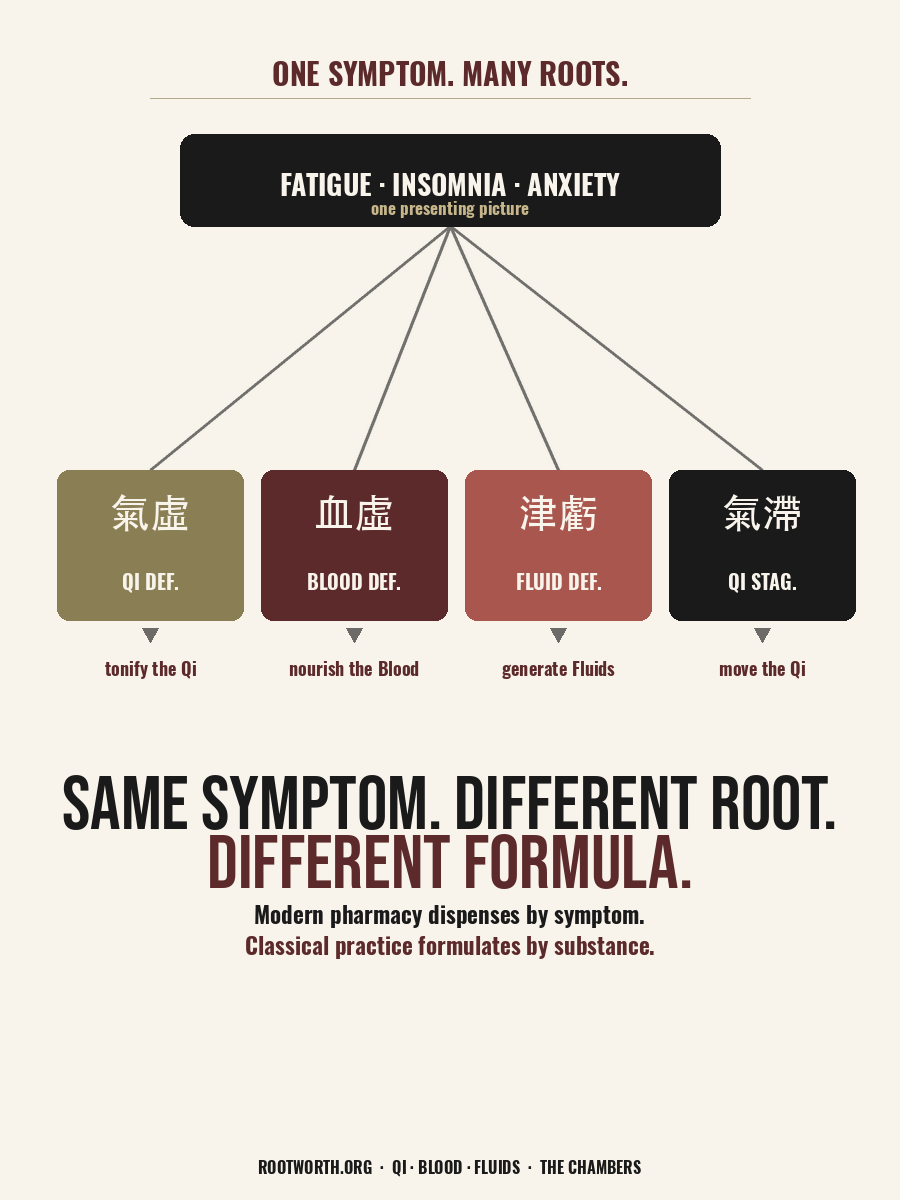
A patient presenting with fatigue, insomnia, and anxiety may have Qi deficiency, Blood deficiency, Fluid deficiency, or a stagnation of any of the three. The symptom picture overlaps significantly. The treatment is radically different. A formula for Blood deficiency given to a Qi-stagnation pattern will deepen the stagnation. A formula that moves Qi vigorously given to Blood deficiency will deplete the Blood further. The correct formula depends on reading which substance is the root — and the pulse, tongue, and intake are the tools that make that reading possible.
Modern pharmacy dispenses by symptom. Classical practice formulates by substance. The same symptom has at least three different causes. Therefore it has at least three different treatments.
The body keeps accounts. Classical medicine reads the ledger.
Blood deficiency is not anemia. Same word. Completely different question.
Qi is not mysticism. It is what you run on when the tank is low.
Three rivers. The practitioner reads which one is low, blocked, or turbid. The formula addresses the source.