
The retina does not detach without a reason. Floaters do not appear without a history. Classical Chinese medicine reads both as expressions of the same underlying terrain: a failure of Spleen Qi to hold structure upward, and of Liver Blood to nourish the vitreous that suspends the retinal layers in place.
⚠️ When to contact your ophthalmologist immediately
Retinal detachment is a surgical emergency. If you experience the sudden onset of new floaters, flashes of light in your peripheral vision, or a shadow, veil, or curtain advancing across your visual field — do not read further. Contact your ophthalmologist or go to an emergency room immediately.
The window for successful surgical reattachment is measured in hours to days. Macular-off detachments — where the central retina has separated — can cause permanent central vision loss even after technically successful surgery. Time is the single most critical variable in outcome.
Classical herbal medicine has a genuine role in the vitreoretinal family — as constitutional support before planned surgery, as a recovery layer in the weeks and months after reattachment, and as a long-term terrain approach for stable floaters and vitreous health. It is never a first-response intervention for acute retinal detachment, and it does not substitute for surgical evaluation.
Three conditions, one terrain
The vitreoretinal family covers a spectrum. At one end is acute rhegmatogenous retinal detachment — a tear in the retinal sheet that allows vitreous fluid to seep beneath and separate the retina from its supporting pigment epithelium. At the other end are benign floaters: wisps, dots, and cobweb-like shapes that drift across the visual field, harmless in themselves but often a source of real distress. Between them sits posterior vitreous detachment (PVD) — the normal aging process in which the gel-like vitreous body gradually liquefies and separates from the retinal surface, sometimes generating a floater shower or a brief ring-shaped opacity called a Weiss ring before settling.
A fourth entity — pigment epithelial detachment (PED), where the retinal pigment epithelium itself separates from Bruch’s membrane — appears most often as a finding within age-related macular degeneration or central serous chorioretinopathy. Classical medicine reads the exudative subretinal fluid accumulation of PED through the Kidney Yang lens described below.
Structurally distinct, these conditions share a common classical terrain: the vitreous gel and the retinal layers it supports depend on the upward-lifting function of Spleen Qi and the nourishing substance of Liver-Kidney Blood and Yin. When either fails, the structural integrity of the vitreoretinal interface begins to falter.
The first classical anchor: the Spleen holds what is above
脾主升清 — Pí Zhǔ Shēng Qīng — “The Spleen governs the upward movement of clear Yang.”
This principle is the classical Chinese medicine reading of retinal detachment at its most literal. The Spleen’s physiological function — in the classical understanding — is to transform the dense turbid matter of food into clear, refined Qi and Blood, and to lift that refined substance upward to nourish the organs, sense faculties, and extremities above. When the Spleen is strong, clear Yang rises; what is above is held in place and nourished. When Spleen Qi is insufficient, the upward-lifting function weakens, and the body’s ability to maintain structural position and tissue integrity — including the adhesion of the retinal layers against the pigment epithelium — is compromised.
This is the Zhōng Qì Bù Zú (中气不足) pattern — Center Qi insufficiency — and it is the foundational constitutional pattern in the classical herbal reading of retinal detachment. The Spleen is not producing enough clear upward-moving Qi to hold the retina in its proper anatomical relationship with the RPE beneath it. The terrain is one of collapse and descent rather than one of active pathology.
In clinical terms, the Center-Qi-insufficiency picture often appears in patients who are constitutionally thin, chronically fatigued, or who have a history of significant digestive weakness. It also appears, more subtly, in the myopic eye — where the axial elongation of high myopia stretches and thins the peripheral retina, reducing the tensional architecture that keeps the retinal sheet properly adherent. The classical interpretation: the Spleen could not supply sufficient structural Qi to maintain the form of the eye under the demands of early intense near work.
The herbal strategy for the Center-Qi dimension is clear in the classical texts: tonify the Spleen, augment the Qi, and restore the upward-lifting function. This is both pre-surgical terrain preparation and the constitutional foundation of the post-surgical recovery. An eye that has had its retina surgically reattached still exists within a constitution — and that constitution needs rebuilding if the long-term prognosis is to improve.
Post-surgical recovery: Blood stasis and the collateral environment
Surgery — vitrectomy, scleral buckling, pneumatic retinopexy — is the correct intervention for retinal detachment. It is not, however, the end of the story. The weeks and months following reattachment surgery involve a complex tissue-repair environment: the laser retinopexy burn lines are healing, the RPE is attempting to restore its supporting relationship with the photoreceptors it feeds, and the vitreous cavity may be occupied by a gas bubble or silicone oil as a temporary tamponade.
Classical Chinese medicine reads this post-surgical environment as one of Blood stasis in the retinal collaterals — Xuè Yū Luò Zǔ (血瘀络阻). Surgery, from the classical perspective, is a controlled trauma: it is correct and necessary, but it creates local stasis, disrupts Qi and Blood flow in the fine collateral network, and leaves behind a repair environment that the body must clear. Blood-invigorating, stasis-clearing herbs that open the collaterals and support tissue remodeling at the vitreoretinal interface have a classical role in this recovery window.
The exudative picture — when subretinal fluid accumulation is the prominent finding, as in exudative retinal detachment, central serous chorioretinopathy, or PED — introduces a third pattern: Shèn Xū Shī Yǐn (肾虚湿饮), Kidney Yang deficiency failing to consolidate and transform Yin-fluids. When Kidney Yang is insufficient, fluid accumulates in the spaces beneath the retina rather than being properly metabolized and distributed. The herbal response shifts toward Kidney-warming, damp-consolidating herbs that restore the transforming function and reduce the accumulation.
The second classical anchor: the vitreous lives on Liver Blood
肝受血而能視 — Gān Shòu Xuè Ér Néng Shì — “The Liver receives Blood and thereby enables vision.”
This statement from the Suwen establishes the classical foundation for floaters and vitreous degeneration. The Liver stores and regulates Blood; it also nourishes the eyes via its primary channel. In the classical understanding, the vitreous humor — the gel-like substance that fills the posterior segment of the eye — is understood as a form of refined Liver Blood substance, a distillate of nutritive Yin that gives the vitreous its clarity, viscosity, and structural support for the retinal layers it contacts.
Posterior vitreous detachment and the floaters it generates are, in this framework, almost always a Liver Blood and Kidney Yin story. The vitreous gel degenerates — liquefies, shrinks, and eventually peels away from the retinal surface — because the Blood and Essence that should be maintaining its quality and coherence have become insufficient. This is the common floater in the busy, sleep-deprived professional in their forties or fifties: a constitution that has run on Liver Blood reserves for too long.
Four patterns cover most floater presentations in classical practice:
Liver Blood deficiency (Gān Xuè Bù Zú, 肝血不足) — the most common floater pattern. The vitreous opacities are typically fine, thread-like, or web-like; they move with the eye and are most noticeable against bright backgrounds. Associated constitutional features include dry or easily fatigued eyes, visual fatigue, night blindness tendency, and the characteristic pale-lipless tongue of Blood deficiency. The herbal response: Liver-Blood-nourishing herbs — the classical “brightens the eyes” category that has anchored Chinese ophthalmic herbalism for two millennia.
Kidney Yin deficiency (Shèn Yīn Xū, 肾阴虚) — the deeper Essence depletion pattern. When Kidney Yin is insufficient, it cannot support the Liver above it, and the vitreous degeneration has a more fundamental substrate: Essence itself is thinning. This pattern tends toward more pronounced vitreous liquefaction, larger or more persistent floaters, and constitutional features of Yin depletion: afternoon heat, night sweating, low back aching, and a red-tipped tongue with reduced coating. The herbal response: Liver-Kidney Yin-nourishing herbs that replenish the deeper constitutional reserve.
Phlegm-turbidity in the vitreous (Tán Zhuó Zhāo Yǎn, 痰浊罩眼) — the Spleen-damp picture. When the Spleen’s transforming function is weak, it generates turbid Phlegm-damp that rises and clouds the vitreous. The floaters in this pattern tend to be denser, more opaque, and less mobile; patients often have associated digestive sluggishness, a tendency toward heavy or foggy mental states, and a thick tongue coating. The herbal response: Phlegm-resolving herbs paired with Blood-moving herbs that clear the turbidity clouding the vitreous field.
Blood stasis (Xuè Yū, 血瘀) — the residue pattern. Old vitreous hemorrhage — from diabetic retinopathy, retinal tear, or trauma — can leave persistent Blood-stasis opacities in the vitreous cavity that resist resorption. The floaters are typically darker, denser, and fixed rather than freely mobile. The herbal response: Blood-invigorating herbs that clear stasis and support the resorption of persistent intravitreous debris.
Three herbs at the center of the vitreoretinal pharmacopoeia
No formula is named here — the formula that emerges from the intake will reflect your precise pattern, and naming classical combinations would obscure the clinical thinking that links herbs to their mechanism. What can be illustrated is the individual character of three herbs that are consistently central to the vitreoretinal herbal discussion.
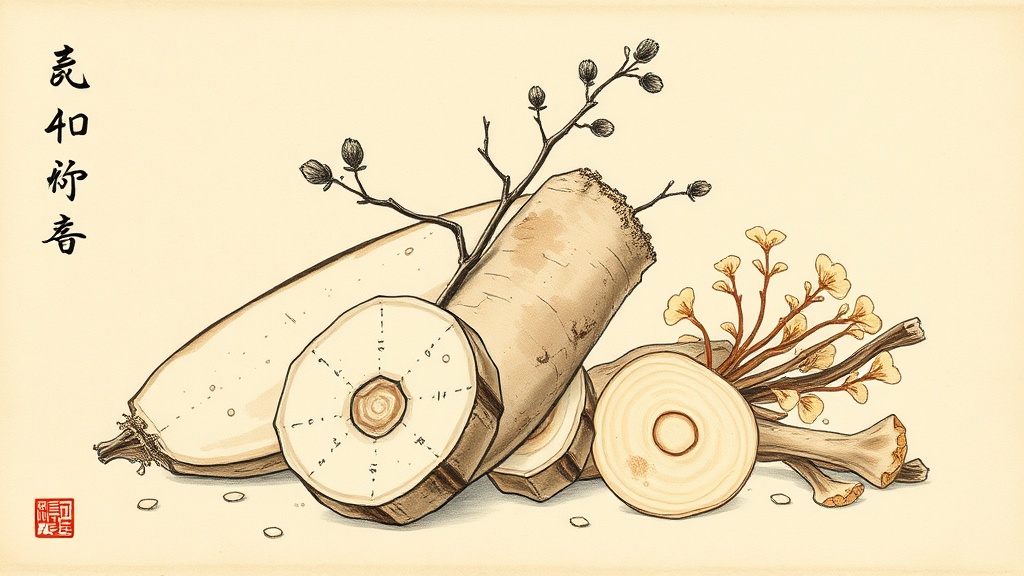
- Dang Gui (Dāng Guī, 當歸) — Chinese angelica root. Dang Gui occupies a unique position in the Blood pharmacopoeia: it simultaneously nourishes and invigorates Blood, addressing both the deficiency and the stasis aspects that are almost always co-present in vitreous degeneration. Where Blood is deficient, Dang Gui replenishes it; where Blood is moving sluggishly, Dang Gui activates it. The dual action makes it the foundational Blood herb for the vitreous gel substrate — the most common single addition to any vitreoretinal formula where the Blood dimension is prominent.
- Gou Qi Zi (Gǒu Qǐ Zǐ, 枸杞子) — wolfberry. This gentle, food-grade berry nourishes Liver and Kidney Yin-Blood and is one of the most consistently cited herbs in the classical ophthalmic literature for vision-brightening and eye nourishment. Its action is through the Liver-Kidney axis — replenishing the Yin and Blood that maintain vitreous gel clarity and photoreceptor function. Wolfberry is the quintessential floater herb in the Liver-Blood-deficiency and Kidney-Yin-deficiency patterns: mild enough for long-term constitutional use, substantive enough to move the constitutional picture over months.
- Shan Yao (Shān Yào, 山藥) — Chinese yam. Shan Yao occupies the Spleen-Kidney-Lung trifecta simultaneously — tonifying center Qi, supplementing Kidney Yin, and supporting the Lung’s governing role over fluid distribution. Its relevance to the retinal detachment picture is its Spleen-tonifying action: it strengthens the upward-holding function of Center Qi that is the constitutional root of retinal structural vulnerability. As a food-grade herb, it is appropriate in long-term constitutional formulas and is often the Spleen layer in the post-surgical recovery prescription.
Functional medicine at the vitreoretinal interface
The functional medicine categories that complement the classical layer in the vitreoretinal family address the biochemistry of the retina and vitreous from a different angle — not through pattern, but through substrate and cellular physiology.
- The essential fatty acid category provides the long-chain polyunsaturated fatty acids concentrated in photoreceptor outer segments and in the cellular membranes of the vitreoretinal interface. Photoreceptors are among the most lipid-dense cells in the body, and membrane integrity at the RPE-photoreceptor junction depends on an adequate long-chain fatty acid substrate. This category also carries significant anti-inflammatory activity at the vitreoretinal border.
- The mitochondrial energy category supports cellular energy production in the photoreceptors and RPE during the high-metabolic-demand environment of post-surgical recovery. The photoreceptor outer segment is one of the most energy-intensive cellular structures in the body; the recovery window after retinal surgery places additional demands on this system.
- The retinal microcirculation category supports capillary integrity and blood flow in the fine vascular network of the choroid and inner retina. This is the FM parallel to the classical Blood-moving layer: both are addressing the quality and efficiency of the circulatory environment at the vitreoretinal interface.
- The probiotic category addresses the gut-eye-immune axis. Systemic inflammatory tone — shaped in part by gut microbiome composition — has an established relationship to retinal health outcomes. The probiotic category offers a systemic inflammation-modulating layer to the overall program.
The vitreoretinal terrain: where Liver Blood and Spleen Qi converge
The intake distinguishes the presentation. The Liver-Blood-deficiency floater — fine, thread-like, worse with fatigue, a constitution running on reserves — has a different herbal center than the Phlegm-turbidity floater, which has its own different profile than the Blood-stasis residue of old vitreous hemorrhage. The Spleen-centered constitutional support for post-surgical retinal detachment recovery differs again from the Kidney-Yang-warming approach to the exudative PED picture.
Whether the presentation is stable floaters, a post-surgical vitreous environment, or the longer project of constitutional support after retinal detachment repair — the herbal approach follows from the pattern. The formula is built from that distinction.
Explore the retinal detachment support page or the broader eye conditions framework — or move directly to the intake process when you’re ready to begin the pattern assessment that determines your formula.
Begin your pattern assessment
A note on these statements
These statements have not been evaluated by the Food and Drug Administration. These products are not intended to diagnose, treat, cure, or prevent any disease. Classical Chinese herbal medicine and functional medicine supplements are offered as part of a pattern-based intake process, not as treatments for diagnosed medical conditions.