Male Factor Infertility
Custom herbal formulas for the classical patterns underlying male infertility — because sperm quality is a direct expression of constitutional Jing, and Jing is addressable.
Roughly half of all fertility investigations identify a significant male factor. Semen analysis returns a count below 15 million per milliliter, or motility below 40 percent, or morphology below 4 percent on strict Kruger criteria, or a DNA fragmentation index that exceeds the threshold at which embryo development is consistently compromised. The reproductive endocrinologist explains the numbers. The andrologist may order a varicocele workup. And then — in the absence of surgical indication — the couple is typically directed toward IUI or IVF, with no mechanism offered for improving the sperm that will be used in that procedure.
Classical Chinese medicine has a different starting question. Not: what procedure can work around the sperm deficiency? But: what constitutional system is failing to produce adequate sperm — and what chemistry, applied to that system over the three months it takes to grow new sperm, will shift the output?
腎藏精。 The Kidney stores Jing.
This is the foundational classical statement for male reproductive function. Sperm is the material expression of Kidney Jing — the deep constitutional substance that governs growth, development, reproduction, and the body's fundamental vitality. When Jing is insufficient, sperm production is insufficient: count is low, morphology is poor, vitality is reduced. When Jing is adequate and the channels through which it moves are clear, spermatogenesis proceeds correctly. The herbs that address male infertility are, at their core, chemistry acting on Kidney Jing — generating it where it is depleted, warming the Yang that activates it, moving the Blood stasis or clearing the Damp-Heat that obstructs its delivery to the germ tissue.
What Western medicine has measured — the four-parameter window into Jing.
Standard semen analysis measures four parameters, each reflecting a different layer of the spermatogenic process:
Sperm count (oligozoospermia: <15 million/mL) — reflects the raw output of spermatogenesis; the Sertoli cell population, the hormonal drive (LH and FSH), and the testicular vascular supply all contribute. In the classical framework, count is the most direct readout of Kidney Jing quantity.
Motility (asthenozoospermia: <40% progressive) — reflects sperm mid-piece mitochondrial function; the sperm's ability to generate ATP for flagellar movement. Oxidative stress at the mitochondrial level — from excess reactive oxygen species, heat, infection, or toxin exposure — damages the mid-piece specifically. Classically: Kidney Yang failing to warm and activate, or Damp-Heat corrupting the sperm's vitality at the energetic level.
Morphology (teratozoospermia: <4% normal on strict Kruger criteria) — reflects the precision of spermatid differentiation during the 74-to-90-day spermatogenic cycle. DNA fragmentation, heat exposure, and endocrine disruption all produce abnormal forms. The 4% threshold that defines teratozoospermia sounds alarming — 96% of sperm are abnormal-shaped by this standard — because it is measuring an exquisitely sensitive differentiation process against strict criteria.
DNA Fragmentation Index (DFI) — the parameter that standard semen analysis misses. A DFI above 15% is associated with significantly impaired fertilization and embryo development; above 25%, the association is strong. DFI can be normal even when count, motility, and morphology appear acceptable, explaining cases where IVF produces embryos that fail to implant or arrest early. Oxidative stress and Blood stasis are the two primary classical drivers of elevated DFI.
Critically: sperm takes 74 to 90 days to complete spermatogenesis. Every sperm in a semen analysis today was a spermatogonium three months ago. Herbal intervention must be sustained for at least one full spermatogenic cycle — 90 days minimum — before the semen analysis will reflect any improvement. Retesting before 90 days is not interpretable as a treatment response.
The classical mechanism table — for practitioners →
This section is provided as clinical reference. The statements below are classical Chinese medical aphorisms and their corresponding pattern mechanisms — not disease claims. All formula recommendations represent classical pattern-based support, not treatment of diagnosed conditions.
| Classical statement | Mechanism when the statement fails | Western parameter affected | Clinical correlation |
|---|---|---|---|
| 腎藏精虛 Kidney Jing deficiency |
Sertoli cell support fails; spermatogonial stem cell pool inadequate; testosterone substrate insufficient | Low count (oligozoospermia); poor morphology; elevated FSH as pituitary compensates for testicular failure | Primary testicular failure; age-related decline; constitutional depletion from chronic overwork, sleep deficit, substance use |
| 腎陽虛 Kidney Yang deficiency |
HPT axis underdrive; Leydig cell testosterone output reduced; mitochondrial thermogenesis impaired in sperm mid-piece | Low motility (asthenozoospermia); cold pattern; low libido; watery semen; low testosterone on labs | Adrenal fatigue presentation; chronic sleep deficit; history of cold exposure; constitutional Yang-deficiency background |
| 濕熱下注 Damp-Heat pouring downward into lower jiao |
Scrotal hyperthermia; inflammatory mediators in seminal plasma; leukocytospermia; oxidative ROS load on sperm DNA | Elevated DFI; poor morphology; leukocytospermia on semen analysis; scrotal discomfort; history of STI or prostatitis | Varicocele inflammation; chronic prostatitis; subclinical genital infection; obesity-associated scrotal heat |
| 血瘀 Blood stasis in spermatic vessels |
Impaired testicular microcirculation; venous pooling (varicocele); hypoxia in spermatogenic tissue; DNA strand breaks | Elevated DFI; poor morphology; varicocele on ultrasound; may have normal count with poor DNA integrity | Clinical or subclinical varicocele; history of testicular trauma or torsion; post-surgical adhesion |
| 肝氣鬱結 Liver Qi stagnation |
HPA axis dysregulation; cortisol elevation → LH suppression; GSH depletion → oxidative sperm damage; impaired estrogen clearance → estrogen dominance | Testosterone decline with secondary elevation of estradiol; poor morphology; elevated DFI; stress-associated subfertility | Wood-root pattern: chronic overwork, emotional stress, sleep dysregulation → GSH depletion → oxidative sperm DNA damage |
An important note on testosterone replacement therapy.
Testosterone replacement therapy (TRT) — whether injected, gelled, or patched — causes azoospermia. This is not a side effect that varies by individual. It is the predictable consequence of the feedback biology.
The pituitary produces LH and FSH in response to low testosterone. LH drives Leydig cell testosterone production in the testes; FSH drives Sertoli cell support of spermatogenesis. When exogenous testosterone is introduced, the pituitary detects adequate testosterone via negative feedback and shuts down both LH and FSH secretion. With no LH signal, the Leydig cells go dormant. With no FSH signal, spermatogenesis halts. Sperm count typically drops to zero or near-zero within weeks to months of starting TRT. TRT and fertility preservation are incompatible.
If low testosterone is documented and must be addressed while fertility is still a goal, two alternatives exist. Clomiphene citrate — a selective estrogen receptor modulator — blocks pituitary estrogen receptors, causing the pituitary to increase LH and FSH output, which raises endogenous testosterone while preserving spermatogenesis. HCG (human chorionic gonadotropin) mimics LH directly, stimulating Leydig cell testosterone production without suppressing the pituitary. Both approaches preserve or can restore spermatogenesis. Neither is interchangeable with TRT. These decisions require direct coordination with the prescribing physician.
Herbs are chemistry acting on blood — four actions for male factor infertility.
The herbal strategy for male infertility works across four complementary blood actions: generating the Kidney Jing substrate that sperm is built from, cooling the Damp-Heat and oxidative fire that damages sperm DNA, moving the Blood stasis that obstructs testicular microcirculation, and warming the Kidney Yang that drives spermatogenesis when the root pattern is cold and depleted. Most clinical presentations require at least two of these actions simultaneously.
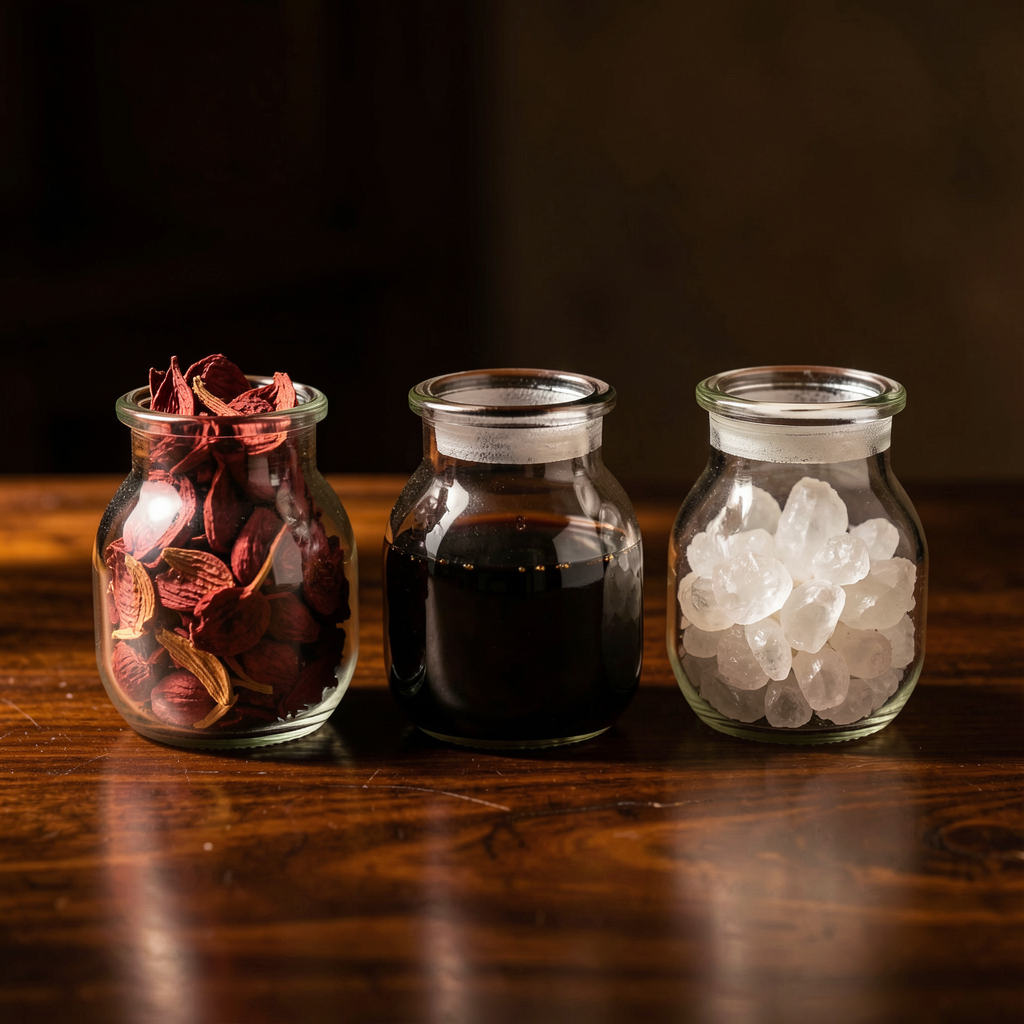
GENERATE — rebuilding the Jing substrate that sperm requires.
- Wu Zi Yan Zong Wan (Wǔ Zǐ Yǎn Zōng Wán, 五子衍宗丸) — the Five-Seed Fertility Pill; the canonical classical formula for male reproductive support. Five seeds in one formula: Gou Qi Zi (枸杞子, Lycium / Wolfberry), Tu Si Zi (菟丝子, Cuscuta), Fu Pen Zi (覆盆子, Rubus / Raspberry), Che Qian Zi (车前子, Plantago), Wu Wei Zi (五味子, Schisandra). Seeds, classically, are Jing-generating materials — the concentrated reproductive potential of the plant. The formula nourishes Kidney Yin and Jing, warms Kidney Yang, and astringe-consolidates the Jing so that sperm is produced and retained with adequate vitality. The first formula to consider for low count and low motility on a Kidney Jing deficiency background.
- Shu Di Huang (Shú Dì Huáng, 熟地黄 / Prepared Rehmannia) — the primary Blood and Jing generating herb in the materia medica; the constitutional root ingredient in You Gui Wan and Lu Wei Di Huang Wan. Generates the deep Blood substrate from which Kidney Jing and sperm are built.
- Gou Qi Zi (Gǒu Qǐ Zǐ, 枸杞子 / Lycium) — nourishes Liver Blood and Kidney Yin; specific affinity for male reproductive function and visual tissue. Modern research documents effects on sperm count and motility in animal models consistent with the classical Jing-nourishing action.
COOL — clearing Damp-Heat and oxidative fire from the lower jiao.
- Long Dan Xie Gan Tang (Lóng Dǎn Xiè Gān Tāng, 龙胆泻肝汤) — the formula for Liver-Gallbladder Damp-Heat pouring downward into the lower jiao. For male factor infertility with scrotal inflammation, varicocele-related heat, chronic prostatitis, leukocytospermia, or recent genital infection — the classical pattern where oxidative inflammatory load in the seminal environment is damaging sperm DNA before ejaculation. This is a potent clearing formula intended for short-course use (two to four weeks) to clear the acute Damp-Heat load; it is not a maintenance formula. After the Damp-Heat resolves, shift to tonification with Wu Zi Yan Zong Wan or You Gui Wan.
- Huang Bai (Huáng Bǎi, 黄柏 / Phellodendron) — the primary herb for Damp-Heat in the lower jiao; added to Jing-building formulas when concurrent Damp-Heat is present but not sufficiently severe to warrant the full Long Dan Xie Gan Tang course.
MOVE — addressing Blood stasis in the spermatic vasculature.
- Xue Fu Zhu Yu Tang (Xuè Fǔ Zhú Yū Tāng, 血府逐瘀汤) — the formula for Blood stasis in the upper and middle body, adapted in practice for spermatic vessel stasis. For varicocele-associated infertility — where venous pooling in the pampiniform plexus creates chronic hypoxia in the spermatogenic tissue, elevating scrotal temperature and generating reactive oxygen species that fragment sperm DNA. Moving the Blood stasis addresses the microcirculatory impairment that produces elevated DFI even when gross count and motility appear acceptable.
- Dan Shen (Dān Shēn, 丹参 / Salvia miltiorrhiza) — moves Blood and promotes microcirculation; added when testicular microcirculation is the primary target without the full Blood stasis picture of varicocele-pattern infertility. Dan Shen's documented effects on nitric oxide signaling and microvascular flow correspond directly to its classical Blood-moving action.
WARM — restoring the Kidney Yang that drives spermatogenesis.
- You Gui Wan (Yòu Guī Wán, 右归丸) — the formula for Kidney Yang and Jing deficiency in its severe, cold, depleted presentation. For the patient with frank low testosterone, low libido, cold extremities, watery semen, and a constitutional picture of chronic adrenal depletion. Rou Gui (肉桂, Cinnamon bark) and Fu Zi (附子, Aconite) warm the Kidney Yang; the Shu Di Huang, Gou Qi Zi, and Tu Si Zi base nourishes the Jing substrate that the warmed Yang now has fuel to activate.
- Er Xian Tang (Èr Xiān Tāng, 二仙汤) — for HPT axis depletion presenting as low testosterone with secondary LH elevation — the pattern of Kidney Yang depletion with a concurrent Yin-deficiency fire component. Xian Mao (仙茅, Curculigo) and Yin Yang Huo (淫羊藿, Epimedium) warm the Kidney Yang and stimulate the HPT axis; Zhi Mu and Huang Bai clear the deficiency fire that has risen alongside the Yang depletion.
The combination lock — four roots, four different keys.
Four patients present with oligoasthenoteratozoospermia. The semen analysis is similar. The combination lock is different for each.
The first patient — Wood root — works seventy hours per week in a high-pressure profession. He sleeps five to six hours a night. His energy is sustained by caffeine and anxiety. His blood work shows testosterone at the lower end of the reference range with estradiol elevated — a pattern consistent with impaired hepatic estrogen clearance. His sperm DNA fragmentation is elevated at 22%. His combination lock reads: Liver Qi stagnation and chronic GSH depletion driving oxidative sperm DNA damage and estrogen dominance — LH suppression from elevated estradiol as the HPT axis choke point. The formula is Jia Wei Xiao Yao San (加味逍遥散), which moves the Liver Qi stagnation and clears the secondary heat that the stagnation has generated. The supplement anchor is NAC — restoring glutathione to reduce oxidative fragmentation. DIM-PRO to support estrogen clearance — but not co-prescribed with NAC in the same dose window, as the combination can interact. Saw Palmetto as a DHT modulator if the Wood-root picture includes hair loss and DHT dominance.
The second patient — Earth root — is insulin resistant, carries 40 extra pounds predominantly in the abdomen, and has been told his testosterone is "borderline low." The mechanism is adipose aromatase: excess abdominal adipose tissue converts testosterone to estradiol via aromatase enzyme, driving the same LH suppression cascade. His sperm count is the primary deficit; motility and morphology are marginal but not severely impaired. His combination lock reads: Spleen Qi deficiency and Phlegm-Damp accumulation producing adipose aromatase-driven testosterone-to-estradiol conversion — the Earth-root path to the same HPT suppression. The formula is Liu Jun Zi Tang (六君子汤) — the classical formula for Spleen Qi deficiency with Phlegm-Damp accumulation. The supplement anchor is Inositol, which improves insulin sensitivity and has documented effects on aromatase activity in metabolic syndrome contexts.
The third patient — Metal root — has a history of IBS with a leaky gut pattern documented on organic acids and food sensitivity testing. His systemic inflammatory burden is high; hs-CRP is elevated. His sperm motility and DNA fragmentation are primarily affected. The classical read: gut-derived systemic inflammation breaching the blood-testis barrier — inflammatory cytokines and endotoxin in the seminal plasma driving oxidative damage to sperm mid-piece and DNA. The formula is Chai Hu Shu Gan San (柴胡疏肝散) to move Liver-Spleen disharmony and reduce the inflammatory Qi stagnation at the gut wall. Supplements: NAC for GSH restoration and L-Glutamine for gut mucosal repair — addressing the breach through which inflammatory load is entering the circulation.
The fourth patient — Water root — has disrupted sleep from shift work for the past four years. His testosterone is genuinely low; LH and FSH are appropriately elevated, indicating that the testes are the limiting factor, not the pituitary. He has low libido, cold feet, and genuine fatigue that does not respond to caffeine. His combination lock reads: Kidney Yang and Jing depletion from chronic sleep deficit — LH peaks occur during REM sleep, so years of disrupted sleep architecture directly translate to insufficient nocturnal LH pulsatility and reduced testosterone output. The formula is You Gui Wan — warmth and Jing generation at the constitutional depth. Wu Zi Yan Zong Wan as a companion formula for the Jing-generating sperm substrate. DHEA — appropriate in the Water-root male pattern where adrenal depletion is contributing to androgen insufficiency, and unlike in female PCOS contexts, DHEA supplementation in the male depletion pattern is directionally correct.
The same semen analysis. Four different systems failing. Four different keys.
Digestion before Jing.
A point worth stating directly: no herbal formula generates Kidney Jing if the Spleen is too deficient to absorb the herbs. Classical medicine is unambiguous on this sequence. The digestive system — the Spleen and Stomach — must be functional before constitutional Jing-building formulas can do their work. A patient with pronounced digestive weakness, bloating, loose stools, or poor appetite needs digestive support built into the formula design, or the Jing-generating herbs will pass through without being metabolized into the constitutional substrate they are intended to build.
This is one of the reasons standardized supplement protocols for male infertility — the 30-day antioxidant kit, the one-size fertility blend — produce inconsistent results. They presume absorption. Classical formula design accounts for it. The intake is designed to surface the digestive picture so that the formula addresses the full channel from ingestion to Jing generation, not only the Jing-generation endpoint.
The 90-day window is a decision, not a waiting period.
There are couples who were told that the male factor was fixed by the urologist's varicocele repair, or resolved by waiting, or irrelevant because ICSI can inject a single sperm into an egg regardless of quality. They are not wrong. ICSI can achieve fertilization with a single morphologically normal sperm. What ICSI cannot do is select against a sperm with a fragmented DNA strand that looks morphologically adequate but will contribute to a failed implantation or an arrested embryo.
The 90-day window before any assisted reproductive procedure is the window during which the sperm that will be used in that procedure are still being formed. Every spermatogonium that is currently in the early stages of a 74-to-90-day maturation cycle will be in the semen three months from now. The constitutional intervention happens now. The lab result — IVF, IUI, or natural conception — reflects what that intervention accomplished.
The intake is online. The formula ships. If a procedure is planned, the question is not whether to intervene — it is whether to use the next 90 days intentionally or to let them pass and offer whatever sperm the body happened to produce.
Functional medicine complement for male factor infertility.
The classical formula addresses the constitutional pattern — the Jing deficiency, the Damp-Heat, the Blood stasis, the Yang depletion. Functional medicine maps the upstream environmental and nutritional cofactors that sustain the pattern:
- Antioxidant panel — universal across all patterns: Zinc (Sertoli cell function; sperm capacitation; testosterone biosynthesis co-factor); Selenium (GPx4 — the glutathione peroxidase isoform that specifically protects sperm mid-piece phospholipids from oxidative damage; found at higher concentration in seminal plasma than in serum); Vitamin E (fat-soluble antioxidant for sperm membrane integrity). These three represent the minimum antioxidant stack for any male factor presentation.
- Ubiquinol or L-Carnitine — mitochondrial fuel for motility: Sperm mid-piece function is ATP-dependent; motility deficit is frequently a mitochondrial substrate problem as much as a structural one. Ubiquinol (reduced CoQ10) provides mitochondrial electron chain support; L-Carnitine facilitates fatty acid transport into the mitochondrial matrix. Both have clinical trial data in asthenozoospermia. For most motility-primary presentations, one or the other — not both simultaneously.
- Testosterone and sex hormone panel: Free testosterone, total testosterone, estradiol, LH, FSH, SHBG, prolactin. Identifies whether the deficit is testicular (LH/FSH elevated = primary hypogonadism) or pituitary (LH/FSH low = secondary hypogonadism — coordinates with TRT / clomiphene decision above).
- Thyroid panel: Hypothyroidism reduces Leydig cell responsiveness to LH and impairs spermatogenesis independently of the HPT axis. A significant percentage of male factor presentations improve significantly when concurrent subclinical hypothyroidism is addressed.
- Scrotal ultrasound with Doppler: Identifies subclinical varicocele (Grade I–II, not palpable) and testicular vascular supply — the structural correlate of the Blood stasis pattern.
How the intake works for male factor infertility.
The intake asks for the full clinical picture: semen analysis with all parameters including DFI if available; hormonal panel (testosterone, estradiol, LH, FSH, SHBG, prolactin, thyroid); ultrasound findings; any reproductive history; any history of genital infection, trauma, or surgery; current medications, supplements, and substances. It also asks for the constitutional picture — sleep, stress, digestive health, energy, libido, thermal pattern, and the four-sphere constitutional read that determines which root pattern is driving the specific parameter deficits on the semen analysis.
Michael reads every intake personally and designs the formula for the specific combination lock — which action or combination of actions (generate, cool, move, warm) the specific pattern requires, and in what proportion. The formula is accompanied by a map of what it is intended to accomplish, what symptom or lab changes will signal that the pattern is shifting, and the 90-day retest protocol.
Understand the framework before you begin.
The Chambers are a free patient education library — the methodology behind every Rootworth formula. Reading them before or alongside your intake helps you understand what the classical assessment is seeing, why individualized formulas outperform generic protocols, and how each layer of treatment connects to the next.
A note on these statements.
Rootworth herbal preparations are dietary supplements. These statements have not been evaluated by the Food and Drug Administration. These products are not intended to diagnose, treat, cure, or prevent any disease. Classical Chinese medicine pattern assessment — the identification of constitutional patterns such as Kidney Jing deficiency, Kidney Yang deficiency, Damp-Heat in the lower jiao, Blood stasis, or Liver Qi stagnation — is distinct from the diagnosis and treatment of disease as defined under United States federal law. Individual results vary. All scientific references on this page refer to published research on herbal constituents or nutritional interventions; references do not imply that any Rootworth formula is intended to produce the effects described. Always continue care with your reproductive endocrinologist, urologist, or andrologist alongside any herbal support program. Do not discontinue any prescribed medication without consulting your prescribing physician.