Chamber XIV
How an intake works.
What happens when you book. What the practitioner is reading. How the formula gets built.
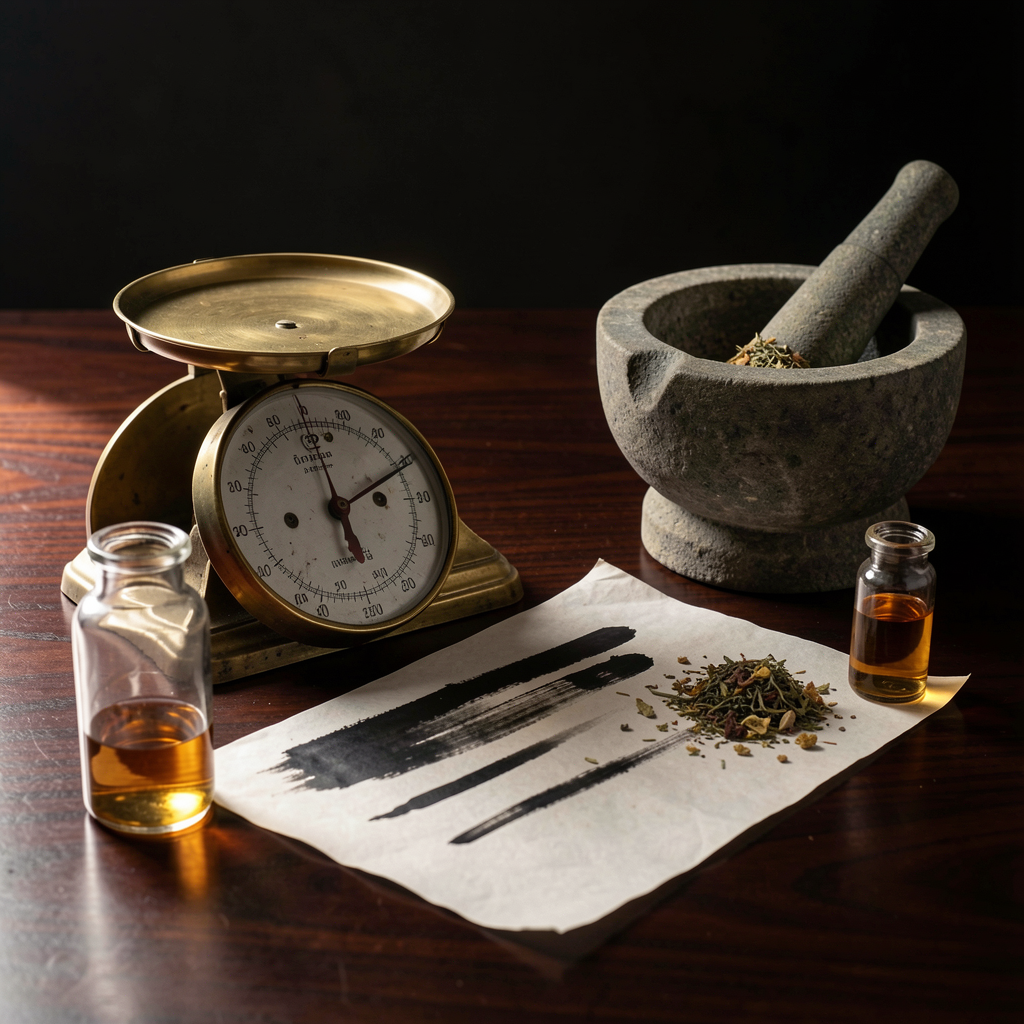
The questions are the diagnosis.
The part nobody explains.
Most people who come to classical herbal medicine have a clear picture of how a conventional clinical encounter goes: brief history, examination organized around the presenting complaint, a diagnosis if one is available, a prescription. The classical intake is a different kind of encounter — and not knowing what to expect is often the friction that delays the first booking.
This chamber explains the intake: not as a sales pitch, but as a map. The encounter makes more sense when you understand what the practitioner is doing — and why the questions they ask are the questions they ask.
The intake is not an interview. It is a reading. The practitioner is building a pattern picture the entire time — from the moment the form is received.
Before you arrive: the intake form.
The intake form is the practitioner's first reading of the pattern — before the first question is spoken, before the pulse is felt. It covers the presenting complaint in detail: when it began, what makes it better or worse, what it has responded to, what it has not. It covers sleep, digestion, energy levels across the day, thirst and fluid intake, temperature regulation, emotional history, and the menstrual cycle for those who have one.
Every question on the form maps to a classical category. Sleep disturbance at 3 AM maps to the Liver's watch hour on the organ clock. Difficulty staying warm maps to Yang deficiency. Excessive thirst with preference for cold fluids maps to interior heat. Low back weakness combined with tinnitus maps to Kidney deficiency. A tendency to loose stools combined with fatigue after eating maps to Spleen Qi deficiency. These are not associations — they are the classical diagnostics, translated into questions a patient can answer in plain language.
The pulse and tongue: what cannot be asked.
There are things the patient cannot tell you, and things they do not know how to name. The pulse and tongue are where the practitioner reads what the form cannot capture.
The pulse — three fingers, three positions, three depths on each wrist — tells the practitioner what is moving and how: the rate, the depth, the force, the quality, and the comparison between the left and right wrists. The left wrist reads the Heart, Liver, and Kidney. The right reads the Lung, Spleen, and the Kidney gate. A pulse that is wiry and thin on the left tells a different story than one that is slippery and full on the right — even if the presenting complaint is the same. The practitioner is reading the body's functional state at that moment: not as a number, but as a picture with texture, depth, and direction.
The tongue shows what has accumulated over time. Color, coating, moisture, shape, and the distribution of these features across the tongue's surface — each zone corresponds to an organ system. A pale tongue with a thick white coating says something different than a red tongue with no coating and cracks down the center line. Both are readable in thirty seconds. Both tell the practitioner where the pattern lives and how long it has been building.
The tongue does not lie. The pulse does not guess. Together they confirm what the intake suggested — or correct it.
The formula: built from the reading.
With the intake form, the pulse, and the tongue, the practitioner has a multi-layered picture of the patient's pattern. The chief pattern determines the formula architecture — the classical formula that addresses the primary dynamic. The secondary findings determine the modifications: which deputies to add, which assistants to include, which envoy herbs guide the formula to the organs most in need. The formula is built from the reading, not selected from a menu.
In classical Chinese herbal medicine, the formula dispensed for one patient is not the same as the one dispensed for the next patient with the same Western diagnosis. It may share a chief herb. The deputies, assistants, and envoys reflect the specific pattern of the specific person in front of the practitioner that day — their constitution, their secondary patterns, their life circumstances, and the direction their body is currently moving.
This is not customization as a luxury feature. It is the correct practice of a system designed, from the beginning, to treat the individual rather than the disease category.
What to expect across visits.
The first visit is the longest — typically 60 to 90 minutes. The pattern is being established, the history gathered, the formula constructed from the full picture. Subsequent visits are shorter. The practitioner re-reads the pulse and tongue, asks what has shifted, and adjusts the formula accordingly. The formula is not fixed. It follows the patient's pattern as it moves — which it will, because treatment moves things, and what the body needs after two weeks on a formula is often different from what it needed before.
The goal is not to keep the patient on herbs indefinitely. The goal is to move the pattern toward resolution — and when the pattern has resolved, to teach the patient what maintains the balance in their specific body, in their specific life. The chambers are part of that teaching. The intake is where it becomes personal.
The intake is the beginning of a conversation. The formula is the first sentence. What the body says back determines what comes next.
The intake is not a form. It is the first treatment.
Every question maps to a pattern. You are being read before you finish speaking.
Modern medicine asks what is wrong. Classical medicine asks what the body is doing. Different questions. Better answers.
The questions are the diagnosis. The diagnosis builds the formula. The formula follows the patient.