Seeds.
Where this comes from.
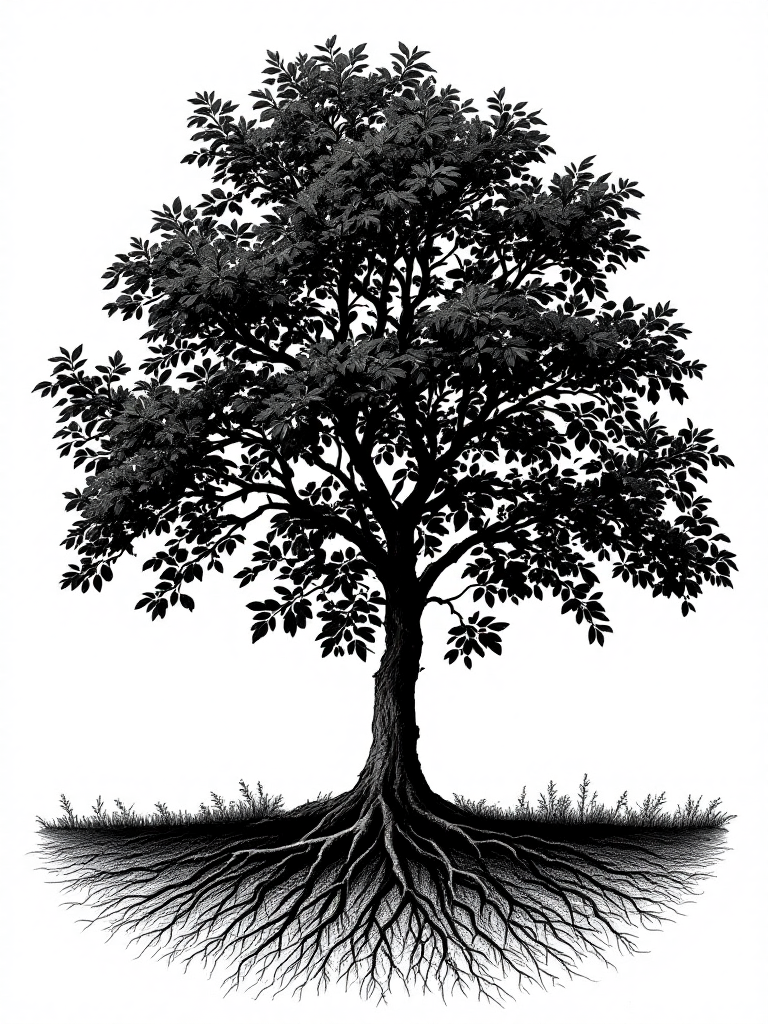
Every tree was once a seed. Before the canopy, before the root system you can see, before anything you could point to and call medicine — there was a practitioner sitting across from a patient, reading the pulse, and deciding that the billing code was not the point of the practice.
That decision is where Rootworth comes from.
The practitioner.
Michael Woodworth holds a Master of Science in Oriental Medicine and a California acupuncture license. He trained in the classical lineage: the Shang Han Lun, the Jin Gui Yao Lue, the foundational texts that Chinese medicine kept reading when modern medicine stopped looking.
The clinic side of the practice is Makari Wellness — in-person, licensed, insured. That is where the acupuncture lives. Rootworth is the other branch of the same tree: the herbal-medicine and movement side. The refusal that needed its own name.
Two practices, one breath.
The refusal.
At some point in clinical practice, every honest practitioner has a reckoning. The patient sitting across from you is a person. The code in the billing system is not. The algorithm that generated the prescription did not read the pulse, did not notice the tongue, did not sit with the person long enough to hear what they could not yet put into words.
The refusal is not dramatic. It is quiet. It looks like: choosing to read the patient instead of running the protocol. Choosing two thousand years of clinical observation over a marketing budget. Choosing not to call the body a market segment.
Real medicine has roots.
How Rootworth came into being.
Treating neurodegenerative eye conditions, I became acutely aware of a problem that shouldn’t exist: there aren’t many practitioners who specialize in these conditions. Patients with macular degeneration, retinitis pigmentosa, optic neuropathy — they’d exhaust their local options, then face a brutal choice. Travel to California. Spend a week or two. Spend thousands. Disrupt their lives. Or accept decline.
When a specialist tells you there’s no treatment, they’re really saying: they don’t have one. That distinction changes everything — but only if you can actually access it.
The evolution.
I started by having patients come in for treatment, then continue with customized herbal protocols at home. The results were striking: properly designed herbal medicine, customized to each patient’s constitution, stopped neurodegenerative progression. Often it reversed it.
Soon, patients who couldn’t afford the trip — the time, the cost, the logistics — asked if I could treat them from a distance with herbs alone. I said yes. And something remarkable happened: it worked.
But let’s be clear: these weren’t miracles. They were people who committed to the work. They changed their patterns. They maintained consistency with their herbs. They gave their bodies months — sometimes years — to actually heal. That commitment matters.
Here’s what I learned: neurodegenerative conditions respond even more thoroughly and quickly when accompanied by regular acupuncture treatment. Acupuncture stimulates both circulation and nerve function in ways herbs alone cannot. The combination is optimal.
But here’s what’s also true: properly designed herbal medicine, taken consistently with genuine lifestyle commitment, works. It’s slower without acupuncture’s neural stimulation. But it works.
Cholesterol normalized. Blood pressure stabilized. Arrhythmias that three ablations couldn’t fix disappeared. The inflammation medicine had learned to manage — actually resolved.
The insight.
The real medicine wasn’t the synchronous interaction. It was the knowledge embedded in the herbal design — and the patient’s willingness to actually use it.
I didn’t need telemedicine visits. I needed comprehensive intakes and follow-up protocols that worked at scale. Your practitioner’s time is limited, but their knowledge — properly structured — is not.
Rootworth exists because properly designed classical herbal medicine doesn’t require frequent visits. It requires excellent intake, thoughtful follow-up, and your genuine commitment to change.
We’re not making telemedicine better. We’re making the assumption that access to specialized care requires geographical privilege obsolete.
The seed.
Rootworth is early. The herbal fulfillment arm is being built. The public intake is not yet open. The chambers are five rooms in a practice we are still constructing — one doctrine document, one clinical concept, one campaign at a time.
This is not unusual for something that intends to grow. The mustard seed is the smallest of all seeds. It becomes the tree where birds nest. We are at the seed stage.
You are here early. That means something. The movement is still forming around the people who show up before it is finished. Your presence, your voice, your refusal to accept that the script is the point — that is what the movement is made of right now.
What grows here.
Custom herbal formulas built from classical methodology. A movement of practitioners and constituents who know the body is not a market. Chambers — the catechism of the movement — for anyone who wants to understand what classical Chinese medicine actually reads in a person. A practitioner network, eventually. A public intake, when the roots are deep enough to hold it.
The tree is not yet standing at full height. But the seed is in the ground. The ground is good. And the practice of tending it — reading, speaking, refusing, building — is already medicine.
The heart has a voice. Use yours.