Chamber XII
Why custom beats SKU.
The shelf does not know your pulse. The formula should.
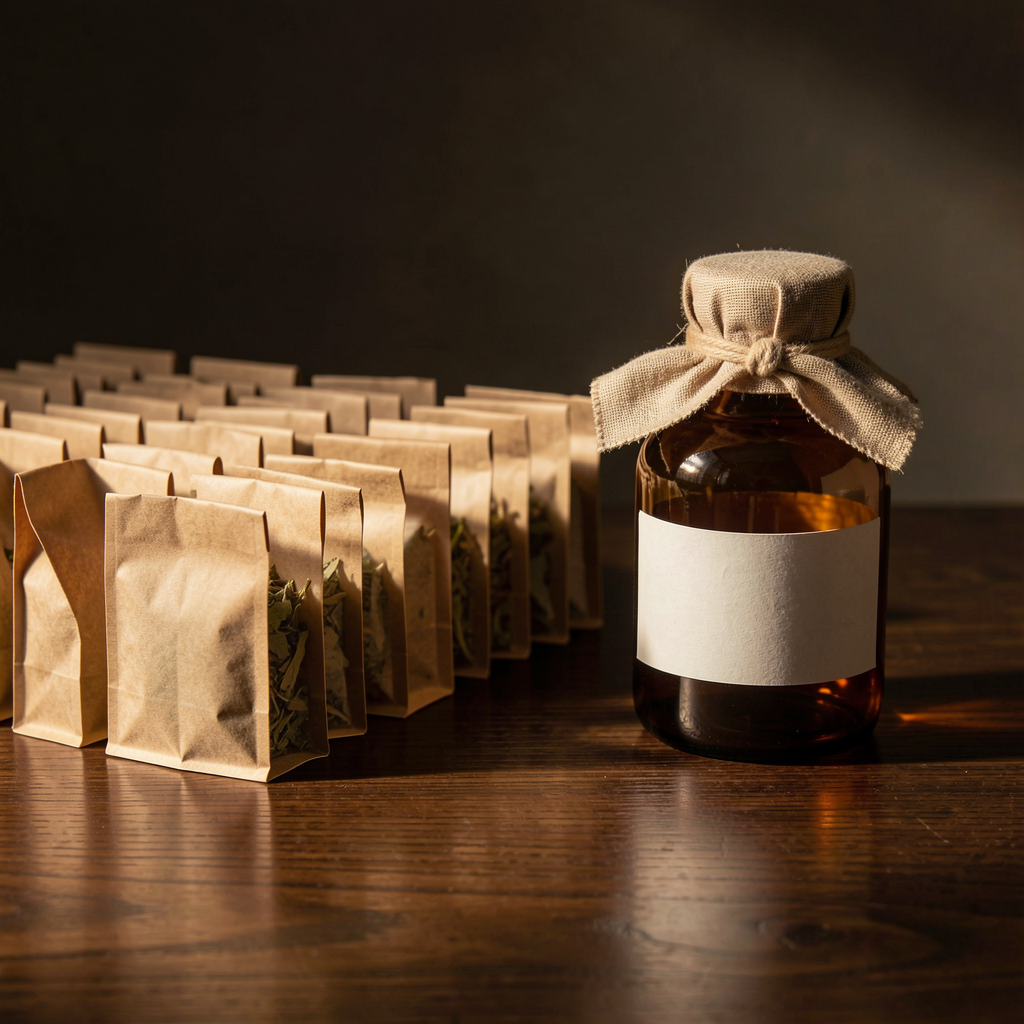
A standard formula is a best guess. A custom formula is an answer.
The SKU problem.
Walk into any natural food store and find the herbal supplement aisle. Every bottle names a condition: Liver Support. Stress Relief. Adrenal Complex. The formulas inside are standard combinations — fixed ratios of fixed herbs, designed to support a category of symptoms in a representative average body. They are real herbs. Some of them produce real results. They are also, by design, formulated for nobody in particular.
The SKU model is not a failure of intention. It is a consequence of scale. You cannot put a pulse reader into a bottle. You cannot ask the shelf what the patient's tongue looks like this week. Standard formulas are the best available protocol for a distribution center. They are not the best available protocol for a patient.
SKUs are what you make when the business model demands shelf inventory. Custom is what you make when the patient is the center of the practice.
Formula architecture: what changes between patients.
A classical formula has a structure — chief herb, deputy herbs, assistant herbs, envoy herbs. The chief herb addresses the main pattern. The deputies support the chief and address secondary patterns. The assistants moderate the chief's action or address complicating factors. The envoy guides the formula to the correct organ system and harmonizes the combination.
Two patients with the same chief pattern — Liver Qi stagnation, for instance — may require entirely different deputy, assistant, and envoy combinations. Patient A's stagnation is accompanied by Blood deficiency, so the deputies nourish Blood. Patient B's stagnation has generated Heat, so the deputies clear heat. Patient C's stagnation is compounded by Spleen Qi deficiency, so the assistants support the Spleen to prevent the formula from burdening digestion further.
Same chief herb. Three different formulas. Same condition. Three different patients. This is the clinical necessity that the SKU model structurally cannot meet — not because the SKU contains bad herbs, but because it has no mechanism for reading the patient's specific deputy, assistant, and envoy requirements. It applies a partial formula to a complete picture and calls it treatment.
What the Shang Han Lun showed.
Zhang Zhongjing's formulas — 113 classical prescriptions built from the Treatise on Cold Damage — are not final answers. They are starting points. The Shang Han Lun itself contains modification lines: if the patient presents with a dry mouth, add this herb; if there is diarrhea, remove this one; if the pulse is floating and tight, use the cold-damage variant; if it is moderate, use the wind-strike variant. The classical text assumes modification. It was written to be adapted.
A practitioner who applies the same formula to every patient who presents with the same pattern is not practicing classical medicine. They are practicing a more sophisticated form of SKU medicine — with better ingredients and a classical label. The modification is the medicine. The formula that has been adapted to the specific patient is doing something the shelf formula cannot do: it is responding to an actual human being, not a representative sample.
The modification is the medicine. Zhang Zhongjing built the formulas to be adapted. The text assumes the practitioner knows the patient. The shelf does not.
Why this matters in an industry built on standardization.
The supplement industry is a two-hundred-billion-dollar market. Most of it runs on the SKU model. The promise is that the herbs are there — the Ashwagandha, the Reishi, the Berberine — and that the body will take what it needs. This is partly true and partly magical thinking. The herbs are real. But the body's ability to use them optimally depends on what else is present in the formula, in what ratio, and in what combination — and those decisions require a clinical reading that the supplement label is not capable of making.
The pharmaceutical model built the same assumption into its design: one drug, one target, one dosage for the approved population. The drug does not know if the patient is Blood deficient or Yin deficient. It does not know if the presenting stagnation has a heat component or a cold one. It does not know if the Spleen needs support before the formula can be properly absorbed. The formula knows, if it was built from the reading.
Custom formulation is not a premium tier of the same product. It is a fundamentally different category of medicine. It starts with the patient. The formula follows the reading. The shelf has nothing to say about either.
The SKU was made for a category. You are not a category.
A standard formula is a best guess. Your pattern is specific.
Off the shelf means off the mark.
Real medicine starts with the patient. Everything else follows.
Chamber XI established what a pattern is. Chamber XII is where the pattern becomes the prescription. The intake is the bridge. Chamber XIV walks through it.