Diabetic Retinopathy
Diabetic retinopathy is not an eye disease. It is a metabolic failure reading itself onto the vessels of the retina — and classical Chinese medicine named the governing mechanism two thousand years before the ophthalmoscope existed.
The Western diagnosis is unambiguous: chronic high blood glucose destroys the retinal microvasculature. The pericytes — the structural guard cells of the retinal capillaries — are lost.
脾主運化。 The Spleen governs transformation and transportation.
脾統血。 The Spleen holds blood within the vessels.
久病入絡。 Chronic disease enters the collaterals.
知其要者,一言而終。 One who knows the essential principle can complete it in a single statement.
一人一方。 One person, one formula.
脾胃者,後天之本。 The Spleen and Stomach are the root of post-natal life.
The Western diagnosis is unambiguous: chronic high blood glucose destroys the retinal microvasculature. The pericytes — the structural guard cells of the retinal capillaries — are lost. The basement membrane thickens. Endothelial junctions break down. Blood leaks where it should stay contained. New, fragile vessels grow into the vitreous and bleed. Vision deteriorates. In severe cases it is lost entirely.
What Western ophthalmology has measured with extraordinary precision, classical Chinese medicine had described in governing-mechanism language for two millennia. The operative statements are not metaphors. They are clinical predictions — falsifiable descriptions of what happens when two specific physiological relationships fail.
脾主運化。 The Spleen governs transformation and transportation.
The Spleen, in classical medicine, is not the anatomical spleen of Western biology. It is the metabolic-digestive governing system — the organ responsible for extracting usable energy from food, transforming grain qi into the blood and fluids the body requires, and transporting that nourishment upward to every tissue that depends on it. When the Spleen fails to transform grain qi, food energy is not converted into usable substance. Glucose circulates without being metabolized. This is the classical description of 消渴 — Xiao Ke, the wasting-and-thirsting pattern. The classical name for diabetes.
脾統血。 The Spleen holds blood within the vessels.
The second classical statement completes the picture. The Spleen does not only transform; it governs containment. Blood, in classical physiology, is held in its proper channels by the Spleen's governing function. When Spleen Qi is insufficient, the holding function fails. Blood is no longer contained. It extravasates — it leaves the vessels and enters the surrounding tissue. In the retina, this means hemorrhage. Cotton-wool spots. Macular edema. Vitreous bleeding.
One organ. Two classical failures. Explaining both the metabolic disease and the retinal hemorrhage — with the same statement about the same system.
Classical Chinese herbal medicine, designed and proportioned for the specific pattern the specific patient is presenting, addresses both failures simultaneously. The formula is chemistry acting on blood — on vessel-wall integrity, metabolic function, microvascular circulation, and the constitutional root from which both failures emerged. This is not metaphor. It is pharmacology read through a different framework.
What hyperglycemia does to the retinal vessels — the blood chemistry story.
Understanding what diabetic retinopathy is, at the level of chemistry and cell biology, is the foundation for understanding what a classical herbal formula is addressing. The two frameworks are not in competition. They are looking at the same machinery from different levels of magnification.
Chronic hyperglycemia — sustained high blood glucose — drives a cascade of chemical modifications in every blood vessel in the body. The retinal vasculature is among the most vulnerable, because the retina has an extraordinarily high metabolic demand and relies on a specialized, tightly regulated microvasculature for its oxygen and nutrient supply.
Advanced glycation end-products (AGEs). When glucose binds to proteins in a non-enzymatic reaction — a process called glycation — it produces advanced glycation end-products. AGEs accumulate in vessel walls, crosslink structural proteins, stiffen the basement membrane, impair the normal flexibility and permeability regulation of the vessel, and activate downstream inflammatory signaling through their receptor (RAGE). In the retina, AGE accumulation in the capillary wall is among the earliest chemical changes in diabetic retinopathy.
Pericyte loss. Retinal capillary pericytes — the cells that wrap around the capillary wall and regulate its tone, permeability, and structural integrity — are selectively lost in diabetes, at a rate faster than in any other tissue. The loss is driven by AGE chemistry, oxidative stress, and the downstream failure of survival signaling. As pericytes disappear, the capillaries they supported lose their structural regulators. Endothelial cells become exposed and dysfunctional.
Basement membrane thickening and endothelial breakdown. The capillary basement membrane thickens as part of the pathological response to pericyte loss and glycation, paradoxically becoming less permeable to nutrients while more permeable to proteins. Tight junctions between endothelial cells — the molecular seal that maintains the blood-retinal barrier — begin to fail. Proteins and fluid leak into the retina, producing macular edema. Red blood cells extravasate into the retinal tissue.
VEGF upregulation and neovascularization. Capillary dropout reduces oxygen delivery to the retina. Hypoxic retinal tissue upregulates vascular endothelial growth factor (VEGF) — a signaling molecule that drives new vessel formation. The new vessels that grow in response are structurally abnormal: they lack the pericyte support and tight junction integrity of healthy vessels, bleed easily into the vitreous, and can form fibrovascular membranes that contract and detach the retina.
Inflammatory amplification — the RAGE-NF-κB-VEGF axis. AGE chemistry does not stop at structural modification. AGEs signal through their receptor (RAGE), activating NF-κB — the master transcription factor for inflammatory gene expression. NF-κB upregulates TNF-α, IL-1β, intercellular adhesion molecules, and VEGF simultaneously. This inflammatory amplification loop drives leukostasis — the adhesion of white blood cells to the retinal capillary endothelium — which directly occludes capillary flow and accelerates endothelial cell death. In classical terms: the metabolic heat generated by the failing Spleen is now generating Toxic Heat at the vessel-wall level. The formula must clear this secondary heat from the Blood level, not merely from the metabolic substrate.
The polyol pathway — sorbitol accumulation as a tissue toxin. In hyperglycemic conditions, excess glucose enters the polyol pathway — converted to sorbitol by aldose reductase, then to fructose. Sorbitol accumulates inside cells (including pericytes and Müller cells of the retina) because it cannot freely cross the cell membrane. This osmotic accumulation disrupts cellular redox balance (NADPH depletion, glutathione reduction), increases oxidative stress, and contributes directly to pericyte apoptosis. In classical terms: unresolved turbid substance accumulating inside the finest structures of the retinal collaterals — a form of internal Phlegm-toxin buildup that the body cannot self-clear. Herbs that resolve Phlegm and clear heat at the vessel-wall level are addressing this chemistry from a classical angle.
This is the Western pathophysiology: a chemistry cascade from glucose to AGE to pericyte loss to basement membrane disruption to endothelial failure to hemorrhage to neovascularization, amplified by inflammatory signaling and toxic polyol accumulation. Every step in that cascade has a classical correlate — and every step is addressable, at some level, with classical herbal chemistry.
久病入絡。 Chronic disease enters the collaterals.
This classical statement describes precisely what Western pathophysiology has now measured. The finest vessels — the micro-collaterals of the retina — are the last place that compromised blood can reach and the first place it abandons when circulation fails. Pericyte loss, microaneurysm formation, and capillary non-perfusion are the Western measurements of what classical medicine called chronic disease entering the collaterals. The longer the metabolic failure persists, the deeper into the fine-vessel architecture the damage penetrates.
The classical mechanism bridge — where the two frameworks meet.
Classical-to-Western mechanism table — for practitioners →
This section is provided as clinical reference. The statements below are classical Chinese medical aphorisms and their corresponding pattern mechanisms — not disease claims. All formula recommendations represent classical pattern-based support, not treatment of diagnosed disease conditions.
| Classical statement | Mechanism when the statement fails | Western finding it produces | Stage of DR it corresponds to |
|---|---|---|---|
| 脾主運化 Spleen governs transformation and transportation |
Grain qi is not transformed into usable energy; glucose circulates unconverted; Xiao Ke (消渴 / wasting-and-thirsting) develops; Stomach Heat accumulates as the unconverted substrate generates turbid heat | Chronic hyperglycemia → AGE accumulation in vessel walls → basement membrane thickening → pericyte loss; HbA1c elevation; insulin resistance pattern | Pre-diabetic and early NPDR substrate; the metabolic root from which all subsequent retinal damage proceeds |
| 脾統血 Spleen holds blood within the vessels |
Spleen Qi insufficient → holding function fails → blood is no longer contained within the capillary walls → extravasates into the surrounding retinal tissue | Dot and blot hemorrhages, flame hemorrhages, cotton-wool spots, vitreous hemorrhage, macular edema from breakdown of the blood-retinal barrier | Moderate NPDR through PDR; the vascular consequence of the metabolic root |
| 久病入絡 Chronic disease enters the collaterals |
Long-standing Blood Stasis and Phlegm-turbidity driven into the finest retinal micro-vessels; stagnation blocks normal microvascular circulation | Pericyte loss, microaneurysm formation, retinal capillary non-perfusion, retinal ischemia, VEGF upregulation | NPDR progression; the transition from vascular fragility to frank ischemia and neovascularization |
| 腎藏精 Kidney stores Jing (constitutional essence) |
Jing depletion (from prolonged Xiao Ke, constitutional decline, or long-standing illness) → Kidney fails to nourish the deep retinal substrate; Kidney-Liver axis support for the eye diminishes | Accelerated photoreceptor and RPE deterioration; concurrent diabetic nephropathy; late-stage bilateral macular degeneration pattern overlapping DR | Late-stage DR; Yin-Yang deficiency pattern common in long-standing Type 2 diabetes with systemic complications |
| 胃熱熾盛 Stomach Heat blazes |
Unresolved food accumulation and metabolic excess generates Stomach Fire → driving hunger, polyphagia, ongoing hyperglycemia despite dietary effort | Insulin resistance-driven hyperglycemia, polyphagia, elevated fasting glucose and postprandial spikes; the metabolic fire maintaining AGE production | Active early-stage Xiao Ke driving ongoing retinal chemistry deterioration; often the primary pattern in early Type 2 |
| 痰瘀互結 Phlegm and Blood Stasis bind together |
Turbid Phlegm (unresolved metabolic waste) and Blood Stasis co-deposit in the retinal collaterals; the combined obstruction is resistant to simple moving strategies | Hard exudates (lipid deposits), fibrovascular membrane formation, tractional retinal detachment risk; difficult-to-move stage of DR | Advanced PDR; requires Phlegm-resolving herbs alongside blood-moving strategy |
These are not retrospective fits. The classical statements were generated by clinical observation of exactly these presentations — the thirsty, wasting patient whose eyes deteriorated; the patient with recurring hemorrhages despite apparent glycemic management; the late-stage diabetic whose retinopathy, nephropathy, and declining constitutional vitality all arose from the same root pattern of Spleen and Kidney failure. The classical practitioner was reading the same patient. The framework named the governing mechanism. The Western ophthalmologist measured its consequences.
Four blood actions for diabetic retinopathy — what a DR formula is actually doing.
Classical herbal formulas for diabetic retinopathy are built from the same four blood actions that underlie all eye formulas — but the proportion and selection for DR is specific to the chemistry of this condition. This is not a generic blood-support formula. Each herb is deployed for a precise reason in the context of the specific DR pattern.
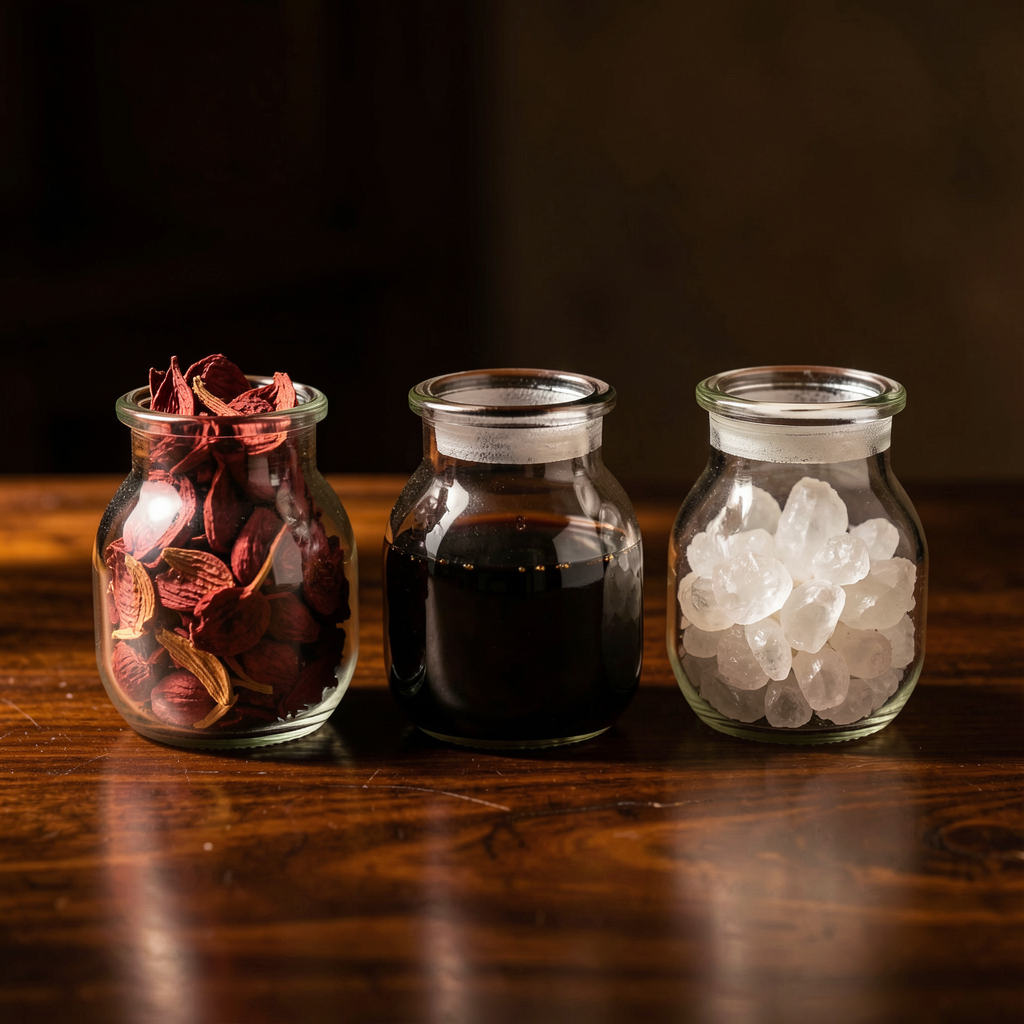
GENERATE — rebuild blood and nourish the retinal substrate. In a Xiao Ke pattern, the sustained metabolic excess has depleted the Yin fluids — the coolant and lubricant system that should be counterbalancing the metabolic heat. The retinal substrate is literally dry, the vessel walls are stiff, and the tissue has lost the fluid reserve that healthy capillary function depends on. Generation herbs rebuild this substrate.
- Shu Di Huang (*Shú Dì Huáng*, 熟地黄 / Prepared Rehmannia) — the foundational blood-generating herb; nourishes Liver and Kidney Blood and Yin; rebuilds the fluid reserve that glycation and chronic heat have depleted. Used in virtually every DR formula with a Yin-deficiency component.
- Dang Gui (*Dāng Guī*, 当归 / Angelica sinensis) — generates and warms Blood simultaneously; nourishes the retinal substrate while maintaining microvascular circulation; the classical herb for "nourishing blood to nourish the eye."
COOL — clear metabolic heat and protect the vessel wall from inflammatory chemistry. Xiao Ke is a heat pattern at its metabolic core — the failure to transform grain qi generates a surplus that converts to heat. That heat damages vessels, drives inflammation, and depletes Yin fluids. Cooling herbs in a DR formula are anti-glycation and anti-inflammatory interventions in biochemical terms.
- Sheng Di Huang (*Shēng Dì Huáng*, 生地黄 / Raw Rehmannia) — the primary blood-cooling and fluid-generating herb in the Chinese materia medica; cools heat without damaging the Yang; generates Yin fluids to counter the dryness of Xiao Ke; documented in laboratory studies for inhibiting AGE formation and VEGF upregulation. The lead herb for the Yin-deficiency dry-heat presentation of Xiao Ke.
- Huang Lian (*Huáng Lián*, 黄连 / Coptis chinensis) — the classical herb for Stomach and metabolic heat; cools the blazing Stomach Fire driving ongoing hyperglycemia; berberine — the primary alkaloid in Huang Lian — has been studied extensively for its effects on glucose metabolism, insulin signaling, and AMPK activation. In classical terms: clears the heat that is burning out the Spleen's transformative function.
- Zhi Mu (*Zhī Mǔ*, 知母 / Anemarrhena asphodeloides) — cools Lung and Stomach heat while generating fluids; classical pair with Huang Bai for Yin-deficiency heat patterns; deployed in formulas addressing the upper and middle Xiao Ke patterns (polydipsia and polyphagia).
MOVE — activate microvascular circulation and address active hemorrhage with stasis. The defining clinical challenge in DR is that active hemorrhage (Spleen not holding blood) and Blood Stasis (久病入絡, chronic disease in the collaterals) co-exist. Most blood-moving herbs increase bleeding risk if used in isolation. The solution in the classical materia medica is specific: one herb moves blood and stops hemorrhage simultaneously.
- San Qi (*Sān Qī*, 三七 / Panax notoginseng) — the essential herb for active DR bleeding with underlying stasis. San Qi moves blood AND stops hemorrhage — it is the only herb in the classical materia medica that performs both functions simultaneously. In DR with active vitreous hemorrhage, subretinal bleeding, or retinal hemorrhage on a background of stasis and capillary non-perfusion, San Qi is typically added as a stand-alone herb or as a primary component of the stasis-resolving layer. Its notoginsenoside chemistry inhibits platelet aggregation while promoting fibrinolysis of existing clots — the pharmacological basis for the classical "move and stop" description.
- Dan Shen (*Dān Shēn*, 丹参 / Salvia miltiorrhiza) — moves blood through the Heart and Liver channels without depleting it; specifically active on microvascular circulation; documented antiplatelet and vasodilatory effects on retinal capillary perfusion; a core herb in any DR formula addressing capillary non-perfusion and early neovascular ischemia.
- Chuan Xiong (*Chuān Xiōng*, 川芎) — the classical cephalic blood-mover; specifically active in the vessels of the head and eyes; moves blood upward to the ocular circulation; pairs with Dan Shen for combined microvascular activation.
WARM — used selectively and only in cold-predominant patterns. DR often presents with significant heat (Stomach Heat, Yin-deficiency heat, AGE-driven inflammatory heat). Warming herbs are not the primary strategy for most DR presentations. However, in late-stage diabetes with Yang deficiency — the cold, edematous, polyuric pattern of Kidney Yang collapse — warming the Kidney Yang becomes essential to restore the metabolic fire that the Spleen requires to transform and hold. The wrong formula at this stage — one that continues cooling and cooling without addressing the underlying Yang decline — will worsen the presentation. Careful pulse and tongue reading distinguishes the heat pattern from the cold pattern. Always.
知其要者,一言而終。 One who knows the essential principle can complete it in a single statement.
The essential principle for DR: address the Spleen's two failures with one formula — restore transformative function (clear the metabolic heat, rebuild Yin, regulate glucose chemistry) and restore containing function (move stasis from the collaterals, stop active hemorrhage, repair the vessel wall). Every DR formula is proportioned to the patient's specific pattern position on this two-axis picture.
Formulas for diabetic retinopathy — the classical architectures.
These are the foundational formulas for the classical patterns underlying DR. In clinical practice, they are starting architectures — modified herb by herb for the specific presentation, the stage of retinal damage, and the constitutional pattern the DR is sitting inside.
- Yu Quan Wan (*Yù Quán Wán*, 玉泉丸) — "Jade Spring Pill"; the lead formula for the Yin-deficiency dry-heat Xiao Ke pattern (the thin, thirsty, hot patient with afternoon fever); cools Stomach heat while generating Yin fluids; contains Tian Hua Fen (天花粉, Trichosanthes) — the classical herb for the upper Xiao Ke driven by heat and fluid depletion. The formula that addresses the metabolic root of the most common early-to-mid DR presentation.
- Yu Nü Jian + Sheng Mai San (*Yù Nǚ Jiān* 玉女煎 + *Shēng Mài Sǎn* 生脉散) — for Qi and Yin deficiency with Stomach Heat; Sheng Mai (Ren Shen, Mai Dong, Wu Wei Zi) rebuilds the Qi-Yin axis that chronic hyperglycemia has depleted; Yu Nü Jian cools the Stomach and nourishes the fluid reserve. Used when the patient shows both constitutional Qi depletion and ongoing metabolic heat — the common mid-stage Type 2 picture.
- Ji Sheng Shen Qi Wan (*Jì Shēng Shèn Qì Wán*, 济生肾气丸) — the Yin-Yang deficiency formula; adds warming Kidney Yang herbs (Fu Zi, Rou Gui) to the Kidney Yin base of Liu Wei Di Huang Wan, plus Niu Xi and Che Qian Zi to address the fluid accumulation and edema of Yang deficiency. The formula for late-stage diabetic retinopathy-plus-nephropathy, where the constitutional picture has shifted from heat and dryness to cold, edema, and Yang collapse. Not appropriate for heat-predominant presentations.
- Huo Xue San Jie Tang (*Huó Xuè Sǎn Jié Tāng*, 活血散结汤) — "Activate Blood, Disperse Binding Decoction"; for the Phlegm-Blood Stasis pattern in advanced DR; addresses the hard exudates, fibrovascular proliferation, and the 痰瘀互結 (Phlegm-Stasis binding) that characterizes difficult-to-move late-stage retinal disease. Requires careful application — Blood-moving formulas in a hemorrhage-active pattern require San Qi as a concurrent stop-hemorrhage component.
- San Qi as stand-alone addition — in active vitreous or retinal hemorrhage with stasis, San Qi is typically added to whatever base formula the pattern requires. It is not a separate formula; it is the essential single herb that addresses the clinical priority of stopping the active bleed while simultaneously resolving the stasis underneath it.
A clinical note on formula modification for DR specifically: the practitioner reads the current pattern against the retinal stage. Early NPDR (dot hemorrhages, microaneurysms only) requires a formula weighted toward constitutional correction — restore the Spleen, clear the metabolic heat or warm the Yang deficiency, begin moving stasis. The formula does not need to be aggressively blood-moving because the vessel-wall damage is early and active hemorrhage is minimal. Moderate-to-severe NPDR, with more extensive hemorrhage and exudate, shifts the formula weighting toward blood-moving and hemorrhage-stopping: San Qi increases proportionally, Dan Shen and Chuan Xiong are added, and the balance between generating (passive nourishment) and moving (active circulation) shifts toward movement. PDR, with active neovascularization or vitreous hemorrhage, requires the most aggressive San Qi component — sometimes combined with Pu Huang (蒲黄, Pollen Typhae) for hemostasis — while the formula simultaneously supports Qi to drive the movement and prevents the stasis from reconsolidating. The formula is not a product. It is a clinical instrument, adjusted for the current stage of a condition that is itself dynamic.
The combination lock — why two patients with Type 2 diabetes and diabetic retinopathy need different formulas.
The diagnosis is identical. The Western treatment pathway is similar — glycemic control, anti-VEGF injections if indicated, laser photocoagulation if indicated, ophthalmology follow-up. But the classical pattern underlying each presentation is different. The formula that addresses one could be wrong — or even counterproductive — for the other.

Patient one: a sixty-one-year-old woman, slender, with a decade of managed Type 2 diabetes. Her HbA1c has been in the 7–8 range despite medication compliance. She describes herself as always thirsty, always warm, with afternoon heat sensations and a dry mouth that persists overnight. She is tired but cannot sleep soundly. Her appetite is strong — almost compulsive. Her ophthalmologist has documented moderate NPDR with early macular edema.
Her classical picture is Yin-deficiency dry-heat Xiao Ke with Stomach Fire. The Spleen's failure to transform has generated sustained metabolic heat that is consuming her Yin fluids. The retinal edema is a product of both the heat driving vascular permeability and the Spleen's failing hold on blood in the vessels. Her combination lock turns: cool the Stomach heat, generate the Yin fluid reserve, move stasis from the retinal collaterals, and stop any active hemorrhage. Yu Quan Wan or Yu Nü Jian base, with Sheng Di Huang heavy, Huang Lian, San Qi, Dan Shen. The formula is cooling, generating, and moving. Warming herbs are explicitly contraindicated.
Patient two: a sixty-eight-year-old man, heavyset, with Type 2 diabetes of fifteen years. He takes metformin and a GLP-1 agonist. He is always cold. He urinates frequently, especially at night. He has peripheral edema in both legs. His appetite is actually diminished — food "sits on him." He is exhausted in a way that feels constitutional, not circumstantial. His ophthalmologist has documented moderate-to-severe NPDR with capillary non-perfusion on fluorescein angiography.
His classical picture is Kidney Yang deficiency with Spleen-Yang failure — the metabolic fire has burned out, and what remains is not heat but cold, with the fluid accumulation that Yang-deficient metabolism produces. The Spleen is failing to transform (polyuria, edema, food sitting heavy), and it is failing to hold blood (retinal hemorrhage). But the solution is not to cool and generate — those strategies will worsen a cold, stagnant pattern. His combination lock turns differently: warm Kidney Yang to restore the metabolic fire, strengthen Spleen Yang to restore transformation and containment, and move blood stasis from the retinal collaterals. Ji Sheng Shen Qi Wan base, with warming additions (Fu Zi cautiously dosed), San Qi for the concurrent stasis-hemorrhage problem, Huang Qi (黄芪, Astragalus) to strengthen Spleen Qi. Cooling herbs — contraindicated for this pattern — would drive his Yang further down.
Patient three — the most common presentation: a fifty-seven-year-old man, moderately built, with Type 2 diabetes of eight years managed on metformin plus a sulfonylurea. He is neither clearly hot nor clearly cold. He has some thirst but not excessive. He has some fatigue but still functional. His digestion is unreliable — sometimes bloated, sometimes fine. He was diagnosed with mild NPDR six months ago and has been trying to "do everything right" since. He is taking berberine, alpha-lipoic acid, benfotiamine, chromium, and magnesium. He does not know if any of it is working.
His classical picture is Spleen Qi deficiency with early Phlegm accumulation and incipient Blood Stasis in the collaterals — the mixed, transitional pattern that precedes both the heat-excess and cold-deficiency poles. This is where most early-stage Type 2 DR patients actually live: not dramatically hot, not dramatically cold, but with a failing Spleen that is generating metabolic turbidity (Phlegm) and allowing early stagnation in the retinal microvasculature. The combination lock for this pattern turns: strengthen Spleen Qi first to restore transformative function, resolve Phlegm-turbidity to clear the metabolic accumulation, and begin moving Blood Stasis in the collaterals. Si Jun Zi Tang base (the foundational Spleen-Qi formula), with additions of Chen Pi and Ban Xia to resolve Phlegm, Dan Shen and San Qi to begin moving the collateral stasis, and a small amount of Huang Lian to address the mild metabolic heat without overcooling a Spleen that needs warmth to function.
His supplement protocol — berberine, alpha-lipoic acid, benfotiamine — contains genuinely useful chemistry for his condition. The problem is that his Spleen Qi is insufficient to absorb and deliver those supplements effectively. The formula does two things simultaneously: it addresses the root constitutional failure, and it restores the delivery infrastructure that his supplements require to reach their intended tissues. After three to four months on the formula, absorption improves, and the supplements he was already taking begin to work better. This is not an unusual observation. It is the predictable consequence of addressing the delivery system before loading it.
The same Western diagnosis. The same retinal staging. Three patients, three entirely different pattern configurations, three formulas with different herb selections and proportions. This is not a nuance. It is the clinical core of classical herbal medicine — and the reason a custom intake is not optional for conditions of this depth.
一人一方。 One person, one formula.
Digestion first — the Spleen is the root organ for both problems, and this changes everything about supplementation.
Most patients with Type 2 diabetes and diabetic retinopathy are taking a standard supplement protocol assembled from functional medicine or ophthalmology recommendations: berberine, chromium, alpha-lipoic acid, magnesium, B12, possibly lutein, zeaxanthin, benfotiamine. The evidence base for each of these is real. The problem is the premise.
脾胃者,後天之本。 The Spleen and Stomach are the root of post-natal life.
Li Dong-yuan established this in the twelfth century, and it has a direct pharmacological implication that the supplement industry ignores: the absorption and transformation of every supplement you swallow depends on the same system that is failing in Type 2 diabetes. The Spleen's transformation function is the classical description of digestive absorption, metabolic conversion, and nutrient delivery to peripheral tissues. When that function is impaired — which is precisely the case in Xiao Ke — supplementation is operating through a compromised delivery system.
Berberine requires absorption across the intestinal wall, hepatic first-pass conversion, and adequate lipid transport to reach target tissues. Magnesium absorption is highly dependent on intestinal transit and secretory function. B12 requires intrinsic factor and a healthy gastric environment. Alpha-lipoic acid, fat-soluble in its reduced form, requires functional biliary output and lipid-packaging for systemic distribution.
A patient who reports chronic bloating after meals, loose stools or poorly formed stool, low appetite or appetite that does not recover after eating, fatigue that worsens immediately after food, or a sense that "nothing works" despite compliance — this is a Spleen Qi deficiency signature in classical terms. It is also a compromised absorption profile in biochemical terms. Supplements absorbed through a failing Spleen reach their targets at a fraction of their theoretical dose.
The classical approach addresses the delivery infrastructure first. The foundational Spleen-strengthening quartet — Dang Shen (*Dǎng Shēn*, 党参), Bai Zhu (*Bái Zhú*, 白术), Fu Ling (*Fú Líng*, 茯苓), Gan Cao (*Gān Cǎo*, 甘草) — restores the transformative capacity through which everything else is absorbed and delivered. A formula that restores Spleen Qi makes every other intervention — herbal, supplemental, and dietary — more effective, because the delivery system is now functioning.
For diabetic retinopathy specifically, this argument is even more pointed. The Spleen is not only the absorption mechanism. It is the root organ for both pathological processes: the metabolic failure driving hyperglycemia, and the vascular containment failure producing retinal hemorrhage. Supplementing around the Spleen while the Spleen remains insufficient is addressing the downstream consequences while the upstream failure continues. The classical approach begins at the root.
The sequencing question matters as much as the formula selection. In classical medicine, the question of what to address first is a clinical decision, not a protocol. For most early-to-mid NPDR presentations where Spleen Qi deficiency is the root, the first formula priority is restoration of the Spleen's transformative function — not because the retinal stasis is unimportant but because the stasis will not respond optimally to blood-moving herbs if the Qi that moves blood is itself insufficient. Huang Qi (黄芪, Astragalus) appears in blood-moving formulas for exactly this reason: it provides the Qi substrate that gives Dan Shen and San Qi the driving force to actually move what has stagnated. Moving Blood Stasis without sufficient Qi to drive the movement is, in the classical framework, like trying to clear a drain without water pressure. The formula works with the sequence, not against it.
The practical implication for patients already on a supplement protocol: begin the herbal formula, continue supplements, and expect the first two to three months to be primarily about restoring the delivery infrastructure. As Spleen Qi strengthens, absorption markers — energy after meals, digestive regularity, reduction in bloating, improved morning vitality — are the early signs the pattern is responding. Retinal outcomes are longer-horizon measures. They are the downstream consequence of a constitutional shift that takes months to establish and years to fully consolidate.
The metabolic root and the question of long-term medication support.
The classical approach to Xiao Ke addresses both the metabolic root — the Spleen's failure to transform grain qi — and the vascular consequence — the Spleen's failure to hold blood. These are not two separate problems requiring two separate treatments. They are two expressions of one root failure, addressable through one constitutionally-calibrated formula strategy.
The classical question is not: how do we manage the glucose number? The classical question is: why has this person's Spleen lost the ability to transform what they eat into usable energy? What pattern of Heat, deficiency, stagnation, or constitutional decline produced this failure — and can that pattern be shifted?
Classical herbal medicine, in the context of metabolic support, is a long-term constitutional intervention. The time horizon is months to years, not days. The goal is to address the pattern substrate that underlies the metabolic dysregulation — the Stomach Fire that drives it in heat-excess patterns, the Spleen-Kidney Yang deficiency that drives it in cold-deficiency patterns, and the accumulated Blood Stasis in the fine collaterals that develops as a consequence of both.
In some clinical observations, patients who have undertaken a sustained classical herbal medicine program addressing the underlying Spleen-Kidney pattern have supported improved metabolic stability over time — a shift in the constitutional substrate that, in partnership with their prescribing physician, some have used as a basis for reviewing medication requirements. This represents a structure-function observation about the body's metabolic environment, not a claim about any disease or drug interaction.
The mechanism this observation points toward is consistent with the classical framework: when the Spleen's transformative function is restored, the upstream metabolic failure that has been driving hyperglycemia is reduced at its source. A Spleen that is transforming grain qi effectively produces less unmetabolized glucose surplus. A Stomach whose heat pattern has been resolved stops driving the polyphagia that overloads the system. A Kidney Yang that has been supported stops allowing the cold fluid accumulation that impairs insulin signaling in cold-type presentations. These are not drug effects. They are constitutional shifts in the metabolic substrate — the kind of change that, over time, may allow the body's response to its current medication regimen to change as well.
This is precisely why the physician partnership is not a disclaimer but a clinical requirement. The practitioner managing your diabetes medications needs to know that a constitutional shift is underway — because the dose of medication calibrated for your previous metabolic state may need adjustment as that state changes. This is a conversation that must happen with your prescribing physician, with your laboratory data in hand, and on a timeline your physician controls.
Always work with your prescribing physician when considering any adjustment to diabetes medications, including GLP-1 agonists and insulin. Never alter your medication regimen without physician guidance. Classical herbal support works alongside, not instead of, your medical care team.
For the patient who has been told there is nothing more to do.
The ophthalmologist's toolkit for diabetic retinopathy is real and important. Anti-VEGF injections suppress the neovascular response. Laser photocoagulation seals leaking vessels. Vitrectomy removes hemorrhage from the vitreous cavity. These are interventions that protect remaining vision and slow the structural damage that active PDR produces. They are not, in any of these cases, addressing why the Spleen lost the ability to transform grain qi in the first place — or why blood is no longer being held in the retinal capillaries.
Most patients with diabetic retinopathy receive glycemic management guidelines, ophthalmology follow-up, and, if they are fortunate, referral to a nutritionist. A practitioner who will read the constitutional pattern underneath the metabolic failure — who will ask not just what the HbA1c number is but why it is that number, for this person, given their specific history of cold or heat, excess or deficiency, the particular way their digestion and energy and sleep have been organized for the last two decades — that practitioner is genuinely rare.
This practice exists for the patients who need that reading and cannot find it near them. The intake is online. The formula is designed at the same level of classical precision that an in-person consultation would produce — because the practitioner doing the reading has spent more than fifteen years in post-graduate specialized herbal study, with diabetic retinopathy as a specific clinical lane. The formula is shipped. You do not need to travel.
The specialty integrative ophthalmology programs that offer classical herbal support alongside conventional retinal care are concentrated in a handful of major metropolitan areas, run long waitlists, and charge fees that most working-age adults with diabetic retinopathy cannot absorb. The population most affected by DR — older working-age adults with Type 2 diabetes, disproportionately impacted by limited healthcare access — is precisely the population for whom geographic and financial barriers to specialist integrative care are highest.
The Spleen has two jobs. When it fails both, the disease is serious. When a formula addresses both failures at their root, the terrain inside which the disease is progressing begins to shift. That shift is what classical medicine has always worked toward.
How the intake works for diabetic retinopathy.
The intake for diabetic retinopathy asks for your full medical picture — Western diagnosis, current ophthalmological staging if known (NPDR mild/moderate/severe, PDR, DME), most recent HbA1c, current diabetes medications, and whether you have any concurrent complications (nephropathy, peripheral neuropathy, cardiovascular disease). These are not just background data. They are classical pattern indicators. A patient with concurrent nephropathy almost always has a Kidney-component pattern. A patient with peripheral neuropathy has Blood Stasis in the collaterals of the extremities — which maps directly onto what is happening in the retinal collaterals. The constitutional picture is one picture.
The intake also asks for: the constitutional history of your diabetes (when it was diagnosed, how it has been managed, how it has responded), your sleep, digestion, energy across the day, how you respond to heat and cold, your thirst and fluid intake patterns, and the systemic symptoms that your diabetes management team may not have asked about — because those symptoms are the pattern. The diagnosis names the disease. The pattern names the person.
Michael reads every intake personally. He reads the pattern against the classical framework — identifies whether the presentation is Yin-deficiency heat, Yang-deficiency cold, Phlegm-Stasis binding, or a combination of these — and designs a formula calibrated to the specific presentation. He maps what the formula is intended to address, in what sequence, and what constitutional signals in your body will indicate the pattern is beginning to respond. That map accompanies your formula.
For diabetic retinopathy specifically: the formula does not replace your ophthalmologist's care. It runs alongside it, addressing the constitutional substrate from which the disease is progressing. Both are necessary. Neither replaces the other.
References — [CITATION PENDING]
The following citations are pending final curation and formatting. This section will be updated before live deployment.
- [CITATION PENDING] Cheung N, Mitchell P, Wong TY. "Diabetic retinopathy." Lancet. 2010. — Epidemiology, staging, natural history of DR as leading cause of blindness in working-age adults.
- [CITATION PENDING] Frank RN. "Diabetic retinopathy." N Engl J Med. 2004. — Pathophysiology of pericyte loss, basement membrane thickening, AGE accumulation.
- [CITATION PENDING] Kowluru RA, Chan PS. "Oxidative stress and diabetic retinopathy." Exp Diabetes Res. 2007. — AGE-RAGE axis, oxidative stress, and endothelial dysfunction in DR.
- [CITATION PENDING] Yao J et al. "Protective effects of berberine (Huang Lian) on diabetic retinopathy." Multiple authors. — Laboratory and clinical data on Huang Lian alkaloids in glucose metabolism and VEGF regulation.
- [CITATION PENDING] Wang CD et al. "Panax notoginseng saponins (San Qi) in microvascular hemorrhage: dual hemostatic and antistasis mechanisms." — Notoginsenoside chemistry, platelet aggregation inhibition, fibrinolytic activity.
- [CITATION PENDING] Zhou L et al. "Salvia miltiorrhiza (Dan Shen) in retinal microvascular disease: mechanisms of action." — Danshensu and tanshinone effects on retinal circulation, antiplatelet aggregation, anti-inflammatory pathways.
- [CITATION PENDING] Ni M. "The Yellow Emperor's Classic of Medicine." Shambhala Publications. — Classical source for 脾主運化, 脾統血, and Xiao Ke framework.
- [CITATION PENDING] Flaws B, Sionneau P. "The Treatment of Modern Western Medical Diseases with Chinese Medicine." Blue Poppy Press. — Classical pattern differentiation for diabetic retinopathy; formula selection for Xiao Ke complications.
- [CITATION PENDING] Li Dong-yuan. "Pi Wei Lun (Treatise on the Spleen and Stomach)." Translation and commentary. — Foundational source for 脾胃者,後天之本 and the clinical primacy of Spleen-Stomach function.
- [CITATION PENDING] Yin Hui-he, Zhang Bo-jiang. "Fundamentals of Chinese Medicine." Paradigm Publications. — Classical statement translations and mechanism descriptions for 久病入絡.
Understand the framework before you begin.
The Chambers are a free patient education library — the methodology behind every Rootworth formula. Reading them before or alongside your intake helps you understand what the classical assessment is seeing, why individualized formulas outperform generic protocols, and how each layer of treatment connects to the next.
A note on these statements.
Rootworth herbal preparations are dietary supplements. These statements have not been evaluated by the Food and Drug Administration. These products are not intended to diagnose, treat, cure, or prevent any disease. Classical Chinese medicine pattern assessment — the identification of constitutional patterns such as Spleen Qi deficiency, Kidney Yang deficiency, Yin-deficiency heat, or Blood Stasis in the collaterals — is distinct from the diagnosis and treatment of disease as defined under United States federal law. Individual results vary. References to clinical observations on this page describe de-identified illustrative composite experiences and are not presented as evidence of efficacy for any specific medical condition. All scientific citations refer to published research on individual herbs or compounds; citations do not imply that any Rootworth formula is intended to produce the effects described in the cited studies. Always continue your ophthalmologist's and endocrinologist's care alongside any herbal support program. Never alter prescription medications, including diabetes medications, without the guidance of your prescribing physician.