Chamber V
The body's own beat.
Pulse. Tone. Time. Spirit.
Your body is not on the clock. It's on a beat.
You don't take the pill at 8 AM because 8 AM matters to the pill.
You take it because the clock says so. But your body does not run on the clock. It runs on its own beat.
Two thousand years before the lab opened, classical medicine had a different premise: the body is rhythmic, the body is time-bound, and reading the rhythm is reading the patient. Same dose, same timing, same drug, for your body, your neighbor's body, the body of the trial subject they used to determine the dose three decades ago in a lab somewhere — that is the foundation of modern pharmacy. Classical medicine prescribed to this body, at this hour, in this season, with this pattern.
The Five Tones 五音 · wǔ yīn
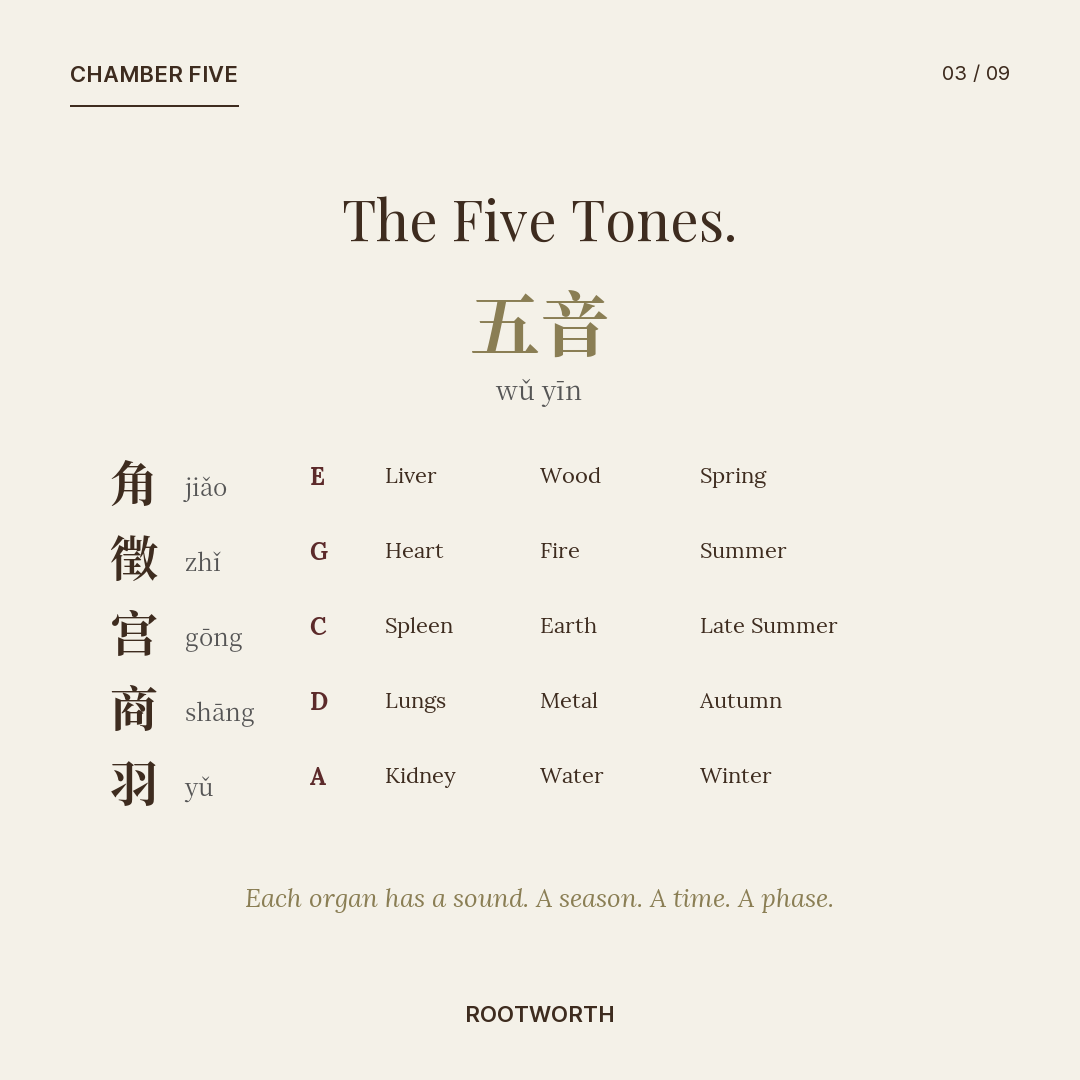
| Tone | Note | Organ | Phase | Season | Time |
|---|---|---|---|---|---|
| 角 jiǎo | E | Liver | Wood | Spring | Morning |
| 徵 zhǐ | G | Heart | Fire | Summer | Noon |
| 宫 gōng | C | Spleen | Earth | Late summer | Afternoon |
| 商 shāng | D | Lungs | Metal | Autumn | Evening |
| 羽 yǔ | A | Kidney | Water | Winter | Night |
Each organ has a sound. A season. A time. A phase.
This is not metaphor. In the Huangdi Neijing Suwen — the foundational text of Chinese medicine, compiled two thousand years ago — this system of correspondences is specific and clinical. A patient whose Liver qi was stuck might be prescribed music in the jiao mode — actual sound, played at actual frequency, used as actual medicine. The body is a tuned instrument. When the tuning is off, the music is off. When the music is off, the body is off.
The pulse is music.
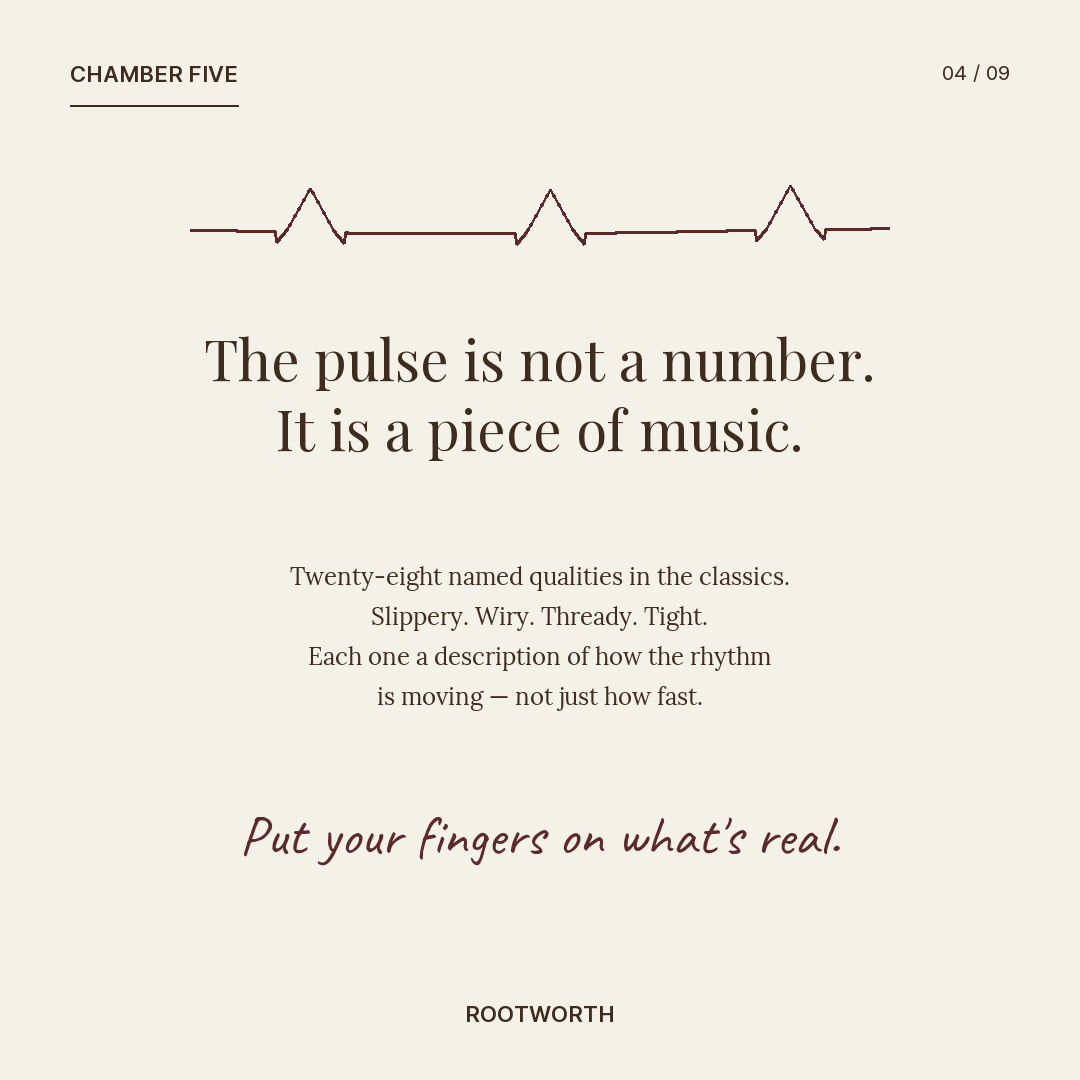
Chamber III covered pulse diagnosis in detail. Here is the addendum: the pulse is not a number. It is a piece of music. Twenty-eight named qualities — slippery, wiry, thready, tight, scattered, hidden — each one a description of how the rhythm is moving, not just how fast. A pulse is a four-dimensional object: rate, depth, width, quality. Taken at three positions on each wrist. At three depths.
A practitioner who has been reading pulses for twenty years is not counting beats per minute. They are listening to a song. The song has a tempo, yes. But it also has texture, phrasing, tension, release, moments where the rhythm grips and moments where it slides. Each of those has a name in the classics, and each of those names corresponds to a specific pattern in the body.
Put your fingers on what's real.
The organ clock 子午流注 · zǐ wǔ liú zhù
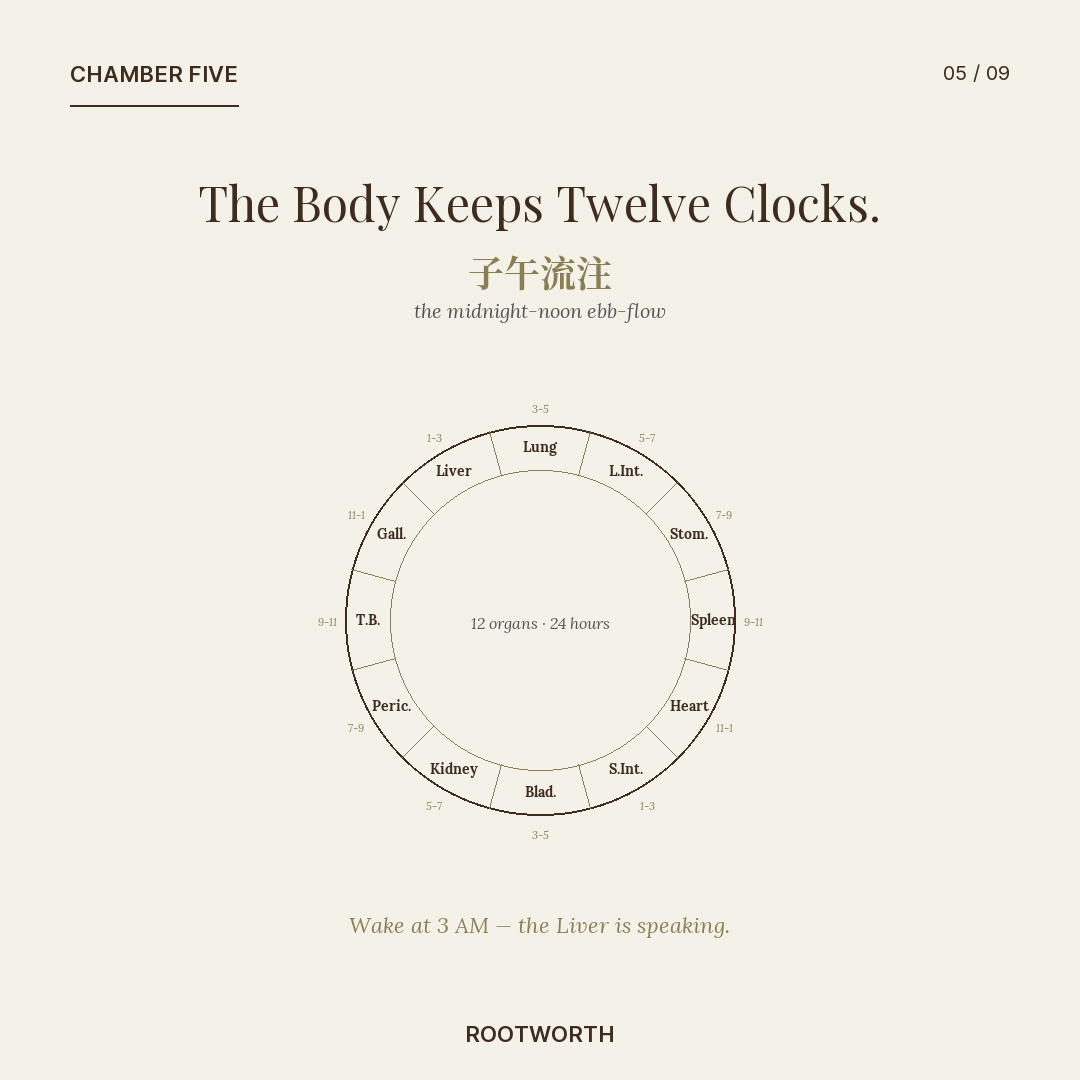
The body keeps twelve clocks. Qi peaks through each of the twelve organ systems in two-hour windows that move through the day and the night. 3–5 AM: Lung. 5–7 AM: Large Intestine. 7–9 AM: Stomach. 9–11 AM: Spleen. 11 AM–1 PM: Heart. And on through the night, each organ carrying the load in turn, until the Liver holds the last watch from 1–3 AM and hands off at dawn.
In 2017, three researchers won the Nobel Prize in Medicine for documenting the molecular machinery of circadian rhythm — the very fact that the body has internal clocks tied to genes, tied to organs, tied to time of day, tied to function. The discovery is now branded "chronobiology." The classical practitioner has been reading the same clock since before the printing press.
3 AM. 3 PM. 1 AM. — These are not malfunctions.
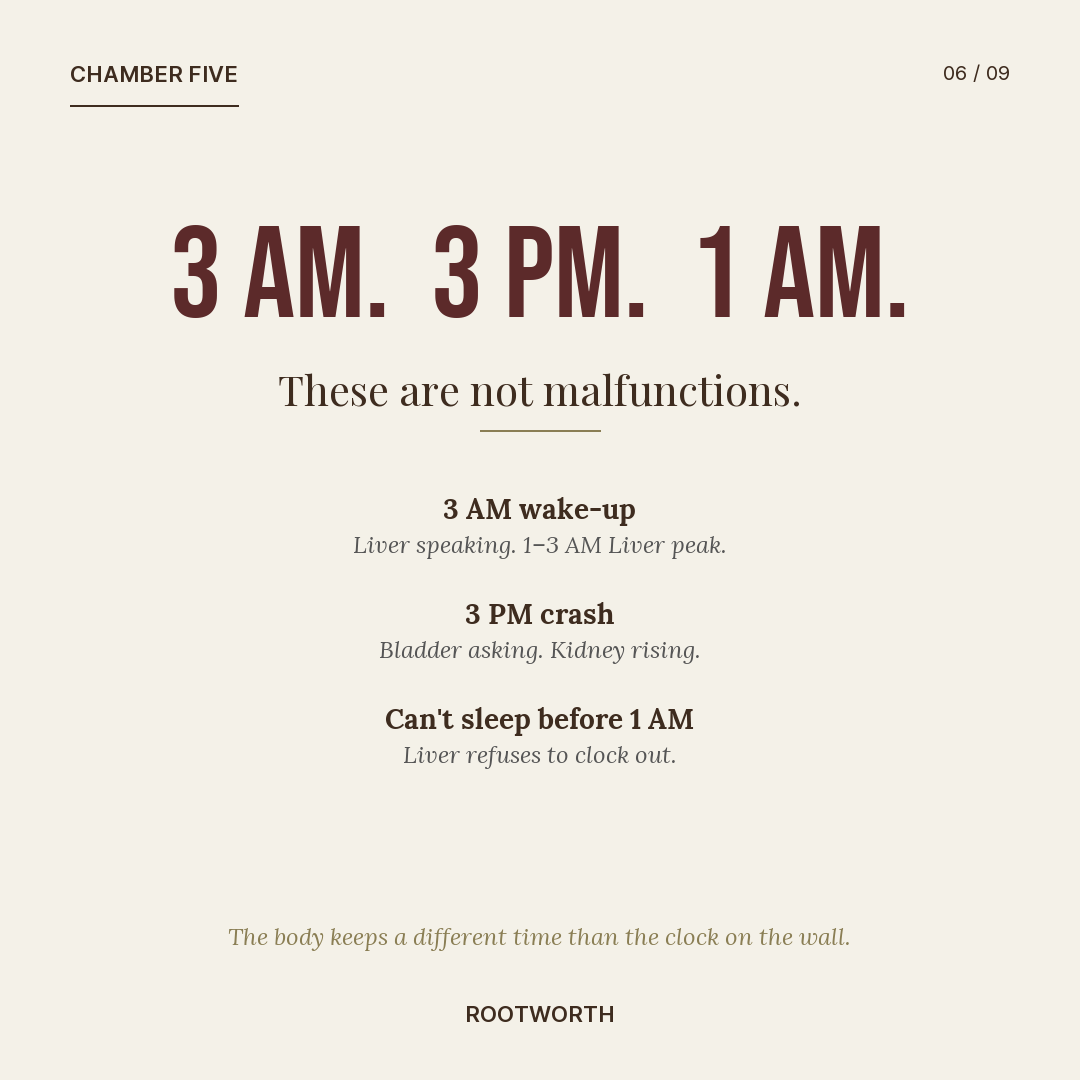
- 3 AM wake-up → Liver speaking (1–3 AM Liver peak)
- 3 PM crash → Bladder asking, Kidney rising
- Can't sleep before 1 AM → Liver refuses to clock out
These are not malfunctions. They are the body keeping time. And the body is keeping a different time than the clock on the wall. Insomnia is not a bug. It is the body telling you what hour it is running. The treatment does not force the body back onto the clock. It reads what pattern the body is in and addresses the pattern that is driving the timing.
Spirit lives in the rhythm. 神
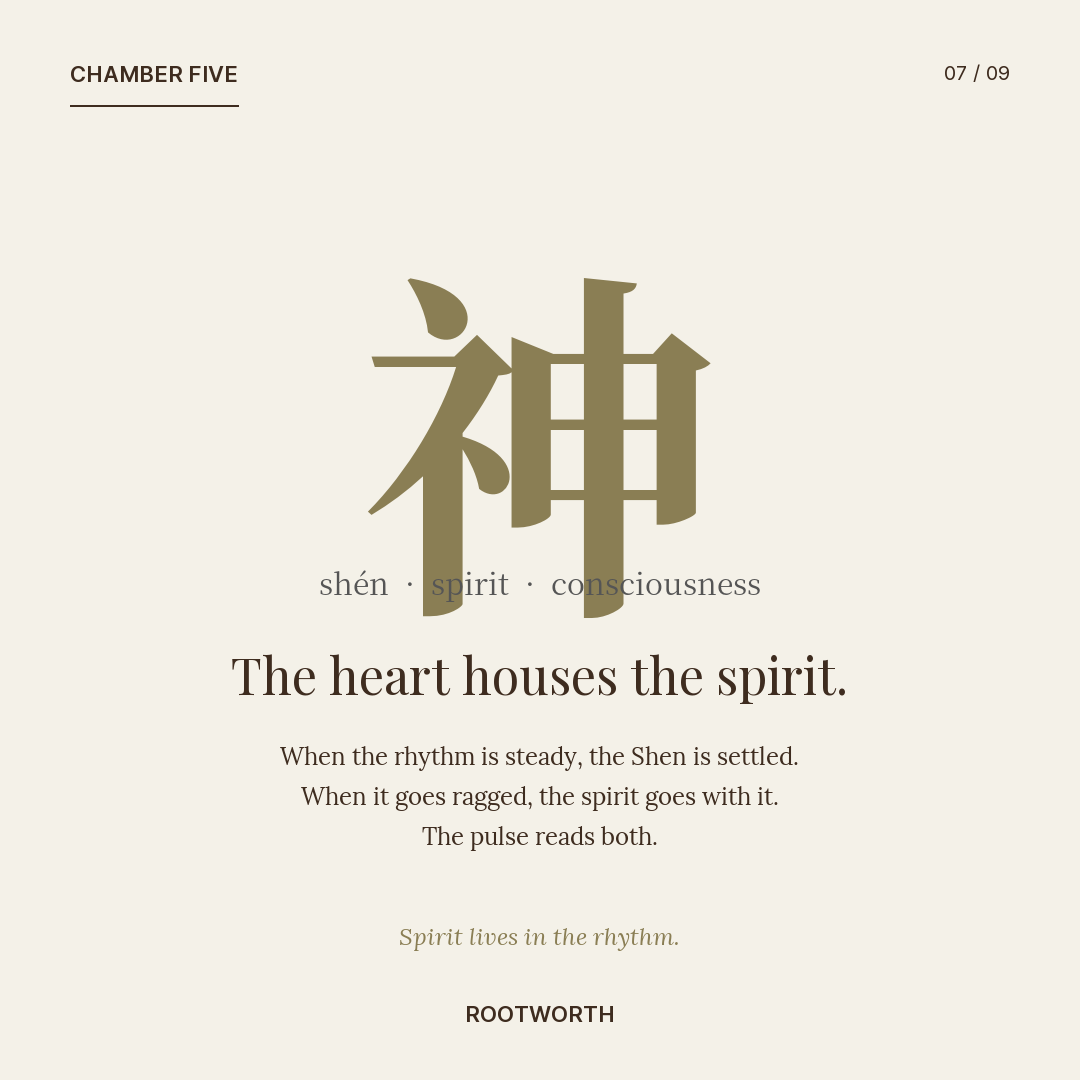
The heart houses the spirit. The character 神 — shén — means spirit, consciousness, the part of you that is awake and aware. In classical Chinese medicine, the Shen is housed in the heart. When the rhythm is steady, the Shen is settled. When it goes ragged, the spirit goes with it. The pulse reads both.
Chamber IV said the heart has a voice. This chamber says: that voice is rhythm.
This is why a practitioner can tell, in sixty seconds of intake, whether you are sleeping. Whether something happened to you that you have not told anyone yet. The pulse carries the news. The Shen is in the rhythm.
Small axe. Big tree.
Pharma sells the 24-hour pill. Same dose. Same time. Every body. Classical medicine reads this body, at this hour, in this season, with this pattern. A licensed practitioner reading a pulse is operating on information density that no algorithm has yet matched.
Healing begins when we listen to the rhythms of our bodies and the wisdom of nature.
— Michael Owende
The monopoly is the new thing. Not the medicine.
Plants, not patents. Practitioners, not algorithms. Patients, not market segments.
Your body knows.
Get back in your own time.
Real medicine has roots. Roots have rhythm.