Chamber IV
Tongue.
The tongue is the heart's voice.
Of all the surfaces the body offers to a practitioner, the tongue is the most stable diagnostic surface we have. It changes slowly enough that a pattern can be watched resolving in real time. It is the second classical diagnostic surface — paired with the pulse — and together with the intake they make the four-part reading.
The tongue is stable in a way no symptom report is. The patient may minimize, may forget, may not have words for what the body is doing. The tongue has no such problem. It has been keeping the record since before the patient walked in. It will keep keeping it until the pattern resolves.
The classical map.
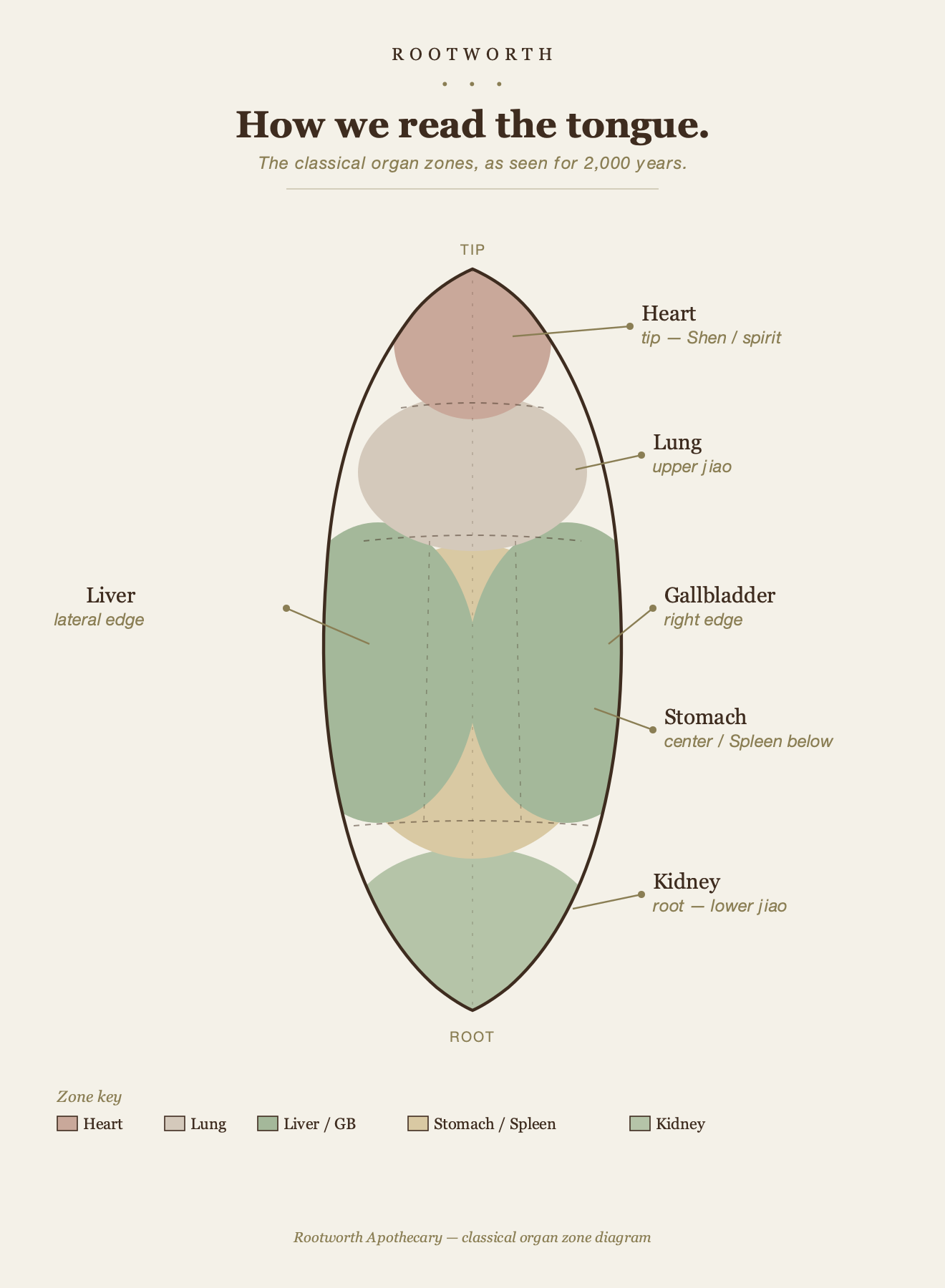
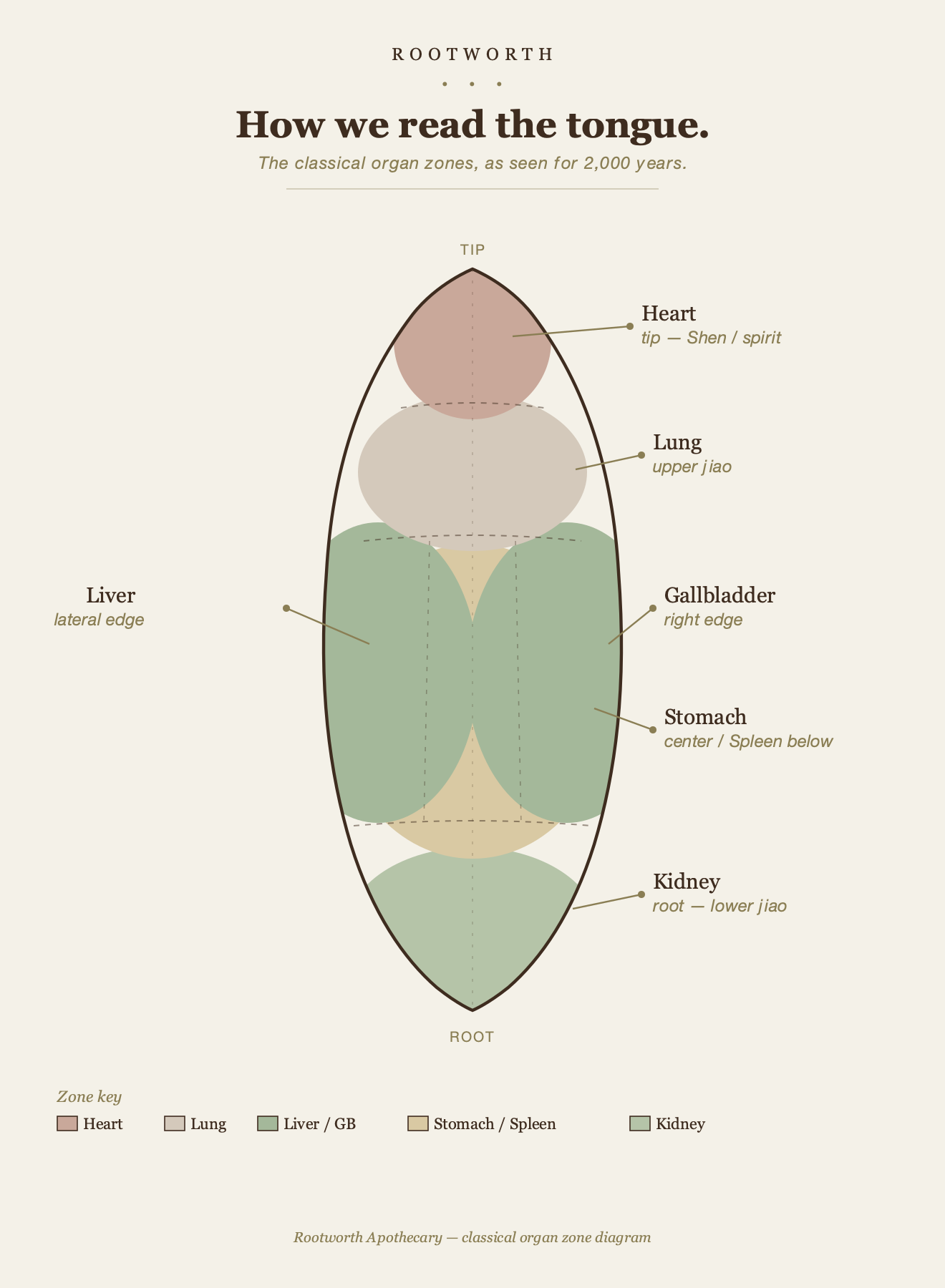
The tongue's surface is a map of the body's internal organ pattern.
- Heart 心 — at the tip
- Lungs 肺 — just behind the tip
- Liver and gallbladder 肝 · 胆 — at the sides
- Spleen and stomach 脾 · 胃 — in the middle
- Kidneys 肾 — at the root
Body and coating. Two layers. Read both.
The classical reading attends to the tongue body — its color, its shape, its moisture, its movement — and to the coating that sits on top of it. Body and coating change at different rates. Body color shifts over weeks and months; coating shifts in days or even hours, after a meal, after a fever, after a long sleep that the body needed.
A pale tongue body with thin white coating is one story. A red tongue body with thick yellow coating is another. A tongue with cracks down the center — the heart line — is a third. The map is well-documented; the reading is the practice. No two people present the same tongue at the same moment, which is why the reading cannot be automated.
The tongue does not lie. It cannot perform wellness. It cannot optimize for what the practitioner wants to see. It is the body, unedited.
What changes. What holds.
Because the tongue changes slowly, it is the chamber where the practitioner can see the arc of treatment. A tongue that was pale in March and is now gaining color in May is a tongue that is showing the formula working. A tongue whose coating thickens despite treatment is the body saying the underlying damp has not yet shifted.
This is the kind of information that does not show up in a follow-up billing code. It does not fit a checkboxes system. It is the slow-time reading of a person's body responding to medicine over months — which is, in classical practice, what treatment looks like.
The heart speaks here.
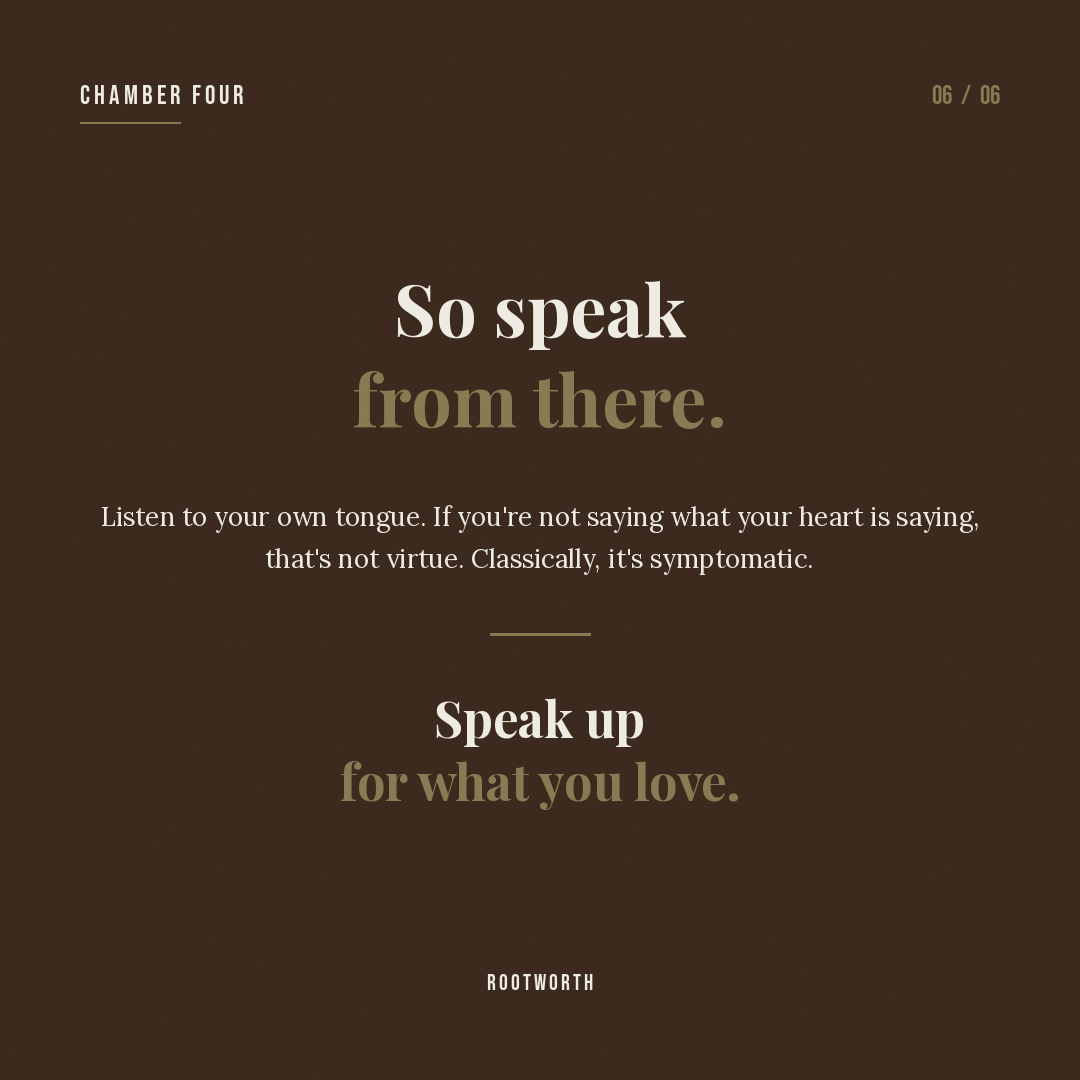
In classical Chinese medicine, the tongue is the sprout of the heart — the heart's visible voice in the body. When the heart speaks, it speaks through the tongue, both literally (the language of speech) and clinically (the tongue surface is the diagnostic field for heart pattern).
The line is also recruitment. Your heart, the reader's heart, has a voice that you have been told to ignore. The practice teaches you to listen. Not to perform health for a protocol. Not to optimize a biomarker. To listen to what the body is already saying — and to speak from there, in whatever language is available to you.
The heart has a voice. Use yours.
The heart has a voice.
舌为心之苗 (shé wéi xīn zhī miáo) — the tongue is the sprout of the heart. The classical teaching is precise: the tongue does not cause what the heart is doing. It reveals it. You read the sprout to understand the root. Color, coating, shape, cracks — each is a diagnostic window into heart qi, yin, blood, and spirit.
This logic runs across all five organ-sense pairs:
- Tongue → Heart
- Eyes → Liver
- Mouth / lips → Spleen
- Nose → Lungs
- Ears → Kidneys
This is the chamber where the clinical and the movement meet. The tongue is the heart's diagnostic surface — and the heart, in this lineage, is not just a pump. It houses the Shen, the spirit, the part of you that is awake and aware. When the heart is steady, the spirit settles. When the heart is strained, the tongue shows it.
The movement is built on the same premise: speak from the heart. Not from the script. Not from the protocol. Not from what the algorithm says. From the body, from the reading, from what is actually true about this person in this moment.
Because we must speak from our heart. Voice what we live.
Tongue diagnosis is one of two surfaces a practitioner reads. The other is the pulse — Chamber III. Together they make the body's diagnosis legible without the patient having to find the words first.