Chamber XI
What is a pattern?
Syndrome differentiation — the heart of classical diagnosis. Two patients. Same Western name. Two formulas.
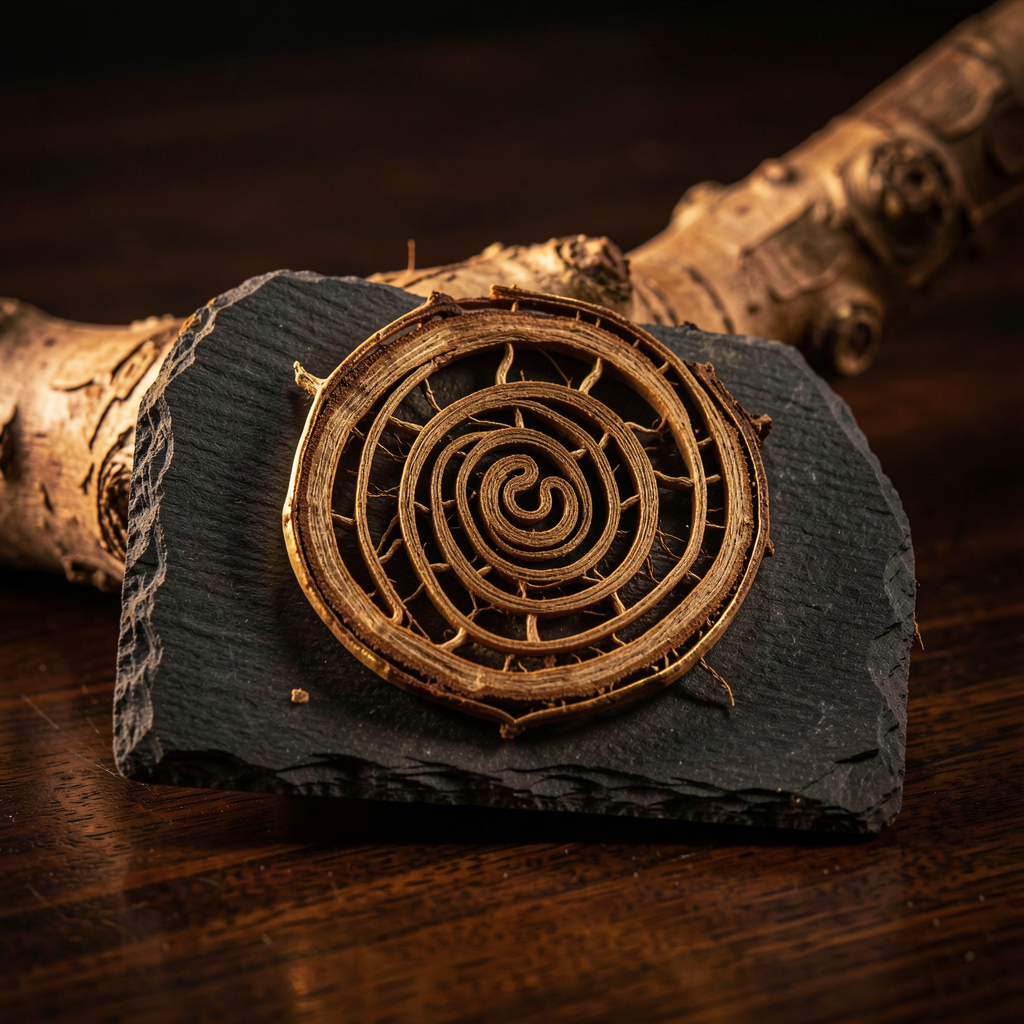
The fingerprint, not the name.
Two patients. One Western diagnosis. Two different formulas.
Patient A has insomnia. She lies awake with a racing mind, feels hot at night, sweats, and has a dry mouth. Her tongue is red with little coating. Her pulse is rapid and thin. Patient B also has insomnia. He cannot fall asleep because of rumination, wakes anxious at 3 AM, and feels cold most of the time. His tongue is pale. His pulse is wiry and thin.
Western medicine calls both insomnia. Classical Chinese medicine reads two completely different patterns. Patient A has Kidney Yin deficiency with Heart Fire disturbing the Shen. Patient B has Liver Blood deficiency with Liver Qi stagnation rising to interrupt sleep. The formulas are as different as the patterns. Giving Patient A's formula to Patient B would worsen his condition. The name does not drive the treatment. The pattern does.
The name is what the symptom is called. The pattern is what is actually happening.
Bianzheng 辨證 — differentiate the pattern, determine the treatment.
Biànzhèng lùnzhì — this is the operational center of classical diagnosis, and every previous chamber is preparation for it: the ability to look at a specific person in a specific moment and identify, from the totality of the pulse, tongue, intake, and symptoms, which pattern is present — and what that pattern requires.
A pattern is not a disease. A disease is defined by its pathology: a specific organism, a specific tissue change, a specific lab value. A pattern is defined by the dynamic state of the body: the direction of flow (upward, downward, inward, outward), the nature of what is present (heat, cold, damp, dryness, wind), the location (surface or interior, organ or meridian), and the polarity (excess or deficiency). Two bodies with the same disease will often be in different patterns. Two bodies with different diseases will often be in the same pattern.
This is the most revolutionary sentence in classical clinical medicine. It overturns the central premise of modern pharmacology: that the diagnosis determines the treatment. In classical practice, the pattern determines the treatment. The diagnosis provides context. The pattern provides direction.
The principle the classics held and modern medicine is beginning to rediscover.
The Shang Han Lun makes a statement classical practitioners have held as a clinical axiom for two thousand years: any disease, regardless of its Western name, if it presents with the hallmark symptoms of a classical conformation — treat as that conformation. It will respond.
This is not "treat the whole person" in the vague aspirational sense that phrase has come to mean. It is a specific clinical claim. A patient with cancer whose presentation matches a Taiyang pattern gets a Taiyang formula. A patient with a common cold whose presentation matches a Shao Yin deficiency pattern gets a Shao Yin formula. The pattern is the clinical center of gravity. The Western diagnosis provides the context. It does not override the reading.
Any disease, if it manifests with the hallmark symptoms of a classical pattern — treat as that pattern. It will respond. The pattern is the prescription. — ICEAM, after the Shang Han Lun
The eight parameters.
The classical practitioner reads the pattern along eight axes — the eight principles of diagnosis:
Interior / Exterior. Cold / Hot. Deficiency / Excess. Yin / Yang.
Each pair describes a dimension of the pattern. Is the disease at the surface (exterior — accessible, acute, new) or deep in the organs (interior — harder to shift, more established)? Is the nature cold or hot? Is the body's response deficient or excessive? The Yin/Yang pair is the master summary: deficient and cold and interior patterns are Yin; excess and hot and exterior patterns are Yang.
The eight parameters do not generate four categories. They generate a multi-dimensional picture that is specific to this patient, at this moment, in this season, in this life stage. Two patients can be cold and interior and deficient in entirely different ways. The differentiation within those categories — which organ, which substance, which cycle direction — is what the pulse, tongue, and intake provide.
Why pattern-centered medicine is not alternative.
Pattern-centered medicine is not a softer version of diagnosis. It is a more complete version. It takes everything the modern clinical encounter collects — history, symptoms, examination findings — and adds a layer of functional reading that biomedicine currently lacks a systematic framework for.
The pulse reads what is moving. The tongue reads what has accumulated. The intake reads what the patient has been living in. Together, these three give the practitioner a picture of the body's dynamic state that a blood panel cannot capture — because a blood panel measures the current composition of one fluid, at one moment, and reads it against a population average. A classical pattern reading measures the body's functional dynamic across time and reads it against itself.
Modern medicine is excellent at naming disease. Classical medicine is designed to read the body before the disease has a name — and after it has one. The fingerprint was always there. We never stopped reading it.
Two people. Same diagnosis. Different pattern. Different formula. That is not alternative medicine. That is medicine.
A diagnosis code is a category. A pattern is a person.
The pattern is what the body is doing. The diagnosis is what the system is calling it. Not the same thing.
The pattern is the patient. The patient is the pattern. The treatment follows from the reading.