
Classical Chinese medicine has described a pressure-and-rise pattern in the eye for centuries — long before intraocular pressure had a name. The Liver Yang framework offers a constitutional lens that conventional care does not reach.
Glaucoma carries the name “silent thief of sight” for a reason. The most common form — primary open-angle glaucoma — erodes peripheral vision so gradually that most people do not notice until significant, irreversible damage has occurred. There is no pain, no acute event, no warning flare. By the time a patient feels something is wrong, the optic nerve has already absorbed years of damage.
Conventional care responds with intraocular pressure (IOP) management — a well-validated and essential approach. But pressure management does not address every aspect of this disease, and a significant subset of glaucoma patients — those with normal-tension glaucoma (NTG) — experience progressive optic nerve damage even when IOP remains within normal range. For this group especially, the question of constitutional terrain becomes clinically relevant.
This post explores how classical Chinese herbal medicine reads the glaucoma picture — not as a replacement for conventional care, but as a parallel framework for understanding the constitutional root from which optic nerve vulnerability develops.
The Classical Teaching: Liver Governs Free Flow
肝主疏泄 — Gān Zhǔ Shū Xiè — The Liver governs free-flowing movement
This foundational classical statement organizes the entire Chinese medical understanding of pressure-related eye disease. The Liver’s primary function is the maintenance of orderly, unimpeded movement — of Qi, of Blood, of fluid, of emotional expression. When the Liver’s free-flowing function is disturbed, Qi stagnates. When stagnant Qi accumulates and transforms, it generates Heat. When that Heat and stagnant Yang have nowhere to discharge, they rise — and the eyes, which the Liver opens into (Gān Kāi Qiào Yú Mù, 肝開竅於目), are the first territory to feel that upward pressure.
This is the classical picture of Liver Yang rising — and it maps precisely onto the elevated-IOP glaucoma presentation: pressure, temporal tension, redness, and a strong correlation between emotional stress and symptom flare. The connection is not metaphorical. The Liver’s Yang-ascending dynamic is the classical correlate of the pressure-generating mechanism that conventional medicine measures in millimeters of mercury.
Three Patterns — Three Clinical Pictures
Classical herbal medicine does not treat “glaucoma” as a single entity. It reads three distinct pattern layers that may appear individually or in combination:
Liver Yang Rising (Gān Yáng Shàng Kàng, 肝阳上亢)
The primary pattern for elevated IOP. Liver Yang, unchecked by sufficient Yin to anchor it, surges upward. The eyes register this as pressure, redness, and temporal headache. Stress, anger, and emotional suppression are the classic triggers. These patients often notice that their eye symptoms correlate directly with difficult periods — the IOP spike follows the argument, the difficult week at work, the months of sustained pressure. The constitutional picture includes a tendency toward irritability, facial flushing, headache at the temples or crown, and a constitution that runs warm rather than cold.
Liver Qi Stagnation Converting to Heat (肝气郁结化火)
When Liver Qi stagnates over time — from chronic emotional constraint, prolonged stress, or a life pattern that suppresses rather than expresses — the stagnant Qi does not stay static. It transforms into Heat. This Heat ascends along the Liver’s natural upward trajectory and generates variable IOP spikes. Clinically, these patients often report pressure readings that fluctuate significantly with their life circumstances. The distinction from pure Liver Yang rising is one of chronicity and depth: Qi stagnation with Heat tends toward more variable, reactive presentations; Liver Yang rising is more constitutionally established.
Kidney Deficiency with Normal-Tension Glaucoma (Shèn Xū, 腎虛)
Normal-tension glaucoma — where the optic nerve degenerates despite normal IOP — points toward the Kidney root. The Kidney governs the deep constitutional Essence (Jing, 精) that nourishes the most metabolically demanding tissues of the body. The optic nerve, with its extraordinarily high energy requirements, is among the most Jing-dependent structures we encounter in classical practice. When Kidney Essence is depleted — through age, chronic illness, or constitutional insufficiency — the optic nerve loses its deep nourishment, independent of pressure. This is a fundamentally different clinical picture requiring a different herbal strategy: not Liver Yang-descending, but Kidney Essence-building and Yin-nourishing.
Illustrative Herbs: The Liver Yang Family
The following herbs are illustrative examples of the classical categories used for the Liver Yang glaucoma picture. They are examples of how classical herbal logic addresses this pattern — not a formula prescription, which requires individual pattern diagnosis.
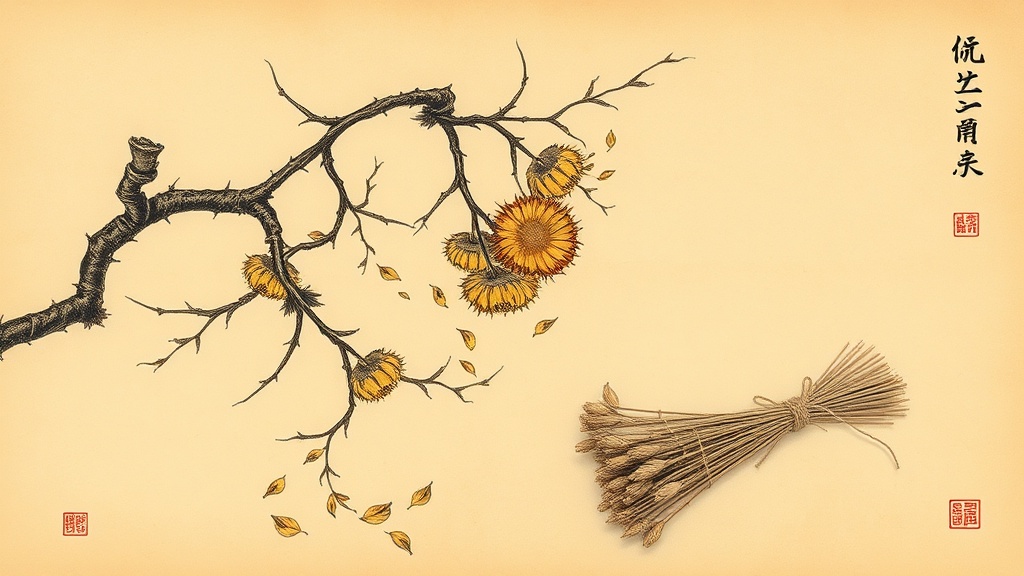
- Gou Teng (Gōu Téng, 釣藤) — the hooks-and-thorns vine (Uncariae Ramulus cum Uncis); the primary classical herb for anchoring Liver Yang and descending the upward-surging pressure dynamic; its curved hooks give it the classical quality of “pulling down” what has risen above
- Ci Ji Li (Cì Jí Lí, 刺蒺藜) — tribulus; calms the Liver and brightens the eyes; used for the stress-IOP connection and for Liver Qi stagnation that has begun converting to Heat; a gentler Liver-calming agent that pairs well with stronger Yang-descending herbs
- Ju Hua (Jú Huā, 菊花) — chrysanthemum; the classical “eye herb”; clears Liver Heat and brightens the eyes; cools the upward-moving Yang dynamic with gentle cooling action without draining the root
For the Kidney deficiency / normal-tension picture, the herbal strategy shifts entirely — toward Kidney Essence-building and Yin-nourishing categories that support the constitutional root from which optic nerve function draws. The formula design follows the pattern, not the diagnosis name.
The Functional Medicine Layer: Two Converging Categories
Classical pattern diagnosis and functional medicine read the same terrain from different entry points. For the glaucoma picture, two functional-medicine spheres are clinically relevant:
- Microvascular perfusion category — optic nerve blood flow is compromised in both elevated-IOP and normal-tension glaucoma. The optic nerve head depends on adequate microvascular perfusion for its metabolic function. This sphere addresses the vascular delivery layer — particularly relevant for the NTG picture where the Kidney root deficiency manifests as inadequate constitutional blood-flow to the deepest visual structures.
- Antioxidant capacity category — the optic nerve head is metabolically active and correspondingly vulnerable to oxidative stress. Supporting the body’s antioxidant capacity at the level of neural tissue addresses the oxidative component of optic nerve degeneration — a layer that neither pressure-lowering medications nor herbal Liver-Yang-descending formulas address directly.
In the Rootworth intake, these functional spheres are addressed through the same pattern-diagnosis lens as the herbal formula. The pattern identifies which functional sphere is most compromised; the intake addresses both the classical root and the functional terrain layer as a single integrated picture.
A Note on Safety and Conventional Care
Classical herbal medicine does not replace IOP-lowering medications or ophthalmologic monitoring. If you are being treated for glaucoma, continue all prescribed care. The classical herbal approach addresses the constitutional root pattern — the Liver Yang axis and the Kidney deficiency terrain that contribute to optic nerve vulnerability — as a parallel layer alongside conventional pressure management, not instead of it.
Glaucoma is a condition where consistent ophthalmologic follow-up is not optional. IOP monitoring, visual field testing, and optic nerve imaging are the clinical tools that track disease progression. Classical herbal medicine has no substitute for these assessments. What it offers is a different layer of constitutional support for the terrain in which glaucoma develops — and an honest engagement with a patient’s full clinical picture that conventional care does not always have time to explore.
Begin your pattern assessment
A note on these statements
These statements have not been evaluated by the Food and Drug Administration. These products are not intended to diagnose, treat, cure, or prevent any disease. Classical Chinese herbal medicine and functional medicine supplements are offered as part of a pattern-based intake process, not as treatments for diagnosed medical conditions.