
The macula is the most metabolically demanding tissue in the eye. When it fails, classical Chinese medicine asks a question that the scan cannot answer: what constitutional terrain made this particular eye, in this particular person, vulnerable to that failure?
Age-related macular degeneration arrives slowly for most people. The central vision blurs. Straight lines bend. Reading becomes effortful. The diagnosis is confirmed by imaging, and the clinical conversation that follows is often shorter than patients expect: monitor it, take a specific antioxidant combination if your category warrants it, return for injections if it converts to wet. There is not much more conventional care offers for the dry form — the slow, atrophying condition that accounts for the majority of AMD cases.
Classical Chinese medicine does not compete with that assessment. It adds a different layer of inquiry: the constitutional terrain that organized the vulnerability. Two people in their seventies can both develop dry AMD — but their patterns, and therefore their formulas, will be different. The formula follows from the pattern, not the diagnosis. This distinction is the beginning of individualized herbal care for macular degeneration.
The Kidney governs Essence — and Essence governs the macula
腎主精 — Shèn Zhǔ Jīng — The Kidney governs Essence
Kidney Essence (Jīng, 精) is the constitutional reserve — the deepest fuel that powers structural integrity throughout the body. In Chinese medicine, the retinal pigment epithelium — the cell layer that sustains the photoreceptors and whose deterioration defines dry AMD — is exactly the kind of tissue that draws on Kidney Jing as its constitutional substrate. It is deep, structural, metabolically demanding, and non-regenerating. When the Essence that nourishes it depletes faster than it can be supported, the tissue atrophies.
This is the Jing-depletion cascade. It does not begin at the eye. It begins in the constitutional reserve — in the decades of accumulated depletion through overwork, inadequate rest, chronic stress, and a body that has been running on its reserves for too long. The eye, as the most metabolically demanding and precisely calibrated tissue in the body, is often among the first structures to show the signs of that depletion. The AMD diagnosis is the visible end of a long upstream story.
The constitutional herbal approach addresses that story at its root — not by reversing what has already atrophied, but by providing the Jing-Blood terrain with what it needs to nourish the retinal tissue that remains, and to slow the pace at which the depletion continues.
Dry AMD: the Liver-Kidney Yin deficiency picture
Dry AMD is, in classical terms, a Liver-Kidney Yin deficiency (Gān Shèn Yīn Xū, 肝腎陰虛) pattern in most presentations. The Liver Blood that nourishes the retina is insufficient; the Kidney Essence that underpins the RPE layer is depleted. The result is a slowly progressive, structural atrophy — exactly what AMD imaging reveals.
The presentation is recognizable in the classical intake beyond the eye symptoms: the gradual fatigue that arrives earlier than it used to, the dryness — dry mouth, dry eyes, dry skin — that reflects insufficient Yin across the system, the low back that aches from the Kidney deficiency pattern, the thin-pale tongue and the weak, slightly thin pulse in the deep positions. The eye is the visible expression of a whole-system pattern. The formula addresses the whole system.
The herbal category for this pattern is Yin-nourishing and Essence-building: herbs that replenish the fluid-substance and constitutional reserve, directed toward the Liver and Kidney channels. Three herbs that classically exemplify this category — offered here as illustrative examples of what the formula may draw from, not as a prescription:
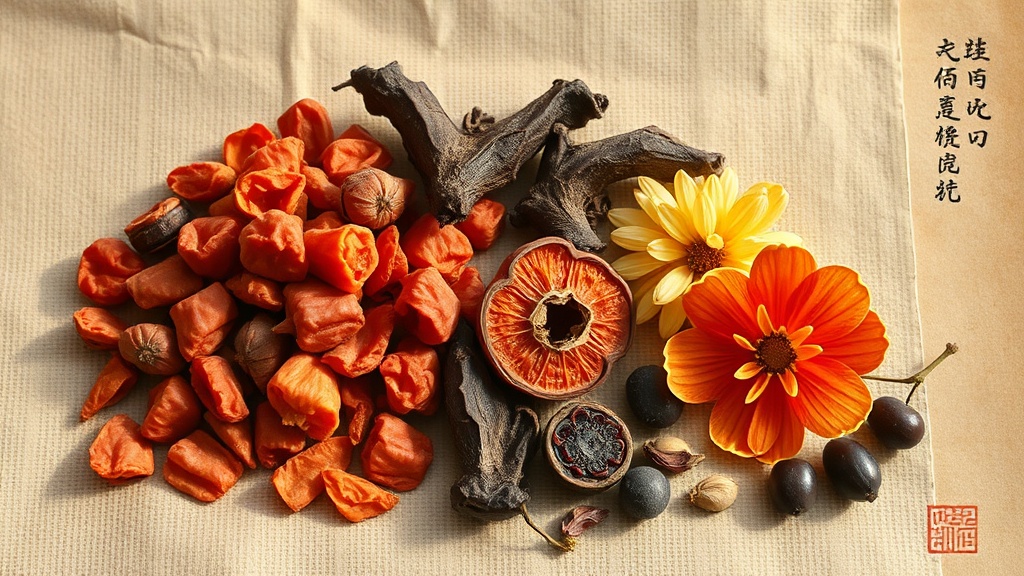
- Gou Qi Zi (Gǒu Qǐ Zǐ, 枸杞子) — wolfberry: The classical “brightens the eyes” tonic, nourishing both Liver and Kidney Yin simultaneously. Modern botanical analysis has identified Gou Qi Zi as the richest known food source of zeaxanthin — the primary macular carotenoid pigment. Classical medicine mapped the clinical connection centuries before the biochemistry was described.
- Nu Zhen Zi (Nǚ Zhēn Zǐ, 女贞子) — ligustrum berry: A Liver-Kidney Yin tonic that appears in virtually every formula for age-related visual decline. Classical texts cite it for visual dimness in deficiency patterns; contemporary botanical research points to its anthocyanin content and its protective activity at the level of the retinal tissue.
- Ju Hua (Jú Huā, 菊花) — chrysanthemum flower: The classical “eye herb” — included in nearly every eye formula as a directional envoy and brightening agent. Clears Liver and brightens the visual field; gently addresses the mild ascending-Yang component that often accompanies chronic Liver Yin deficiency.
Wet AMD: when Blood stasis enters the picture
Wet AMD adds a second pattern layer to the Liver-Kidney Yin deficiency root: Blood stasis in the retinal collaterals (Xuè Yū, 血瘀). The pathological neovascularization that defines wet AMD — the fragile, leaking new vessels that form under the macula — reflects what classical texts describe as Blood that has left its proper channels (Lí Jīng Zhī Xuè, 離經之血). The Yin-deficient terrain is desiccated; Blood thickens and stagnates; the body’s attempt to compensate produces vessels that are architecturally inadequate and prone to hemorrhage.
For wet AMD, the herbal formula adds a Blood-moving, collateral-opening category layer to the Yin-nourishing foundation. This is not a dramatic shift in direction — it is a refinement of the same formula, adding the herbs that move and clear without damaging the Blood-Yin substrate that the foundational herbs are building. The art of formula design in this picture is exactly that balance: nourish the root, move the stasis, do not exhaust what remains.
The formula is always adjusted as the pattern shifts across the course of treatment. Wet AMD can and does transition through active and quiescent phases; the formula tracks those changes.
The functional terrain spheres: what the supplement layer addresses
The classical herbal formula addresses the constitutional root. Pattern-matched functional terrain support addresses the upstream environmental and physiological drivers that the classical pattern identifies. For AMD, three spheres are most consistently relevant:
- Macular carotenoid antioxidant sphere: The macular pigment layer is the eye’s primary defense against light-induced oxidative stress — the ongoing photodamage that accumulates across decades and contributes to RPE deterioration. This sphere addresses the carotenoid and polyphenol class of terrain support. It maps directly to the Liver-Wood sphere in classical terms: the same constitutional layer that Gou Qi Zi nourishes in the herbal formula.
- Microvascular perfusion sphere: The retinal circulation is the most delicate microvascular bed in the body. Both dry AMD (gradual ischemic component to RPE loss) and wet AMD (pathological neovascularization) have a microvascular dimension. This sphere supports circulation and capillary integrity through the category of agents that address the Heart-Fire sphere — the governance of the vessels.
- Neuro-optic mitochondrial sphere: The retinal ganglion cells and photoreceptors are high-energy, non-regenerating neurons. Their mitochondrial function is the neurological layer that corresponds to Kidney Essence — the deep energy substrate of structural integrity. This sphere supports neuronal energy metabolism and the mitochondrial health of the retinal tissue. For AMD, this is the sphere that addresses the constitutional energy dimension that the herbal formula approaches from the Jing-building side.
The intake identifies which spheres are most compromised in a given patient. The combination of the herbal formula’s constitutional depth and the terrain-support layer’s functional precision is the two-layer treatment model.
What the formula can and cannot do
No formula reverses AMD. The constitutional framework supports the Jing-Blood terrain that nourishes remaining retinal tissue and may address the stasis patterns that drive wet progression. It does not regenerate retinal pigment epithelium that has already atrophied. It does not replace anti-VEGF intervention for active wet AMD. It does not substitute for ongoing monitoring with your retinal specialist.
What it does: it addresses the constitutional terrain that made the eye vulnerable. It nourishes the system from which the macula draws. It may slow the pace of a pattern that is, in classical terms, a depletion cascade — one that does not stop unless the root is addressed, and one that is, to some meaningful degree, addressable through the herbs and the terrain support that classical medicine has organized for exactly this picture.
The formula is a living clinical relationship with a pattern. It changes as the pattern changes. It is not a supplement stack. It is a constitutional intervention, individualized from the intake, sustained over the course of treatment, and tracked for clinical response.
Begin your pattern assessment
A note on these statements
These statements have not been evaluated by the Food and Drug Administration. These products are not intended to diagnose, treat, cure, or prevent any disease. Classical Chinese herbal medicine and functional medicine supplements are offered as part of a pattern-based intake process, not as treatments for diagnosed medical conditions.