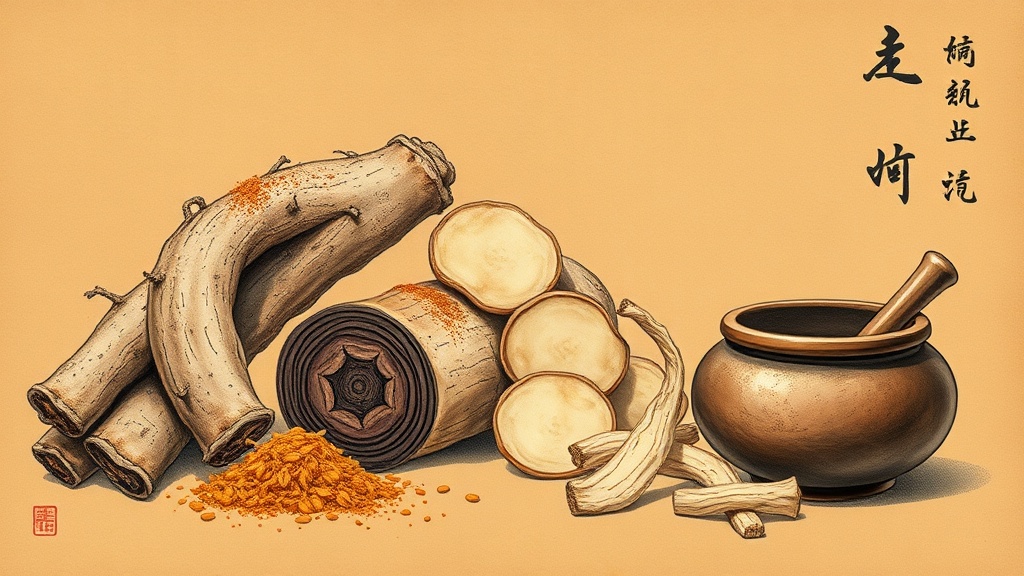

Classical Chinese medicine mapped the metabolic terrain of diabetes — the wasting-thirsting disorder — long before ophthalmoscopes existed. The retinal consequences were written into the framework. Understanding them is the first step toward a coherent herbal response.
Xiao Ke: The Classical Chinese Framework for Metabolic Disease
More than a thousand years before the discovery of insulin, classical Chinese physicians recognized a pattern of metabolic dysregulation they called Xiāo Kě (消渴) — the wasting-thirsting disorder. Literally, “wasting and thirsting”: the body consumed its own substance, fluids were chronically depleted, and the person ate and drank without apparent nourishment taking hold.
Xiao Ke is the classical parallel to what modern medicine calls diabetes mellitus. The framework is not metaphorical — it is a precise constitutional map. The classical physicians identified three centers of the disorder: the upper (Lung — excessive thirst), the middle (Stomach — excessive hunger), and the lower (Kidney — excessive urination). At the root of all three sits Kidney Yin deficiency (Shèn Yīn Xū, 腎陰虛): the deep fluid-substance of the body, depleted, can no longer anchor the metabolic fire. The result is wasting.
What the classical framework also recognized — and this is the observation that makes it directly relevant to diabetic retinopathy — is that Xiao Ke does not remain a constitutional pattern in isolation. Over time, it enters the vessels.
When Xiao Ke Enters the Collaterals
消渴日久,必有瘀血 — Xiāo Kě rì jiǔ, bì yǒu yū xuè — “In chronic Xiao Ke, there will be Blood stasis.”
This classical clinical observation is one of the most precise statements in the Chinese medical literature on the progression of metabolic disease. The mechanism is clear from within the framework: when Kidney Yin is deficient over a long period, the Blood loses its fluid substrate; it becomes thick and viscous, moving sluggishly through the peripheral vessels. When Qi — the force that drives Blood movement — is also deficient (a common secondary development in long-standing Xiao Ke), movement through the smallest vessels slows further. Stasis forms in the collaterals (Luò Mài Xuè Yū, 络脉血瘀).
The retinal vasculature is part of this collateral network. In Chinese medicine, the collaterals are the finest, most peripheral branches of the channel system — the capillary level. When stasis forms here, the clinical picture is micro-hemorrhage, microaneurysm, and ischemic changes. Western ophthalmology calls this diabetic retinopathy. Classical medicine calls it Blood stasis in the retinal collaterals — a predictable progression of long-standing Xiao Ke.
There is also a third layer in many patients: Spleen Qi deficiency (Pí Qì Xū, 脾气虚) generating Dampness. When the Spleen’s transformative function is impaired by the chronic constitutional depletion, pathological Dampness accumulates. This turbid, sticky pathogen contributes to the “thickness” of the blood and mirrors the inflammatory and lipid-dysregulation picture of metabolic syndrome — the same clinical terrain that makes retinal vascular disease more aggressive.
A Two-Layer Herbal Approach
The herbal framework for diabetic retinopathy follows directly from this three-pattern analysis. The clinical logic requires two coordinated layers:
Layer one: Kidney Yin-nourishing and Qi-tonifying herbs address the Xiao Ke constitutional root. Without addressing this layer, the conditions that generate Blood stasis in the collaterals continue unchecked. These herbs restore the fluid substrate from which healthy Blood is made, support the Spleen’s role in Qi generation, and reduce the Dampness accumulation that compounds the vascular picture. This is the constitutional foundation of the formula.
Layer two: Blood-moving and collateral-opening herbs address the local retinal stasis pattern. These herbs do not generate Qi or nourish Yin — they move what is already there, clearing the obstructed collaterals and restoring normal flow to the retinal microvasculature. The classical principle holds that moving the stasis without replenishing the root will exhaust the Blood; therefore both layers must be present in the formula, calibrated to the relative prominence of each pattern in the individual.
The specific classical base formula and its modifications are not generalizable here — they depend on the patient’s precise pattern, constitution, tongue, pulse, and stage of the condition. What follows are illustrative herbs from each category:
Illustrative herbs from the Blood-moving and collateral-opening category:
- San Qi (Sān Qī, 三七) — notoginseng — is the classical herb for “blood in the collaterals.” Its defining quality is the ability to move Blood stasis without exhausting the Blood — a critical distinction when the patient’s constitutional substrate is already depleted by Xiao Ke. Classical texts place it first among herbs for internal hemorrhage within the vessel wall.
- Dan Shen (Dān Shēn, 丹参) — salvia miltiorrhiza — activates Blood and removes stasis; it cools and moves simultaneously, addressing the Heat that chronic stasis generates in the vessels. It is one of the most thoroughly researched herbs in the context of retinal and cardiovascular microcirculation.
Illustrative herbs from the Qi-tonifying and constitutional root category:
- Huang Qi (Huáng Qí, 黄芪) — astragalus — tonifies central Qi, strengthens the Spleen’s transformative function, and is classically described as stabilizing the vascular membrane — the “exterior” of the vessels. It drives the Qi necessary to move Blood through the peripheral collaterals and addresses the metabolic Spleen-Qi layer of the DR pattern simultaneously.
What Classical Medicine Does — and Does Not — Claim Here
The Xiao Ke framework does not claim to replace blood glucose management. It has never made that claim. What it offers is a constitutional reading of why the retinal vasculature was vulnerable — what was already insufficient in the terrain before the microvascular damage became visible — and a herbal approach that addresses both the metabolic root and the local Blood stasis consequence.
Functional medicine adds a parallel layer: addressing retinal antioxidant capacity (the oxidative stress burden on the retinal pigment epithelium is among the highest of any tissue in the body) and microvascular perfusion (capillary integrity, blood viscosity, endothelial function). These categories of support are addressed through pattern-matched supplementation — at the category level, without fixed-dose protocols — as part of the same intake process that identifies the classical herbal pattern.
The two frameworks are not redundant. They read different layers of the same system. The classical formula addresses the constitutional root. The functional supplement tier addresses the upstream environmental and metabolic terrain drivers. Together, they provide a more complete picture than either alone.
The non-negotiable core: Managing blood glucose through conventional medicine, diet, and lifestyle is the primary intervention for diabetic retinopathy. Herbal medicine and functional support work alongside these — not instead of them. Regular ophthalmologic monitoring is an essential part of care that classical herbal medicine does not replace.
Begin your pattern assessment
A note on these statements
These statements have not been evaluated by the Food and Drug Administration. These products are not intended to diagnose, treat, cure, or prevent any disease. Classical Chinese herbal medicine and functional medicine supplements are offered as part of a pattern-based intake process, not as treatments for diagnosed medical conditions.