
The eye bears the brunt of Liver Fire because Fire ascends, and the Liver opens to the eye. Understanding why uveitis keeps returning begins with that classical teaching — and what it reveals about the root pattern beneath each flare.
Important: Acute uveitis is a medical emergency. Sudden-onset eye redness, pain, photophobia, or unexplained visual changes require immediate evaluation by an ophthalmologist. Untreated intraocular inflammation can cause permanent, irreversible vision loss — from cataracts, secondary glaucoma, macular edema, and optic nerve involvement. Classical herbal medicine addresses the constitutional root pattern that drives recurrence; it is not a substitute for acute ophthalmologic treatment.
Uveitis is inflammation of the uvea — the middle vascular layer of the eye, comprising the iris, ciliary body, and choroid. In its most common anterior form (iritis), the onset is acute and unmistakable: sudden redness, significant pain, photophobia, and blurred vision. In chronic and recurrent forms — particularly in patients with HLA-B27 association, inflammatory bowel disease, sarcoidosis, or underlying autoimmune conditions — it becomes a different kind of burden: flares that are managed medically, but keep returning. Each episode brings risk. Over time, the cumulative damage accumulates.
The classical question is never only “what is causing this episode?” It is “what is producing a body that keeps generating these episodes?” That is the constitutional question, and it is where classical Chinese herbal medicine has its clinical jurisdiction.
Fire by Nature Ascends
火性炎上 — Huǒ Xìng Yán Shàng — “Fire by nature ascends.”
This classical statement organizes the entire ophthalmological Fire pattern in Chinese medicine. Fire rises — to the face, to the sense organs, to the eye. And the eye is uniquely exposed to that ascent because the Liver (Gān, 肝), the organ most prone to Fire pathology in classical theory, opens directly to the eye. This relationship — Gān Kāi Qiào Yú Mù (肝開竅於目), “the Liver opens to the eyes” — is the foundational organizing principle of classical Chinese ophthalmology.
When Liver Qi fails to flow smoothly — through emotional suppression, chronic stress, constitutional Heat, or accumulated frustration — it transforms into Fire. That Fire ascends to its organ: the eye. The redness is Heat flooding the Blood vessels. The photophobia is Fire’s intolerance of stimulation. The pain is Qi obstructed by Heat, pressing against the structures of the eye. Acute uveitis, in this framework, is Liver Fire arriving at the Iris — the Wind Wheel (Fēng Lún, 風輪), the Liver’s anatomical domain in the classical five-region map of the eye.
This is not decorative framing. It is a clinical map that locates the root of the condition — and a map points toward where treatment should begin.
Three Pattern Layers in Uveitis
Liver Fire Ascending (Gān Huǒ Shàng Yán, 肝火上炎) — the Acute Phase
The acute, full-expression picture. Sudden, intense, unmistakable redness. Marked photophobia. Tearing. Periorbital pain that is deep and aching rather than superficial. Liver Fire in full manifestation leaves little interpretive ambiguity — the intensity of the presentation matches the intensity of the Fire pattern.
The constitutional picture often reveals a precipitating pattern: significant stress, protracted frustration or anger, a period of emotional suppression, or exposure to external Heat. The Liver Qi, obstructed by the emotional burden, has transformed and risen. This pattern is most common in first-episode acute anterior uveitis and in patients whose recurrences track with high-stress periods.
Clinically, Liver Fire is the most tractable of the three patterns — Fire-clearing herbs act with relative speed when the pattern is clear and the Yin substrate is not yet significantly depleted. The challenge is not treating this episode. It is addressing the constitutional terrain that produces the next one.
Damp-Heat in the Middle Jiao (Zhōng Jiāo Shī Rè, 中焦湿热) — the Chronic Recurrent Layer
The persistent, smoldering picture. This is the pattern most closely associated with chronic recurrent uveitis — particularly in patients with HLA-B27 association, inflammatory bowel disease, or a metabolic-syndrome-adjacent constitutional profile. Dampness (Shī, 湿) and Heat (Rè, 热) combine in the digestive sphere and establish a chronic inflammatory substrate. “Dampness clings where Fire cannot resolve” is the clinical teaching: Heat cannot fully clear because the Dampness holds it, and the substrate remains — dense, humid, Heat-laden — available to produce the next inflammatory episode.
These patients are recognizable systemically: digestive irregularity, heaviness after eating, a thick and greasy tongue coating, fatigue that deepens after meals. The uveitis is one expression of a wider Middle Jiao Damp-Heat picture that extends beyond the eye. Treating only the eye-level inflammation without addressing the Damp-Heat substrate leaves the engine of recurrence intact.
Yin Deficiency with Empty Heat (Yīn Xū Nèi Rè, 阴虚内热) — the Root Depletion
The background pattern that converts acute episodes into a chronic condition. When Yin (Yīn, 陰) — the cooling, nourishing, fluid dimension of the body’s physiology — is depleted, Heat has no opposition. It rises not because it is in excess, but because it is unanchored. “Fire without fuel burns hotter and longer” captures the clinical picture: smoldering, persistent, low-grade inflammation that lacks the dramatic acuity of full Liver Fire but is more exhausting precisely because it never fully resolves.
This pattern is common in patients with long-standing recurrent uveitis, in older patients with constitutional Yin depletion, and in those who have been on chronic immunosuppressive regimens that further exhaust the Yin substrate. The presentation is subtler — less acute redness, more chronic dryness, nighttime heat sensations, a quality of deep fatigue and depletion. The treatment priority here shifts fundamentally: Yin nourishment becomes the primary action, and Fire-clearing becomes secondary and gentler, applied from within an enriched substrate rather than against a background of further depletion.
Classical Herbs for the Uveitis Pattern Spectrum
The herbal approach to uveitis is pattern-specific, not condition-specific. A patient in the acute Liver Fire picture receives a formula centered on Fire-clearing and Heat-draining herbs. A patient in the Yin deficiency background requires a formula where Yin nourishment is the primary architecture and Fire-clearing is secondary. These are meaningfully different prescriptions — what is appropriate in one pattern can be actively inappropriate in another. The following herbs illustrate the categories involved; they are examples, not a prescribable list.
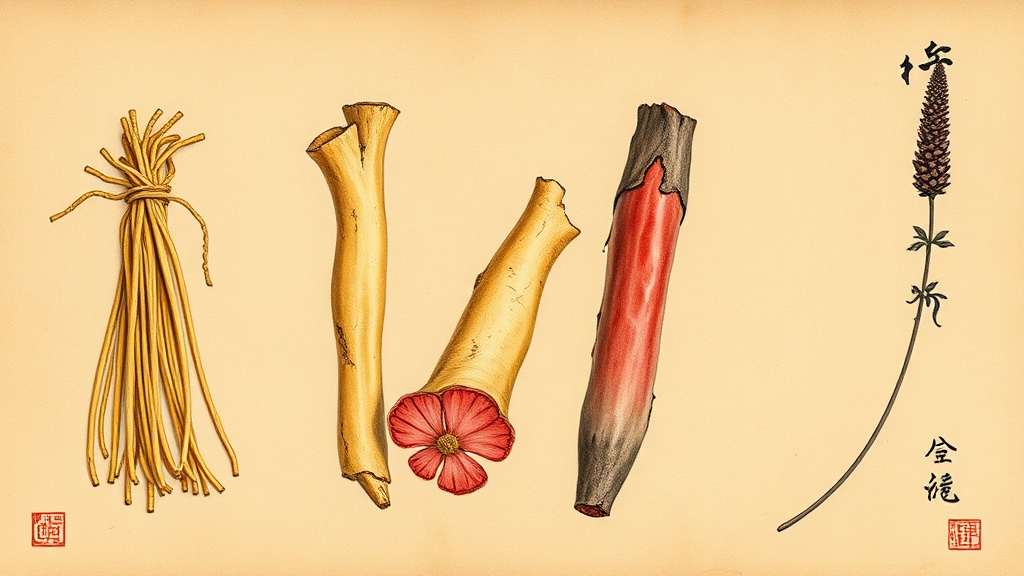
- Long Dan Cao (Lóng Dǎn Cǎo, 龙胆草) — gentian root; the preeminent Liver-Fire-clearing herb in the classical materia medica; strongly bitter and cold; classical description: “drains Fire from the Liver and Gallbladder through the lower path”; indicated in the acute, full-Heat Liver Fire presentation; not appropriate as a sustained constitutional herb — its bitter cold action is for clearing, and cold accumulation is a concern in longer-term use without careful pattern matching
- Huang Qin (Huáng Qín, 黄芩) — scutellaria root; clears Heat and dries Dampness; extends the formula’s reach from the pure Liver Fire picture into the Damp-Heat Middle Jiao pattern; the pairing of Long Dan Cao and Huang Qin addresses both pattern layers simultaneously in appropriate presentations
- Chi Shao (Chì Sháo, 赤芍) — red peony root; cools the Blood and resolves Blood stasis; the uveal tract is the most vascular structure in the eye, and active intraocular inflammation generates a Blood-layer component as it resolves; Chi Shao addresses both the cooling dimension and the stasis-resolving dimension of the vascular inflammatory picture
- Xia Ku Cao (Xià Kū Cǎo, 夏枯草) — prunella spike; classical for Liver Yang and Liver Fire presentations affecting the eye; clears Heat, dissipates nodular accumulation, and carries a specific tradition of use in inflammatory eye conditions that overlaps with the uveitis-adjacent clinical territory; often used as a gentler Liver-Fire herb when the acute intensity has subsided
For the Yin deficiency background, the formula architecture changes entirely. Yin-nourishing herbs become the foundation, and herbs from the list above — if used at all — are reduced in dosage and secondary in the design. The pattern determines the formula. This is why self-prescribing from an herb list is not equivalent to a pattern-matched prescription designed from a complete constitutional intake.
The Ocular-Gut-Immune Axis: Where Classical and Functional Medicine Converge
One of functional medicine’s most significant contributions to the understanding of recurrent uveitis is the ocular-gut-immune axis — the clinical recognition that gut health, microbiome composition, and intestinal barrier integrity are directly implicated in the systemic inflammatory activity that drives uveitis recurrence. This is most clearly documented in IBD-associated uveitis, where the gut-eye inflammatory connection is well established. It extends, with varying degrees of evidence, into the broader autoimmune-associated and idiopathic recurrent uveitis population.
Classical Chinese medicine arrived at a parallel insight through a different analytic path. The Middle Jiao Damp-Heat pattern — centered in the Spleen and Stomach sphere, the classical digestive organ system — is the constitutional engine of chronic recurrent uveitis for a significant portion of patients. The Spleen’s failure to transform and transport cleanly generates the Damp-Heat substrate that inflammatory flares draw on. The gut is the source. The eye is the expression.
The Rootworth intake addresses both layers as a unified clinical picture. The classical herbal formula addresses the Damp-Heat Middle Jiao root, the Liver Fire expression pattern, and the Yin deficiency background, according to the individual’s presenting picture. The functional medicine component — what we call the ocular-gut-immune axis support category — addresses the microbiome environment, intestinal barrier function, and immune regulatory systems that modulate the inflammatory cascade at the systemic level. Specific interventions within this category are determined by the individual’s complete constitutional and functional assessment at intake: their gastrointestinal history, inflammatory markers if available, dietary pattern, and prior antibiotic or immunosuppressive exposure all factor into which support within the category is most appropriate.
This is not a supplement stack applied to a diagnosis. It is a two-layer constitutional model: classical herbs for the pattern root, functional support for the systemic terrain the pattern has produced.
The Scope of What We Do — and What We Don’t
We want to be precise about this.
Acute uveitis episodes require ophthalmologic management. Corticosteroid eye drops, periocular or intravitreal corticosteroids where indicated, and systemic immunosuppression for severe or refractory cases are the established first-line interventions for controlling intraocular inflammation and preventing the structural complications — posterior synechiae, secondary glaucoma, cataract, and macular edema — that untreated inflammation causes. This is the primary care framework. We do not compete with it, and we do not recommend substituting herbal medicine for it.
What we offer is the constitutional layer: the pattern diagnosis that identifies why a particular person’s immune system keeps generating inflammatory episodes at the intraocular level, and the herbal formula that addresses that root pattern over time. For patients in the chronic recurrent picture — whose acute episodes are managed ophthalmologically but who continue to experience repeated flares — the constitutional approach addresses the terrain that makes recurrence the default outcome. The Damp-Heat Middle Jiao substrate. The Liver Fire constitutional predisposition. The Yin deficiency depletion that removes the Fire’s natural opposition.
These are the root patterns. They are what a classical herbal formula, designed from a complete constitutional intake, is built to address. The acute ophthalmologic care manages the episode. The classical herbal work tends the terrain that produces them.
Begin your pattern assessment
A note on these statements
These statements have not been evaluated by the Food and Drug Administration. These products are not intended to diagnose, treat, cure, or prevent any disease. Classical Chinese herbal medicine and functional medicine supplements are offered as part of a pattern-based intake process, not as treatments for diagnosed medical conditions.