Diminished Ovarian Reserve / Low AMH / Poor Egg Quality
Custom herbal formulas for the constitutional patterns underlying low AMH — because egg quality is not a number. It is a state of the body that produced those eggs.
Diminished ovarian reserve is one of the most frightening diagnoses a woman pursuing pregnancy can receive. The bloodwork comes back, the number is low, and a reproductive endocrinologist — often in a brief conversation between other appointments — delivers a verdict: reduced chances, limited time, consider donor eggs. The number becomes a sentence. What the number actually measures, and what can be done about the system that produced it, rarely gets discussed.
Classical Chinese medicine has been addressing this exact clinical picture for two thousand years — not under the label of AMH, which was identified in the 1990s, but under the framework of the organ system responsible for reproductive essence. That framework names the cause of poor egg quality with specificity. It also names the herbs that address it.
腎藏精,精化卵。 The Kidney stores Jing; Jing transforms into the egg.
This is the foundational statement for everything that follows. Kidney Jing is the constitutional substrate of reproductive capacity — the deep reserve of essence that the body draws from to produce mature oocytes, sustain follicle development, and power the final ninety-day maturation cycle that determines whether an egg is viable. AMH is a downstream measurement of how well that system is functioning. When the Kidney Jing is replete, ovarian activity is strong. When Jing is depleted — by age, by illness, by overwork, by prior medical interventions, or by constitutional inheritance — ovarian activity declines. AMH follows.
What Western medicine has measured — the ovarian reserve engine.
Anti-Müllerian hormone is produced by granulosa cells of small antral and pre-antral follicles. A higher AMH reading reflects a larger pool of responsive follicles; a lower reading reflects a smaller pool. Day-3 FSH climbs as the pituitary escalates its stimulatory signal to an ovary that is becoming less responsive. Antral follicle count on transvaginal ultrasound gives a direct visual of the small follicles available in that cycle.
Together, these three markers — AMH, day-3 FSH, and AFC — constitute the standard assessment of ovarian reserve. When all three are abnormal (AMH below 1.0 ng/mL, day-3 FSH above 10 mIU/mL, low AFC), the diagnosis of diminished ovarian reserve is established. In clinical practice, even one abnormal marker with the right history can prompt concern.
The contributing factors the Western workup identifies include advancing maternal age (with the steepest decline after 35), prior ovarian surgery such as ovarian cystectomy or oophorectomy, endometriosis involving ovarian tissue, prior pelvic radiation or chemotherapy, genetic predisposition including fragile X premutation carrier status, and prior aggressive ovarian stimulation. In a significant proportion of cases — particularly in younger women with DOR — no clear cause is identified.
What DOR produces: poor response to IVF stimulation protocols, fewer eggs retrieved, lower fertilization rates, fewer embryos available for transfer, and higher rates of aneuploidy (chromosomal abnormality) in the embryos that do develop. This is the mechanism behind the reduced pregnancy rates that make the diagnosis carry so much weight.
The classical framework reads the same system from a different angle. What the Western measurement calls "reduced follicular pool" or "diminished response to FSH," the classical reading identifies as the depletion of the Kidney Jing and Tian Gui — the constitutional reproductive essence — that governs whether the ovary has the energy and substrate to respond. The two frameworks are describing the same phenomenon: a system that has lost the constitutional depth to sustain full reproductive function.
The classical statements — what predicts this decline.
Diminished ovarian reserve resolves at the classical level into a sequence of statements, each pointing to a different organ system and a different layer of the failure:
腎藏精。 The Kidney stores Jing — the constitutional reproductive essence.
Kidney Jing is not blood, not Qi, not Yin alone. It is the deepest constitutional reserve of the body — the substance inherited from one's parents and sustained through life by adequate rest, nourishment, and restraint of its consumption. All reproduction draws from Jing. Egg maturation, follicle development, and the energy required to sustain a luteal phase all draw from this reserve. When Jing is replete, the ovary responds to the body's signals with vigor. When Jing is depleted, the response becomes sluggish, then weak, then insufficient. AMH measures the downstream output of this system.
天癸至,任脈通,太衝脈盛,月事以時下。 When Tian Gui arrives, the Ren Mai opens, the Chong Mai fills, and menstruation descends in its proper time.
This passage from the Su Wen — written before the common era — describes the onset of reproductive maturity and its governing mechanism. Tian Gui (天癸) is the reproductive essence, the substance that matures the Extraordinary Vessels and activates the entire reproductive axis. When Tian Gui wanes — as it naturally does with age, or prematurely through depletion — folliculogenesis declines, the menstrual cycle shortens and lightens, and ovarian activity diminishes. This is the classical description of what happens to AMH as it falls.
The classical mechanism table — for practitioners →
This section is provided as clinical reference. The statements below are classical Chinese medical aphorisms and their corresponding pattern mechanisms — not disease claims. All formula recommendations represent classical pattern-based support, not treatment of diagnosed disease conditions.
| Classical pattern | Core mechanism | Clinical presentation | Primary formula direction |
|---|---|---|---|
| 腎精 + 腎陰虛 Kidney Jing + Yin deficiency |
Jing and Yin depletion dries the follicular environment; heat from Yin deficiency accelerates depletion further; the core pattern in younger DOR patients | Night sweats, dry vaginal mucosa, scanty or shortened menses, warm palms in evenings, restless sleep, red tongue with thin or absent coat, thin rapid pulse | Zuo Gui Wan 左归丸 — Kidney Yin + Jing generation; add Tu Si Zi, He Shou Wu, Gou Qi Zi as Jing-fillers |
| 腎精 + 腎陽虛 Kidney Jing + Yang deficiency |
Jing depletion with Yang insufficiency; the warming, activating function fails; follicular development is slow and cold; thyroid-adrenal overlap common | Persistent coldness (cold hands, cold feet, low basal body temperature), fatigue, low libido, long or delayed cycles, pale copious urination, pale moist tongue, deep slow pulse | You Gui Wan 右归丸 — Kidney Yang + Jing; Er Xian Tang 二仙汤 for dual Yin + Yang depletion |
| 腎陰陽兩虛 Kidney Yin + Yang dual deficiency |
Both follicular nourishment (Yin phase) and luteal warmth (Yang phase) fail; AMH severely low; older patients with significant DOR; the combination lock with two keys | Mixed heat and cold signs; follicular-phase dryness alternating with luteal-phase coldness; cycle irregularity; fatigue; typically AMH < 0.5 ng/mL | Alternate Zuo Gui Wan (follicular phase) + You Gui Wan (luteal phase); Er Xian Tang as base for severe dual deficiency |
Herbs are chemistry acting on blood — four actions for diminished ovarian reserve.
DOR is fundamentally a deficiency pattern — the constitutional substance required for robust follicle development has been depleted. The herbal strategy for most DOR patients is therefore weighted toward generation: rebuilding the Jing and Blood that the ovary draws from to do its work. Depending on the pattern, this generation is paired with warmth (for Yang-deficiency presentations) or coolness (for Yin-deficiency presentations), with targeted support for ovarian microcirculation in either case.
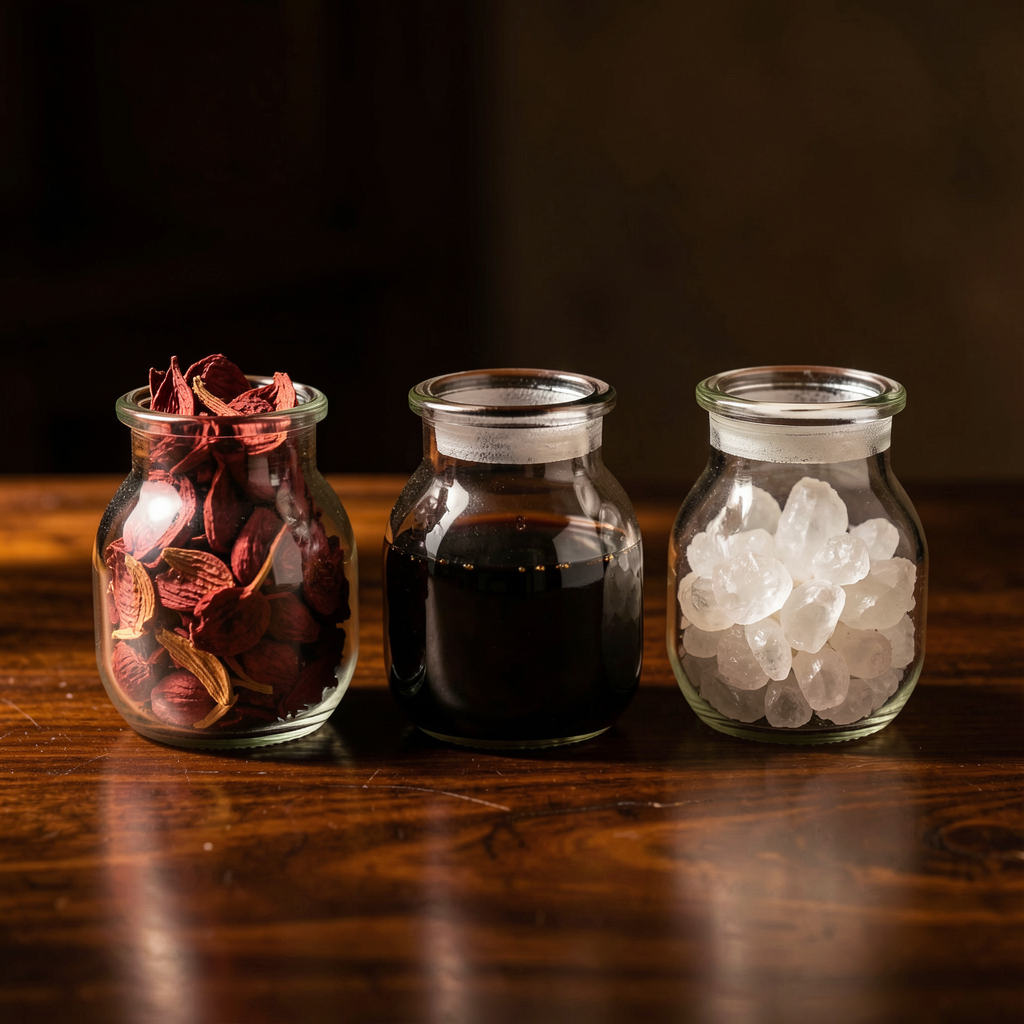
GENERATE — the primary action for DOR. These herbs build the Kidney Jing and Blood substrate that follicle development requires. This is the foundation of every DOR formula regardless of secondary pattern.
- Shu Di Huang (Shú Dì Huáng, 熟地黄 / Prepared Rehmannia) — the primary Kidney Yin and Jing-filling herb in the materia medica. The constitutional root herb of Zuo Gui Wan and You Gui Wan both. Prepared Rehmannia generates the deep Blood and Yin substrate that the ovary draws from; it is the single most important herb for the "fill the Jing" mandate of DOR treatment. Indicated in virtually every DOR pattern as the constitutional base.
- He Shou Wu (Hé Shǒu Wū, 何首乌 / Prepared Polygonum) — Jing and Blood tonic specifically targeting the constitutional reproductive reserve; the classical herb for restoring vitality to a depleted system. Pairs with Shu Di Huang to fill the Kidney Jing from two angles simultaneously.
- Tu Si Zi (Tú Sī Zǐ, 菟丝子 / Cuscuta) — tonifies Kidney Jing and Yang; secures the essence; the herb that "anchors" the Jing once it has been generated. Classical fertility herb across almost every pattern type — it both builds and holds. Used in Shou Tai Wan as the fetal-securing herb; here it is used as a Jing-building anchor in the pre-conception phase.
- Gou Qi Zi (Gǒu Qǐ Zǐ, 枸杞子 / Lycium / Wolfberry) — nourishes Liver Blood and Kidney Yin; the Jing-nourishing herb that specifically targets the eye (Liver channel) and the reproductive axis (Kidney channel) simultaneously. Research interest has focused on its polysaccharides, which have demonstrated antioxidant activity in granulosa cells.
- E Jiao (É Jiāo, 阿胶 / Donkey-hide Gelatin) — generates Blood and holds fluid; the classical herb for profound Blood and Yin deficiency where the body cannot retain what it generates. The hemostatic and fluid-holding function makes it essential in both DOR formulas and early-pregnancy securing formulas.
- Dang Gui (Dāng Guī, 当归 / Angelica sinensis) — generates and warms Blood; nourishes the Blood substrate the Chong Mai draws from to fill the uterus and support follicular development. The classical female tonic herb; present in almost every Blood-building formula including Si Wu Tang, Ba Zhen Tang, and Gui Shao Di Huang Tang. Warm-generating action.
WARM — for the Yang-deficiency and cold DOR patient.
- You Gui Wan (Yòu Guī Wán, 右归丸) — the canonical Kidney Yang + Jing tonic formula; the formula for the cold DOR patient. Ingredients include Shu Di Huang (Jing base), Fu Zi (附子, Aconite) and Rou Gui (肉桂, Cinnamon bark) for Yang warmth, Lu Jiao Jiao (鹿角胶, Deer Antler Gelatin) as the ultimate Yang-Jing tonic — the substance that bridges the constitutional warmth of the Yang and the generative depth of the Jing simultaneously. For the patient with low basal body temperature, thyroid or adrenal involvement, fatigue, and persistent cold: this is the key.
- Er Xian Tang (Èr Xiān Tāng, 二仙汤) — for the dual Yin + Yang deficiency pattern in older DOR patients (AMH < 0.5 ng/mL, often 37+); contains Xian Mao (仙茅) and Yin Yang Huo (淫羊藿, Epimedium) to warm Yang alongside Huang Bai and Zhi Mu to cool secondary deficiency heat. The formula for when both follicular nourishment and luteal warmth are failing simultaneously and the picture is complex and mixed.
- Gui Zhi (Guì Zhī, 桂枝 / Cinnamon Twig) — warms the Chong Mai and uterine channel; promotes Blood circulation to the lower abdomen and uterus; added to DOR formulas when uterine coldness or poor lower-body circulation accompanies the Jing deficiency.
GENERATE + COOL — for the Yin-deficiency DOR patient.
- Zuo Gui Wan (Zuǒ Guī Wán, 左归丸) — the canonical Kidney Yin + Jing tonic formula. Where You Gui Wan warms the Yang, Zuo Gui Wan fills the Yin. For the thin, warm patient with night sweats, scanty menses, dry mucosa, and a red tongue. The formula removes the warming herbs present in Liu Wei Di Huang Wan and replaces them with Gui Ban Jiao (龟板胶, Tortoise Shell Gelatin) and Lu Jiao Jiao — the yin-yang pairing of Kidney essence — to fill Jing from both poles simultaneously at constitutional depth.
- Sheng Di Huang (Shēng Dì Huáng, 生地黄 / Raw Rehmannia) — cools Blood and generates Yin; the raw form with greater cooling action than the prepared form; added when the Yin-deficiency heat picture is prominent and requires active cooling alongside generation.
MOVE — supporting ovarian microcirculation.
- Dan Shen (Dān Shēn, 丹参 / Salvia miltiorrhiza) — activates Blood and promotes circulation; the classical herb for the specific pattern of poor ovarian blood flow that can accompany constitutional deficiency in DOR. Tanshinones, the active constituents, have been studied extensively for vascular effects. The clinical teaching for DOR: low AMH is not only a Jing deficiency story — it is also a blood flow story. The ovaries that are failing to respond often show poor microvascular perfusion on Doppler assessment. Dan Shen is added in moderate amounts (Blood-moving herbs are not the primary strategy in deficiency DOR — generation leads, movement supports).
The combination lock — why the same AMH needs a different formula.
Two patients present in the same month. Both are thirty-eight. Both have an AMH of 0.4 ng/mL. Both have been told by their reproductive endocrinologist that their ovarian reserve is significantly diminished. Both are asking whether there is anything else they can do. The combination lock for each of them is entirely different.
The first patient is thin. She runs five days a week. She is always warm — kicks the blankets off at night, wakes at three a.m. with a warm flush through her chest. Her periods have shortened to four days where they used to be six; the flow is lighter and darker. Her tongue is red with almost no coat. Her pulse is thin and slightly rapid. Her combination lock reads: Kidney Jing + Yin deficiency — the same depletion that is drying her mucosa, heating her nights, and shortening her cycle is depleting the Jing her ovaries draw from. The formula is Zuo Gui Wan with Tu Si Zi, Gou Qi Zi, and He Shou Wu added as targeted Jing-fillers. Functional medicine complement: Ubiquinol 600 mg daily for mitochondrial support in the oocyte maturation phase. Timeline: minimum three months — one oocyte maturation cycle — before the formula's effects can reach the eggs under development now.
The second patient carries extra weight in her lower body and belly. She is always cold — socks to bed, cold hands even in summer, a fatigue that has been present for years and that her internist attributed to "stress." Her thyroid TSH is 3.8 — technically normal, functionally sluggish. Her periods come late, sometimes day 35 or 38. The flow is pale and thin. Her tongue is pale with a moist coat. Her pulse is deep and slow. Her combination lock reads: Kidney Jing + Yang deficiency — the failure to warm is as central as the failure to generate. The formula is You Gui Wan, with attention to the adrenal-thyroid overlap that the Yang deficiency picture almost always involves in contemporary patients. Functional medicine complement: DHEA 25 mg daily (to sensitize pre-antral follicles to FSH via adrenal androgen precursor activity), Royal Jelly (gonadotropin-like adrenal support), Ubiquinol 600 mg.
Same AMH. Same age. Same diagnosis. Different key. The formula that opens one lock will not open the other.
The functional medicine complement — upstream drivers of oocyte quality.
Classical herbal medicine addresses the constitutional pattern underlying DOR. Functional medicine identifies the upstream nutritional and metabolic cofactors that determine the environment in which oocytes mature. For DOR, the functional medicine layer is unusually high-yield — because the final ninety days of oocyte maturation before ovulation require an extraordinary increase in cellular energy production, and that production is subject to nutritional support that most women with DOR have never received.
- Ubiquinol (CoQ10) 400–600 mg daily — the highest-evidence fertility supplement in the conventional literature for DOR. Oocytes are among the most metabolically demanding cells in the body; the maturation process from pre-antral follicle to ovulable egg requires a massive increase in mitochondrial ATP production over the final 90 days. Ubiquinol (the reduced, active form) is the substrate for that mitochondrial chain. Studies in women with DOR and poor IVF response consistently show improvements in embryo quality with pre-cycle Ubiquinol loading at these doses.
- DHEA 25–50 mg daily — for women 34 and older with AMH below 1.0 ng/mL; not appropriate for women with PCOS or androgen excess. DHEA is the adrenal androgen precursor whose conversion to androgens at the granulosa cell level sensitizes pre-antral follicles to FSH, enabling more of the existing follicle pool to enter the recruitment cycle. Research supporting DHEA in DOR and poor IVF response has been accumulating for two decades. In the classical framework, this maps to the adrenal androgen support function within Kidney Yang — the DHEA intervention and the Yang-warming herbal strategy are addressing overlapping terrain.
- Royal Jelly — contains 10-hydroxy-2-decenoic acid (10-HDA) with demonstrated gonadotropin-like activity and adrenal reserve support. Used in Japanese fertility practice for decades; the classical overlap is with adrenal depletion in the Yang-deficiency DOR patient.
- Three-month treatment window — the most important instruction for DOR patients: oocyte maturation from primordial follicle recruitment to ovulation takes approximately 85–90 days. Any intervention — herbal or nutritional — that is intended to affect the quality of the egg at retrieval or ovulation must be in place for at least three months before those eggs are expected. Starting two weeks before an IVF cycle will not reach the eggs already in their final weeks of maturation. The work is done upstream, in the cycle before the cycle.
For the patient who has been told to consider donor eggs.
An AMH of 0.4 is not a sentence. It is a measurement — and it is a measurement of activity, not of a fixed anatomical count that cannot change.
This is the most important clinical reframe available for DOR patients who have received the donor egg conversation. AMH measures how active the ovary is being. It measures whether the small follicles present are producing the hormone that indicates they are recruited and responsive. That activity is influenced by the constitutional substrate those follicles are drawing from — the Kidney Jing, the Blood, the ovarian microcirculation, the mitochondrial energy available in each developing oocyte.
When the constitutional substrate changes, ovarian activity can change. Some patients who engage in sustained herbal and nutritional support — with formula correctly matched to pattern, at the three-month minimum necessary for the intervention to reach eggs under current development — have seen AMH measurements rise significantly. Not all patients. Not predictably. But consistently enough that "consider donor eggs" is not the last word for every patient who receives it.
The intake is online. The formula ships. Before that conversation with your reproductive endocrinologist becomes a decision, the constitutional pattern underneath deserves to be read — and addressed.
How the intake works for DOR.
The online intake for diminished ovarian reserve asks for the full clinical picture: your AMH value and when it was measured, your day-3 FSH, your antral follicle count if available, any IVF cycle history including stimulation protocol, number of eggs retrieved, fertilization rate, and embryo outcomes. If you have had prior ovarian surgery, endometriosis, autoimmune conditions, or thyroid or adrenal involvement, that context matters for the constitutional reading.
The constitutional intake asks for: menstrual cycle length and trend over time, flow quality (volume, color, clots), body temperature patterns (basal body temperature chart if you have one, but also whether you run warm or cold constitutionally), sleep, energy and its daily curve, digestive health, and any systemic symptoms that accompany the fertility concern — because the pattern that is depleting the Kidney Jing is almost never limited to the ovaries. It shows in the whole body.
Michael reads every intake personally. He identifies whether the DOR pattern is primarily Kidney Yin + Jing deficiency (the Zuo Gui Wan axis), Kidney Yang + Jing deficiency (the You Gui Wan axis), or the dual deficiency picture that requires an alternating or combined strategy. The formula is accompanied by the functional medicine complement appropriate to your specific pattern and IVF timeline, and by a map of what to watch for over the three-month treatment window.
Understand the framework before you begin.
The Chambers are a free patient education library — the methodology behind every Rootworth formula. Reading them before or alongside your intake helps you understand what the classical assessment is seeing, why individualized formulas outperform generic protocols, and how each layer of treatment connects to the next.
A note on these statements.
Rootworth herbal preparations are dietary supplements. These statements have not been evaluated by the Food and Drug Administration. These products are not intended to diagnose, treat, cure, or prevent any disease. Classical Chinese medicine pattern assessment — the identification of constitutional patterns such as Kidney Jing deficiency, Kidney Yin deficiency, Kidney Yang deficiency, or Liver Blood insufficiency — is distinct from the diagnosis and treatment of disease as defined under United States federal law. Individual results vary. All scientific references on this page refer to published research on herbal constituents or nutritional interventions; references do not imply that any Rootworth formula is intended to produce the effects described. Always continue your reproductive endocrinologist's care and any prescribed fertility protocols alongside any herbal and nutritional support program. Do not discontinue any prescribed medications without the guidance of your physician.
- Begin intake — read the process and start your formula
- Recurrent miscarriage — classical formulas for pregnancy loss and fetal securing
- All fertility conditions — the full classical framework for reproductive health
- PCOS — constitutional pattern work for polycystic ovarian syndrome
- Classical training — why this practice holds the conditions it does