Uterine Fibroids — Leiomyoma
The fibroid is not the beginning of the story. The classical framework reads the constitutional accumulation that produced it — Blood stasis, Phlegm congealing, Liver Qi obstructed — and addresses that upstream architecture, not only the mass it built.
The uterine palace and the accumulations that form within it.
Uterine fibroids — leiomyomata — are benign smooth-muscle tumors arising within the uterine wall. They affect an estimated seventy to eighty percent of women by age fifty. They are the most common pelvic tumor in women of reproductive age, and they account for the majority of hysterectomies performed in the United States each year. The Western framework describes them accurately at the structural level: benign tumors driven by estrogen and progesterone, responsive to hormonal milieu, likely to shrink at menopause when that milieu withdraws. What the Western framework offers less precisely is an account of why the specific patient's constitution produced fibroids while her sister's did not — why one woman's Liver metabolizes estrogen and clears it cleanly while another's does not; why one woman's pelvic circulation moves freely and another's accumulates.
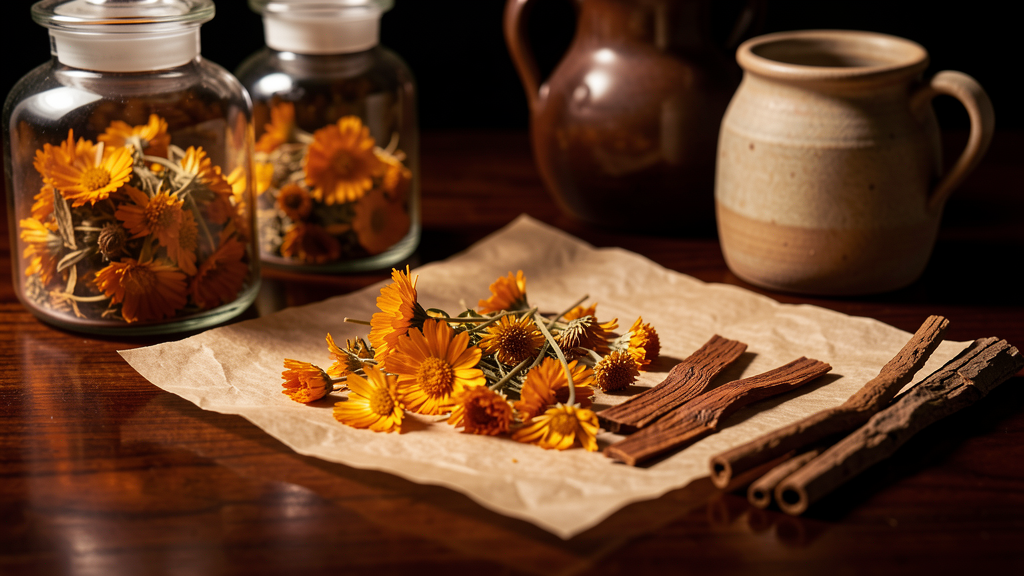
癥瘕。 Concretions and accumulations.
This is the classical disease category that encompasses fibroids — the ancient Chinese name for hardened masses in the uterine palace that have formed from long-standing Blood stasis combined with Phlegm accumulation. 癥 (Zhēng) refers to fixed, palpable masses arising from Blood accumulation. 瘕 (Jiǎ) refers to moveable accumulations rooted in Qi stagnation. Fibroids, which are fixed and firm, are primarily Zhēng — Blood has congealed and solidified into a mass that has structure, location, and resistance. But most fibroids also carry a Jiǎ component, because the Qi stagnation that drove the Blood to stagnate in the first place has not been resolved — it continues to maintain the pathological environment in which the mass persists and may grow.
久病入絡。 Chronic disease enters the collaterals.
This statement describes the process by which the fibroid forms over time. Qi stagnation — long-standing, insufficiently addressed — eventually drives pathology into the Blood level. Blood begins to stagnate in the pelvic collaterals. Stagnant Blood does not move. It accumulates. Over months and years, the accumulation congeals further as Phlegm — the substance produced when fluid metabolism is chronically impaired — mixes with the stagnant Blood. The result is the smooth-muscle nodule: fibrin, extracellular matrix, and hypertrophied smooth muscle cells organized around a stagnant core. The chemistry of the fibroid is the chemistry of Phlegm-Blood stasis hardened by time.
肝氣鬱結。 Liver Qi stagnates and binds.
Liver Qi stagnation is the upstream driver in the majority of fibroid presentations. The Liver governs the free flow of Qi throughout the body. In the reproductive domain specifically, the Liver governs the smooth circulation of Blood through the uterus during menstruation and between cycles. When Liver Qi stagnates — through chronic stress, suppressed emotion, long-standing frustration, or constitutional Liver predisposition — that free circulation becomes obstructed. The pelvic environment stops clearing after each cycle. What should flow freely begins to accumulate. The classical framework mapped this upstream driver in clinical observation; the Western counterpart is visible in the estrogen-dominance model of fibroid growth: fibroids are estrogen-dependent, and the Liver is the primary organ responsible for estrogen metabolism and clearance. When the Liver's function is obstructed, estrogen is not metabolized efficiently. It recirculates. It drives fibroid growth.
脾統血失職。 The Spleen fails in its duty to hold blood within the vessels.
This is the classical explanation for the heavy menstrual bleeding that submucosal and intramural fibroids produce. The Spleen's function of holding Blood within the vessels — of governing the containment of Blood so that it flows through proper channels and exits at appropriate times — is compromised when Spleen Qi is deficient. In the fibroid patient with heavy periods, this manifests as Blood that cannot be held: it floods the uterine cavity at menstruation, producing menorrhagia, the prolonged soaking, the flooding periods, the passage of dark clots that clinically distinguish fibroids from functional dysfunctional uterine bleeding. The Spleen must be addressed alongside the Blood stasis to stop the hemorrhage while the deeper work of moving the stasis proceeds.
What Western medicine has measured — and what the pattern framework adds.
Western reproductive medicine has mapped fibroid biology in considerable detail. Leiomyomata arise from a single myometrial smooth muscle cell that undergoes somatic mutation and then proliferates under the influence of estrogen and progesterone — particularly the locally produced growth factors IGF-1, EGF, and TGF-β, which are upregulated in the fibroid microenvironment. The extracellular matrix component is disproportionate: fibroids contain far more collagen, fibronectin, and proteoglycan than normal myometrium, producing the firm, rubbery consistency that distinguishes them on palpation and ultrasound. This excess extracellular matrix is not merely structural — it sequesters and concentrates growth factors, creating a locally sustained growth signal independent of circulating hormone levels.
Location determines clinical impact. Submucosal fibroids — projecting into the uterine cavity — produce heavy menstrual bleeding and are the most clinically disruptive type; even small submucosal fibroids can cause significant hemorrhage and are the primary fibroid type associated with recurrent pregnancy loss. Intramural fibroids — within the myometrial wall — produce bulk symptoms: pelvic pressure, urinary frequency, dysmenorrhea, and menorrhagia when they distort the cavity. Subserosal fibroids — projecting outward toward the serosa — are more likely to produce pressure symptoms than bleeding, though large subserosal fibroids can cause significant pelvic bulk and mechanical pressure on adjacent structures.
Racial disparity in fibroid burden is one of the most dramatic in reproductive medicine: African American women are three times more likely to develop fibroids, develop them at younger ages, present with larger and more numerous fibroids at diagnosis, and are more likely to undergo hysterectomy than their White counterparts. The mechanisms underlying this disparity remain incompletely understood in Western literature; constitutional stress burden, Vitamin D deficiency (which has emerging evidence in fibroid prevention), and the downstream effects of chronic Liver metabolic stress from allostatic load all appear relevant.
Current Western management options span a wide range of invasiveness: expectant management for asymptomatic fibroids; GnRH agonists (leuprolide) or the newer GnRH antagonists (elagolix) for temporary hormonal suppression — producing shrinkage that reliably reverses when the medication is stopped; progestin-releasing IUDs for symptom management in intramural disease without cavity distortion; myomectomy (laparoscopic or open) to remove fibroids while preserving the uterus; uterine artery embolization (UAE); and hysterectomy as the definitive intervention. All existing pharmacological options are temporary: GnRH therapies suppress rather than address the underlying constitutional estrogen-metabolism pattern, and fibroids predictably recur or regrow after cessation. Even myomectomy, while removing specific fibroids, does not address the constitutional environment that produced them — recurrence rates are significant.
This is the gap the classical framework is designed to fill. The surgical intervention removes the mass. The hormonal intervention temporarily suppresses the hormonal signal. Neither addresses the Liver Qi stagnation that is impairing estrogen clearance, or the Blood stasis in the pelvic environment that is maintaining the accumulation, or the Phlegm that has congealed with the Blood to give the fibroid its fibrous structure, or the Spleen Qi deficiency that is allowing the hemorrhage. The constitutional architecture that produced the fibroid is still operating after the surgery. The formula addresses that architecture.
Classical patterns and their formula architectures.
Fibroids are not a single-pattern condition. The same Western diagnosis — uterine leiomyoma — arises from constitutionally distinct upstream configurations. The pattern determines the formula. Four primary configurations present in clinical practice:
Classical pattern table for fibroids — for practitioners →
This section is provided as clinical reference. Classical Chinese medical patterns and their formula architectures are described below, not disease treatment claims. All formula recommendations represent classical pattern-based herbal support under DSHEA, not claims to diagnose, treat, cure, or prevent any disease.
| Pattern | Classical mechanisms | Clinical presentation | Primary formula direction |
|---|---|---|---|
| Blood stasis + Qi stagnation (primary pattern) |
肝氣鬱結 → 氣滯血瘀; Liver Qi stagnates, Blood follows Qi into stagnation; pelvic circulation obstructed | Fixed firm mass, dysmenorrhea, dark clotted menses, pain that is localized and relieved somewhat by passage of clots, stress-correlated cycle irregularity, wiry pulse | Gui Zhi Fu Ling Wan 桂枝茯苓丸 — the canonical fibroid formula; simultaneously warms and moves the stasis, dissolves the mass, clears the residual heat the stagnation has generated |
| Phlegm-Blood stasis (large or multiple fibroids) |
Spleen fails to transform fluid → Phlegm accumulates; Phlegm congeals with Blood stasis → denser nodule formation; larger or multiple fibroid burden | Larger fibroids, heavy prolonged flow, viscous clotted blood, possible intercyclic spotting, sensation of pelvic heaviness rather than sharp pain, slippery wiry pulse | Gui Zhi Fu Ling Wan + Er Chen Tang 二陈汤 elements (Fa Ban Xia, Chen Pi, Fu Ling) to dissolve Phlegm alongside Blood stasis; Hai Zao 海藻 to soften and dissolve mass |
| Spleen Qi xu + Blood stasis (heavy bleeding with deficiency) |
脾統血失職 — Spleen fails to hold Blood; hemorrhage is the primary presentation; deficiency and stasis coexist; cannot only move Blood without first holding it | Flooding periods, prolonged bleeding, clots with watery blood interspersed, fatigue and pallor after periods, easy bruising, poor appetite, soft pulse | Bu Zhong Yi Qi Tang 补中益气汤 to lift and hold Blood + San Qi 三七 to simultaneously move stasis and arrest hemorrhage; sequenced before introducing stronger Blood-movers |
| Kidney xu + Blood stasis (long-standing or perimenopausal fibroids) |
Kidney root depletion underlies long-standing Blood stasis; constitutional deficiency allows the accumulation to persist; reproductive aging alongside fibroid burden | Long-standing fibroid history, declining menstrual volume alongside continued stasis signs, constitutional Kidney deficiency picture (fatigue, low back, tinnitus), deep thin pulse | Gui Zhi Fu Ling Wan + Zuo Gui Wan 左归丸 (Yin) or You Gui Wan 右归丸 (Yang) depending on deficiency type; Kidney root addressed concurrently with stasis resolution |
The critical clinical point: most fibroid presentations are not single-pattern. The combination lock almost always involves more than one of these configurations overlapping, with a primary pattern requiring the first formula and secondary patterns addressed as the primary responds. The intake reads the specific configuration. The formula addresses the specific lock.
Herbs are chemistry — the four blood actions for fibroids.
Fibroids are a Blood accumulation condition. Every herb in a fibroid formula is deployed against a specific function in the Blood domain: moving what has stagnated, dissolving what has hardened, stopping what is hemorrhaging, or generating what has been lost through bleeding. These are chemistry functions, not metaphors. The herbs named below carry documented pharmacological activity that corresponds directly to the classical action attributed to each.
MOVE the Blood — dissolve the stasis, reduce the mass. This is the primary action for fibroid treatment. The goal is to restore pelvic circulation, break down the fibrous-stasis matrix of the fibroid, and clear the accumulation that is maintaining it. Representative herbs:
- Gui Zhi (Guì Zhī, 桂枝 / Cinnamon twig) — moves Blood by warming the pelvic vessels; a gentle Yang-activating herb that sets the Blood in motion without aggressively breaking stasis; the principal ingredient in Gui Zhi Fu Ling Wan, where it warms and moves as the first action of the formula
- Tao Ren (Táo Rén, 桃仁 / Peach kernel) — the most direct Blood-breaking herb in the Gui Zhi Fu Ling Wan formula; documented anticoagulant and fibrinolytic properties; breaks the fibrin matrix that forms the structural scaffold of the stasis accumulation
- Chi Shao (Chì Sháo, 赤芍 / Red Peony) — clears heat from the Blood while moving it; the cooling Blood-mover in Gui Zhi Fu Ling Wan, preventing the stasis from generating excess heat as it is mobilized
- Mu Dan Pi (Mǔ Dān Pí, 牡丹皮 / Moutan Bark) — cools Blood and resolves stasis; the second cooling-moving herb in Gui Zhi Fu Ling Wan; important for the heat component that long-standing stasis generates
- San Leng (Sān Léng, 三棱) and E Zhu (É Zhú, 莪术) — the aggressive mass-dissolving pair for larger or more established fibroids; stronger Blood-breakers than the Gui Zhi Fu Ling Wan constituents; used when fibroids are large, multiple, or have a Phlegm-stasis hardening that requires more force to dissolve
- Dan Shen (Dān Shēn, 丹参 / Salvia miltiorrhiza) — moves Blood in the pelvic vessels and supports microcirculation; documented tanshinone content with demonstrated activity against smooth-muscle proliferation
TRANSFORM Phlegm — dissolve the fibrous nodule. The extracellular matrix component of the fibroid — the collagen, fibronectin, and dense fibrous tissue — corresponds classically to Phlegm congealed with Blood. Phlegm-dissolving herbs address this structural layer:
- Hai Zao (Hǎi Zǎo, 海藻 / Sargassum seaweed) — the classical herb for softening and dissolving firm masses; from Hai Zao Yu Hu Tang (the thyroid nodule formula), it dissolves firm Phlegm-stasis accumulations; iodine and polysaccharide content documented with anti-fibrotic and mass-softening properties
- Fu Ling (Fú Líng, 茯苓 / Poria) — resolves Dampness and supports Spleen's fluid-transforming function; also the herb in Gui Zhi Fu Ling Wan that drains the fluid accumulation underlying the Phlegm layer
STOP + MOVE — arrest hemorrhage while clearing stasis. The most clinically precise action available for the Spleen-xu fibroid patient with heavy bleeding, where neither pure stopping nor pure moving alone addresses the double problem:
- San Qi (Sān Qī, 三七 / Notoginseng) — the essential herb for this pattern; documented hemostatic activity AND Blood-activating platelet-affecting properties in the same molecule; stops the hemorrhage without driving further stasis; the only classical herb that holds both functions simultaneously. In the clinical context of fibroids with heavy bleeding, this is the indispensable single herb
GENERATE Blood — replenish what the hemorrhage has consumed. Heavy fibroid bleeding produces Iron-deficiency anemia in many patients. The classical equivalent is Blood deficiency — the substrate from which vitality, cognition, and further reproductive function are drawn has been depleted by chronic heavy loss. The generating action must accompany the moving action in any patient with significant bleeding history:
- E Jiao (Ē Jiāo, 阿胶 / Donkey-hide gelatin) — the primary Blood-generating herb in the classical materia medica; stops bleeding from deficiency while simultaneously rebuilding Blood; documented iron-binding protein and gelatin activity
- Dang Gui (Dāng Guī, 当归 / Angelica sinensis) — both generates and moves Blood; the most used herb for deficiency-Blood management in reproductive medicine; balances the generating and moving functions simultaneously
The canonical formula — Gui Zhi Fu Ling Wan 桂枝茯苓丸. This formula, from the Jingui Yaolue (Jin Gui Yao Lüe, 金匮要略), is the classical fibroid formula. Its five herbs — Gui Zhi, Fu Ling, Tao Ren, Mu Dan Pi, Chi Shao — collectively execute all four early-stage Blood actions in a single balanced prescription: warm and move the stasis (Gui Zhi + Tao Ren), cool the heat generated by stagnation (Mu Dan Pi + Chi Shao), drain the fluid-Phlegm component (Fu Ling). It is not a heavy formula. It is precisely calibrated for the stasis-in-abundance patient who does not yet require aggressive mass-dissolving. For larger fibroids, it becomes the base to which San Leng, E Zhu, Hai Zao, and Phlegm-transforming elements are added. For the deficiency patient with heavy bleeding, it is preceded by the holding formula and reintroduced when the Spleen has been strengthened enough to carry the Blood-moving work.
The Liver, estrogen metabolism, and the functional medicine complement.
Fibroids are estrogen-dependent tumors. They grow in the presence of estrogen and shrink when estrogen withdraws at menopause. But not all women with estrogen exposure develop fibroids — which means that estrogen exposure alone is insufficient as an explanation. The relevant variable is estrogen metabolism: how efficiently the body metabolizes and clears estrogen through the Liver's Phase I and Phase II detoxification pathways, and whether the gut microbiome is effectively preventing deconjugated estrogens from being reabsorbed through the enterohepatic circulation.
In the classical framework, this is the Liver Qi stagnation picture. The Liver governs the free flow of Qi. When that flow is obstructed, the Liver's metabolic function — including, in the Western parallel, its Phase I and Phase II estrogen-clearing function — is impaired. Estrogen recirculates. The fibroid's primary growth signal is continuously supplied.
The functional medicine complement addresses this from the chemistry side:
- DIM-PRO (Diindylmethane) — the primary estrogen-clearance support compound; shifts estrogen metabolism from the 16-alpha-hydroxyestrone pathway (proliferative, fibroid-promoting) toward the 2-hydroxyestrone pathway (anti-proliferative); directly addresses the Wood-sphere estrogen-dominance pattern at the biochemical level
- Natto-Serrazimes (systemic enzyme complex) — nattokinase and serrapeptase; documented fibrinolytic activity; reduces the fibrin scaffold around fibroids and decreases pelvic inflammatory load; reduces the extracellular matrix that gives fibroids their hard structure — the classical Phlegm-dissolving action at the chemistry level
- Vitamin D — emerging evidence documents Vitamin D receptor expression in fibroid tissue; deficiency correlates with fibroid incidence and burden; Vitamin D has demonstrated anti-proliferative effects on uterine fibroid cells in vitro; particularly relevant in the context of the documented racial disparity in both Vitamin D deficiency and fibroid burden
- Anti-inflammatory diet — chronic pelvic inflammation maintains the inflammatory microenvironment in which fibroids persist and grow; reducing prostaglandin-driving foods and increasing omega-3 intake supports the same constitutional clearing that the classical herbs are driving at the pattern level
The combination lock — why two fibroid patients need different formulas.
Two patients sit across from the same gynecologist. Both have fibroids confirmed on ultrasound. Both are told the standard options: watchful waiting, hormonal suppression, or surgery. They leave with the same conversation. They do not share the same combination lock.

The first patient is thirty-eight. A professional in a demanding job, chronically stressed, prone to digestive tension, irregular sleep. Her periods are heavy and clotted. The pain is sharp and localized — it gets worse before the flow starts and then eases when clots pass. She has a single intramural fibroid, four centimeters. Her pulse is wiry. Her tongue has slight purple discoloration at the edges. Classically, this is straightforward Blood stasis on a Liver Qi stagnation ground — the canonical picture for Gui Zhi Fu Ling Wan. Her Wood-sphere estrogen metabolism needs support alongside the formula: DIM-PRO, anti-inflammatory diet. The combination lock opens in one turn — clear the Liver Qi, move the stasis, support estrogen clearance. The formula is Gui Zhi Fu Ling Wan with Chai Hu added to move the Liver Qi that is maintaining the stasis, and San Qi to manage the hemorrhage component. DIM-PRO runs concurrently.
The second patient is forty-four. She has three fibroids — one submucosal, two intramural. Her periods are flooding: she uses super-plus tampons and pads simultaneously for the first three days and is exhausted for a week after each cycle. Her complexion is pale. She bruises easily. She is fatigued between periods too. She reports that food "just sits" and she often has no appetite in the mornings. Her pulse is soft and slightly slippery. Her tongue is pale with tooth marks at the edges. Classically, this is a two-layer stack: Spleen Qi deficiency failing to hold the Blood (the hemorrhage), with Blood stasis sitting underneath it. She cannot be given Gui Zhi Fu Ling Wan directly — moving Blood in a patient whose Spleen is this deficient risks driving more hemorrhage, not less. Her combination lock opens in sequence. First: Bu Zhong Yi Qi Tang to lift the Spleen Qi and begin to hold the Blood, San Qi to move stasis and stop hemorrhage simultaneously. Then, as the Spleen strengthens and the flooding periods settle to heavy-but-manageable, the formula transitions: Gui Zhi Fu Ling Wan enters, the Blood-moving work begins in earnest, and E Jiao rebuilds the Blood deficiency that years of heavy loss have created.
Giving the second patient the first patient's formula on intake — moving Blood aggressively in a Spleen-deficient patient — could produce an increase in bleeding in the short term. Not because the formula is wrong for the diagnosis, but because the sequence is wrong for the specific pattern stack. The combination lock has tumblers. The sequencing is a clinical decision, not a protocol.
Breaking free from the surgery-or-wait decision.
The standard presentation of fibroid management goes like this: the fibroids are there, they are benign, if they are not causing symptoms we will watch them, and if they are causing symptoms here are the surgical and hormonal options. This is a reasonable clinical framework for managing structural findings. It is not a framework for addressing what produced the structural findings.
GnRH agonist therapy works. It suppresses the hormonal signal and fibroids shrink — meaningfully, and sometimes dramatically. Then it stops. The fibroids return. Because the Liver Qi that was impairing estrogen metabolism is still stagnating. Because the Blood stasis in the pelvic environment is still operating. Because the constitutional architecture that organized the tumor is still present, waiting for the hormonal signal to resume. The intervention was targeted at the downstream signal. The upstream driver was never addressed.
Myomectomy removes the fibroid. It is often the right clinical intervention — especially for submucosal fibroids producing hemorrhage, for fibroids large enough to cause structural bulk problems, for patients who have chosen preservation of the uterus over hysterectomy as a structural intervention. The recurrence rate after myomectomy is real, and it is real for the same reason: the constitutional environment that produced the fibroid has not been changed. A new fibroid, or a recurrence of the resected one, emerges from the same terrain the surgeon left behind.
The classical framework does not replace the surgical option. For patients with large, symptomatic fibroids producing significant hemorrhage or structural symptoms, surgical management is often clinically indicated, and the intake conversation includes that reality directly. What the classical framework offers is the work the surgery cannot do: addressing the constitutional Liver Qi stagnation, moving the pelvic Blood stasis, supporting estrogen clearance, and changing the terrain so that the post-surgical environment is not the same environment that produced the fibroid in the first place. If surgery is indicated, the formula supports the constitutional work before and after. If surgery is not yet indicated — if watchful waiting is the clinical position — the formula addresses what is being watched, not only the watching.
You are not choosing between surgery and herbs. You are choosing whether to address the constitution that produced the fibroid alongside whatever structural intervention the gynecologist recommends.
How the intake works for uterine fibroids.
The online intake asks for the full clinical picture: your fibroid diagnosis, most recent ultrasound findings (size, location, number, any interval change), current symptoms and their severity, menstrual history from the beginning — cycle length, flow heaviness, pain type and timing, clot characteristics — and the full constitutional picture, including stress patterns, digestion, energy, sleep, and emotional history.
For fibroids specifically, the intake gathers: whether your pain is fixed or moving; whether bleeding is primarily heavy, prolonged, or both; whether you have constitutional signs of deficiency alongside the stasis picture; whether there is a history of prior fibroids, prior hormonal treatment, or prior surgery; and what your current gynecologist's monitoring and management plan is, because the herbal work proceeds alongside that plan, not instead of it.
Michael reads every intake personally. He identifies the primary and secondary patterns, maps the sequence — whether Blood-moving can be introduced directly or must be preceded by Spleen-holding — and designs the formula for where you are in the progression, not for the average fibroid diagnosis. The formula is accompanied by a map of what it is intended to accomplish in what sequence, and what you will notice in your cycle if the pattern is responding.
Always continue gynecological monitoring. Fibroid size and location are documented with imaging. Changes in bleeding and pain are clinically tracked by your gynecologist. The herbal work addresses the constitutional substrate. The gynecologist monitors the structural findings. These work in parallel.
Understand the framework before you begin.
The Chambers are a free patient education library — the methodology behind every Rootworth formula. Reading them before or alongside your intake helps you understand what the classical assessment is seeing, why individualized formulas outperform generic protocols, and how each layer of treatment connects to the next.
A note on these statements.
Rootworth herbal preparations are dietary supplements. These statements have not been evaluated by the Food and Drug Administration. These products are not intended to diagnose, treat, cure, or prevent any disease. Classical Chinese medicine pattern assessment — including 癥瘕 (concretions and accumulations), Blood stasis, Liver Qi stagnation, Spleen Qi deficiency, and Phlegm accumulation patterns — is distinct from the diagnosis and treatment of disease as defined under United States federal law. Individual results vary. All formula recommendations on this page represent classical pattern-based herbal support and are not claims to treat, manage, or cure uterine fibroids or any associated condition. Always continue your gynecologist's monitoring and follow their guidance regarding any structural management decisions. Do not discontinue prescribed medications without guidance from your prescribing physician.
- Begin intake — read the process and start your formula
- Fertility overview — the classical framework for fertility and reproductive health
- Dysmenorrhea & painful periods — classical patterns and formula architecture
- Fertility case histories — de-identified clinical illustrations
- Chambers — the methodology underneath the formula
- About — the practitioner's credentials and clinical scope