Dry Eye / Sjögren's Syndrome
Custom herbal formulas for the classical patterns underlying dry eye — because the lacrimal gland does not fail in isolation.
Dry eye disease is one of the most common eye conditions in clinical practice and one of the most under-treated. The drops that occupy shelf space in every pharmacy address the symptom — the surface dryness — without touching the system that is failing to produce the tears that should prevent it. For many patients, artificial tears are a permanent maintenance intervention for a problem that has a constitutional root.
Classical Chinese medicine identified that root two thousand years before lacrimal gland histology existed. The eye is nourished by two organ systems working in concert: the Liver, which supplies Blood to the visual apparatus and the lacrimal tissue directly, and the Kidney, which holds the deep fluid reserve the whole body draws from. When either fails, the eye dries.
肝血不足,目失所養。 When Liver Blood is insufficient, the eye loses its nourishment.
This is the foundational classical statement for dry eye. It names the mechanism directly: the Liver fails to supply the Blood that the lacrimal gland and the ocular surface require. The fluid the eye needs to maintain its tear film is not generated locally by the eye — it is supplied systemically, through the Blood that the Liver sends upward along its channel. When that Blood is deficient, the supply is interrupted at the source. Artificial tears replace the symptom; they do not restore the supply.
What Western medicine has measured — the tear film failure engine.
Western ophthalmology divides dry eye disease into two primary mechanisms, often overlapping in clinical practice:
Aqueous-deficient dry eye — the lacrimal gland fails to produce sufficient aqueous (watery) component of the tear film. The lacrimal gland is a secretory tissue that requires adequate vascular supply, neural stimulation, and hormonal support to maintain its output. Its most severe form is the autoimmune destruction characteristic of Sjögren's syndrome, in which lymphocytes infiltrate and destroy both the lacrimal and salivary gland tissue, producing profound dryness at every mucosal surface simultaneously.
Evaporative dry eye — the meibomian glands fail to produce sufficient lipid layer to cap the tear film and prevent evaporation. Meibomian gland dysfunction (MGD) is now recognized as the dominant mechanism in the majority of dry eye presentations, often in combination with aqueous deficiency. The lipid layer's job is to reduce the surface tension of the tear film and slow its evaporation rate; without it, even adequate aqueous production evaporates before it can protect the ocular surface.
The downstream consequence in both cases is the same: tear film instability → hyperosmolarity of the remaining tear fluid → activation of inflammatory cascades on the ocular surface → damage to the conjunctival goblet cells that produce mucin (the adhesive inner layer of the tear film) → further deterioration of tear film stability. The inflammation created by dry eye damages the very structures that would correct it. This is why dry eye so frequently becomes self-perpetuating once it has established.
In Sjögren's syndrome, this surface deterioration sits within a picture of systemic autoimmune destruction that the conventional medical literature is now linking to mitochondrial dysfunction, gut dysbiosis, and chronic neuroinflammation — a systemic terrain, not a local gland failure.
The classical framework reads that systemic terrain directly. What the Western workup calls lacrimal gland destruction, the classical reading identifies as Liver Blood failing to nourish the lacrimal tissue, Kidney Yin failing to supply the deep fluid reserve the gland draws from, and — in the inflammatory Sjögren's variant — Heat in the Blood level driving the autoimmune destruction. Each layer requires a different herbal strategy.
The classical statements — what predicts this dryness.
Dry eye disease resolves at the classical level into a cascade of statements, each pointing to a different organ system and a different layer of the failure:
肝血虛。 Liver Blood deficiency — the Liver fails to nourish the eyes and the lacrimal apparatus.
The Liver opens into the eyes (肝開竅於目). The Blood the Liver sends upward nourishes the visual apparatus, the retina, and the secretory tissue of the lacrimal gland. When Liver Blood is insufficient — from chronic depletion, poor diet and absorption, prolonged illness, blood loss, or constitutional weakness — the lacrimal gland loses the Blood supply it requires to produce tears. This is not metaphor. The lacrimal gland is a secretory tissue whose output depends on its vascular supply. Liver Blood deficiency in the classical framework corresponds directly to insufficient cholinergic and vascular support to the lacrimal acinar cells.
腎陰虛。 Kidney Yin deficiency — systemic fluid depletion dries every mucosal surface.
Kidney Yin is the deepest fluid reserve in the body — the constitutional moisture that all surfaces, all secretory glands, and all mucosal tissues draw from. When Kidney Yin is depleted, the dryness is not localized. It is systemic: dry eyes, dry mouth, dry skin, dry vaginal mucosa, reduced joint lubrication. Sjögren's syndrome is the Western disease that most precisely maps the classical picture of Kidney Yin depletion — every secretory gland failing simultaneously, because the deep fluid reserve that was meant to supply them all has been exhausted.
陰虛則熱。 Yin deficiency generates heat — the inflammatory overlay.
When Yin is depleted, Yang rises unanchored as heat. In dry eye terms: Yin-deficiency fire produces the inflammatory cascade at the ocular surface — the goblet cell destruction, the conjunctival inflammation, the surface hyperosmolarity — that converts a deficiency dryness pattern into an inflammatory dryness pattern. Sjögren's uveitis and the autoimmune surface destruction of severe dry eye disease both carry this inflammatory overlay: Yin depletion at the root, deficiency fire driving inflammation at the surface.
The classical mechanism table — for practitioners →
This section is provided as clinical reference. The statements below are classical Chinese medical aphorisms and their corresponding pattern mechanisms — not disease claims. All formula recommendations represent classical pattern-based support, not treatment of diagnosed disease conditions.
| Classical statement | Mechanism when the statement fails | Western finding it produces | Dry eye subtype / systemic association |
|---|---|---|---|
| 肝血不足 Liver Blood insufficient |
Liver fails to send adequate Blood upward to nourish the lacrimal tissue; secretory capacity of the lacrimal gland declines; ocular surface loses its nutritive supply | Reduced basal tear production; Schirmer's test reduction; subjective grittiness, foreign-body sensation, visual blurring with prolonged near work | Aqueous-deficient dry eye; age-related dry eye; post-menopausal dry eye; dry eye on a Blood-deficiency constitutional background |
| 腎陰虛 Kidney Yin deficiency |
Deep fluid reserve depletes; every secretory gland loses its substrate; systemic dryness at all mucosal surfaces; constitutional depletion pattern | Profound bilateral dry eye; concurrent xerostomia; systemic mucosal dryness; constitutional heat signs (afternoon warmth, night sweats, red tongue without coat) | Sjögren's syndrome (primary and secondary); age-related multi-gland dryness; severe aqueous-deficient dry eye |
| 肺陰虛 Lung Yin deficiency |
Lung governs body surfaces and the Wei Qi layer; Lung Yin deficiency leaves the ocular surface without the protective fluid layer it distributes to exterior surfaces; evaporative component increases | Evaporative dry eye; decreased tear film breakup time (TBUT); meibomian gland dysfunction; concurrent dry skin, dry nose, dry throat | Evaporative dry eye; MGD-predominant dry eye; dry eye with concurrent respiratory mucosal dryness |
| 脾氣虛 Spleen Qi deficiency |
Spleen fails to transform grain Qi and distribute fluids upward; the digestive-absorptive system cannot generate adequate fluid to supply the eye; fatigue-driven dry eye | Dry eye with concurrent digestive weakness; low energy; reduced appetite; dry eye worse with fatigue and prolonged activity | Dry eye on a Spleen-deficiency constitutional background; fatigue-driven dry eye worsening with long work hours or screen time |
| 陰虛則熱 Yin deficiency generates heat |
Depleted Yin fails to anchor Yang; deficiency fire rises to the ocular surface; inflammatory cascade activates; goblet cells and conjunctival epithelium damaged by the surface heat | Inflammatory dry eye; corneal staining on fluorescein; conjunctival injection; surface inflammation overlying deficiency dryness; Sjögren's with inflammatory component | Inflammatory dry eye syndrome; Sjögren's with uveitis; dry eye with concurrent constitutional heat signs |
Herbs are chemistry acting on blood — four actions for dry eye.
Dry eye is a fluid deficiency with, in many cases, an inflammatory overlay. The herbal strategy addresses both: generating the Yin-fluid and Blood that the lacrimal system draws from, cooling the inflammatory heat that compounds the dryness, and — where the primary driver is Spleen Qi failure to distribute fluids upward — warming and lifting the metabolic engine that supplies the eye from below.
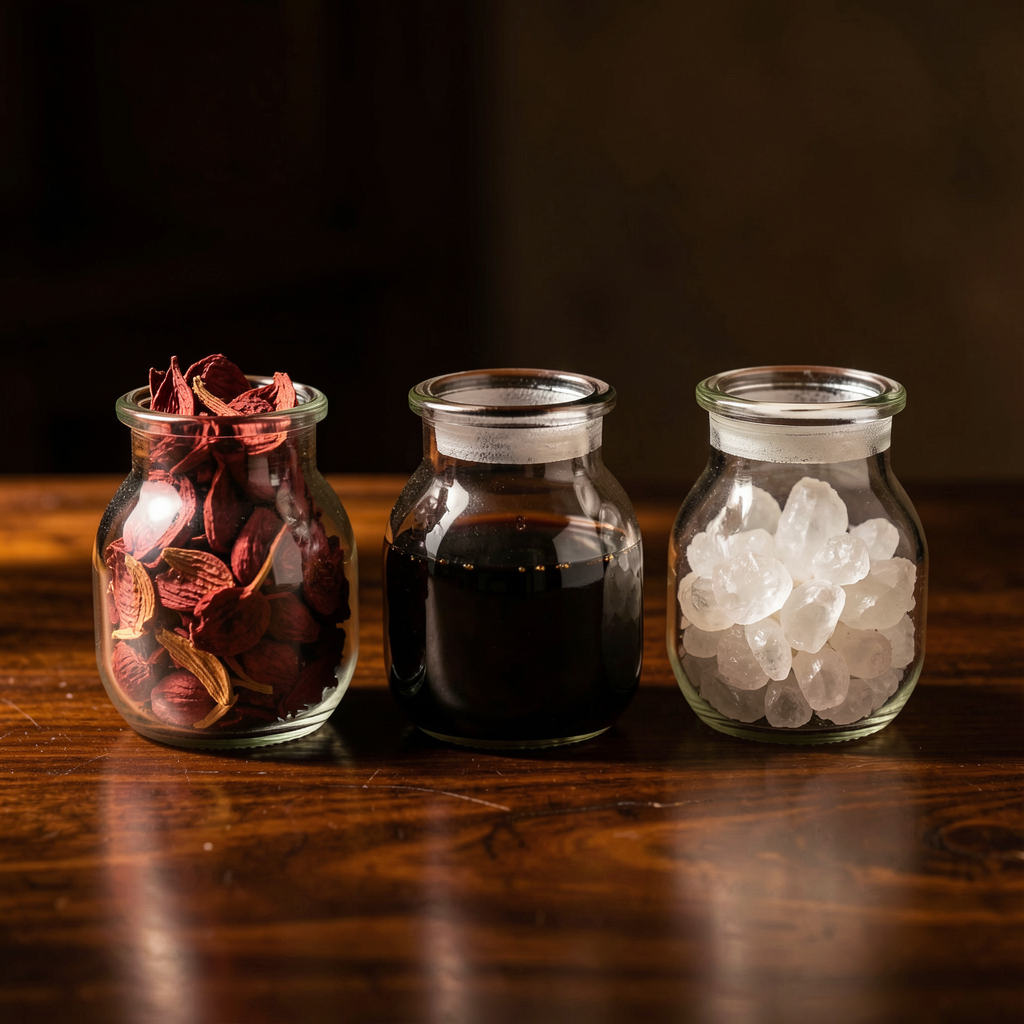
GENERATE + COOL — the primary action for most dry eye presentations. The dominant strategy in Liver Blood deficiency and Kidney Yin deficiency dry eye is generating the fluid that the body cannot self-produce and simultaneously cooling the secondary heat that emerges from the depletion.
- Mai Men Dong (Mài Mén Dōng, 麦冬 / Ophiopogon) — the central Yin-fluid generating herb for the Stomach and Lung; generates the upper-body fluid supply that reaches the lacrimal apparatus. Ophiopogon polysaccharides have documented effects on salivary and lacrimal secretion in Sjögren's models. Used in virtually every dry eye formula as the fluid-generation anchor.
- Sheng Di Huang (Shēng Dì Huáng, 生地黄 / Raw Rehmannia) — cools Blood and generates Yin-fluid simultaneously; the essential dual-action herb when both deficiency heat and fluid depletion are present. The raw form (sheng, unprocessed) has greater cooling action than the processed form.
- Sha Shen Mai Men Dong Tang (Shā Shēn Mài Mén Dōng Tāng, 沙参麦冬汤) — the base formula for Lung-Stomach Yin deficiency dryness. Sha Shen (沙参, Adenophora / Glehnia) and Mai Men Dong generate the upper-body Yin; Sang Ye (桑叶, Mulberry leaf) and Tian Hua Fen (天花粉, Trichosanthes root) clear the residual heat and generate fluid. For dry eye with concurrent dry throat, dry cough, and dry skin — the Lung-surface pattern of insufficient fluid distribution to the body's exterior.
- Qi Ju Di Huang Wan (Qǐ Jú Dì Huáng Wán, 杞菊地黄丸) — the canonical Liver-Kidney dry eye formula. Gou Qi Zi (枸杞子, Lycium / Wolfberry) nourishes Liver Blood and Kidney Yin specifically targeting the eye channel; Ju Hua (菊花, Chrysanthemum) clears Liver heat and brightens vision; the Di Huang base generates the Kidney Yin substrate. The first formula most classical practitioners reach for in straightforward Liver-Kidney deficiency dry eye.
GENERATE — rebuilding Blood and fluid at the constitutional depth.
- Dang Gui (Dāng Guī, 当归 / Angelica sinensis) — generates and warms Blood; nourishes the lacrimal apparatus through the Liver Blood channel. Essential in Liver Blood deficiency dry eye where the dryness is accompanied by pallor, fatigue, and menstrual insufficiency — the whole Blood-deficiency picture.
- E Jiao (É Jiāo, 阿胶 / Donkey-hide Gelatin) — generates Blood and holds fluid within the vessels; the classical herb for profound Blood and Yin deficiency where the body cannot retain its own moisture. Used in Yi Guan Jian and other Sjögren's-pattern formulas where fluid retention capacity has been lost alongside fluid generation.
- Shu Di Huang (Shú Dì Huáng, 熟地黄 / Prepared Rehmannia) — the primary Blood-building herb in the materia medica; generates the deep Blood substrate that the Liver draws from; the constitutional root herb in Liu Wei Di Huang Wan and its derivatives. Heavier and more nourishing than Sheng Di; indicated when Blood deficiency is deep rather than when cooling is the primary need.
COOL — for Sjögren's-type inflammatory dry eye.
- Yi Guan Jian (Yī Guàn Jiān, 一贯煎) — the formula for Liver Yin deficiency with stagnation and dryness. Sheng Di, Gou Qi Zi, Dang Gui, Mai Men Dong, Sha Shen nourish the Yin; Chuan Lian Zi (川楝子, Sichuan Chinaberry) moves the Liver stagnation that has developed on top of the Yin depletion. This is the formula for Sjögren's-type dry eye where the dryness is accompanied by hypochondriac tension, emotional constriction, and the sense of dryness at every level of the person — not only the eyes. The Sjögren's patient who has been told their condition will only progress responds to this formula at the constitutional depth.
- Zhi Bai Di Huang Tang (Zhī Bǎi Dì Huáng Tāng, 知柏地黄汤) — for inflammatory dry eye where Yin-deficiency fire is driving surface inflammation alongside the deficiency dryness. Zhi Mu and Huang Bai cool the deficiency fire; the Di Huang base nourishes the Yin that the fire is emerging from. Indicated when dry eye presents with heat signs: redness, burning, afternoon heat sensation, red tongue without coat.
- Chi Shao (Chì Sháo, 赤芍 / Red Peony Root) — added to the cooling tier when Sjögren's autoimmune inflammation is the primary driver alongside the dryness; cools Blood and moves Blood stasis at the lacrimal and conjunctival vasculature simultaneously.
WARM + LIFT — for Spleen Qi deficiency driving upward fluid failure.
- Bu Zhong Yi Qi Tang (Bǔ Zhōng Yì Qì Tāng, 补中益气汤) — the classical formula for Spleen Qi deficiency with inability to raise clear Yang to the upper orifices. For the patient whose dry eye is worst with fatigue, whose vision blurs in the afternoon when their energy drops, whose digestive system is weak and whose whole body reflects a failure to transform and transport. Huang Qi (黄芪) and Dang Shen (党参) build the Spleen Qi; Sheng Ma (升麻) and Chai Hu (柴胡) lift the clear Yang upward to supply the head and eyes. This is an entirely different herbal strategy than the Yin-generating formulas — and it is the correct strategy when the primary driver is metabolic failure to distribute fluids upward rather than fluid deficiency per se.
The combination lock — why the same diagnosis needs a different formula.
Three patients present with dry eye. Each is told, accurately, that their Schirmer's test is low and their tear film breakup time is shortened. Each goes home with a bottle of preservative-free artificial tears. For each of them, the combination lock requires a different key.
The first patient is a fifty-four-year-old woman entering menopause. Her dry eye started two years ago, gradually. Her eyes feel gritty, especially in the late afternoon. She is also experiencing hot flashes, night sweats, a warmth in her palms in the evening, and restless sleep. Her tongue is red without a coat. Her pulse is thin and rapid. Her combination lock reads: Kidney Yin deficiency with secondary deficiency heat — the menopausal depletion of Yin that is drying her eyes is the same depletion driving the hot flashes and the night sweats. The formula is Qi Ju Di Huang Wan as the base, with Zhi Mu and Huang Bai added to address the deficiency fire. Artificial tears address the surface symptom; this formula addresses the constitutional depletion that is producing it.
The second patient is a sixty-two-year-old woman with Sjögren's syndrome — diagnosed five years ago after she noticed progressive dry eyes and dry mouth together. She takes hydroxychloroquine. She is exhausted. Her joints ache. She feels that she is drying out at every level: eyes, mouth, skin, joints, mood. Her tongue is dry and red. Her pulse is thin and wiry. Her combination lock reads: Kidney Yin deficiency with Liver stagnation — the profound fluid depletion of Sjögren's combined with the constriction of long-standing chronic illness that has blocked the Liver's free movement. The formula is Yi Guan Jian, which addresses both simultaneously: nourishes the depleted Yin while moving the stagnation that has developed on top of it. The question for Sjögren's is never simply "generate more fluid" — it is "why is the body not retaining the fluid it generates, and why is the Liver not moving it freely to the surfaces that need it?"
The third patient is a forty-one-year-old man with significant screen time demands — eight to ten hours daily. His dry eye flares with work and resolves on weekends. He has poor energy in the afternoon, loose stools, bloating after meals, and a pallor that colleagues comment on. His tongue is pale with a thin white coat. His pulse is soft and slightly weak. His combination lock reads: Spleen Qi deficiency with failure to distribute fluids upward — the dry eye is the local expression of a systemic failure to transform food and water into the clear fluid that should reach the upper orifices. The formula is Bu Zhong Yi Qi Tang. Adding Yin-nourishing herbs to a patient with a cold, deficient Spleen would make his digestion heavier and slower. The key turns differently: warm and lift the Spleen, build its capacity to send fluids upward, and the eye receives what it needs from a restored delivery system.
The three locks are different. The artificial tear bottle was the same for all three.
Sjögren's syndrome — the deepest end of this pattern.
Sjögren's syndrome deserves its own address within the dry eye discussion, because it sits at the extreme end of the Kidney Yin depletion spectrum and because the conventional medical framework offers patients limited tools beyond symptom management and immunosuppression.
Sjögren's is an autoimmune condition in which lymphocytes destroy the lacrimal and salivary glands, producing progressive dryness at every mucosal surface. Secondary Sjögren's overlaps with rheumatoid arthritis, lupus, scleroderma, and other systemic autoimmune conditions. The conventional treatment addresses the inflammatory destruction with hydroxychloroquine, pilocarpine for secretory stimulation, and — in severe cases — biologics targeting the B-cell axis. These interventions manage the autoimmune attack. They do not address the constitutional terrain in which a body began attacking its own secretory glands.
The classical reading of Sjögren's is straightforward: profound Kidney Yin depletion, with secondary Liver Yin deficiency, producing systemic dryness at every mucosal surface — and a Yin-deficiency fire driving the autoimmune inflammatory component. This is not a coincidence of symptom description. It is the same pathophysiology described through a different framework.
The herbal strategy for Sjögren's works at the constitutional depth: generating Yin, nourishing the Blood from which secretory function draws, moving the Liver stagnation that compounds the dryness, and cooling the deficiency fire that drives the autoimmune surface destruction. The pace is measured in months, not weeks — because the depletion that produced this picture accumulated over years, and its constitutional reversal requires sustained work at the same depth.
Patients with Sjögren's who engage in sustained herbal treatment over six to twelve months consistently report improvements in subjective dryness, salivary flow, and — frequently — energy and systemic inflammatory load, even in cases where the ophthalmology and rheumatology assessments have remained stable. This is constitutionally legible: the formula is addressing the terrain, not the gland. When the terrain shifts, the gland responds in its own time.
For the patient who has been told to use drops forever.
Most patients with dry eye receive the same advice: use preservative-free artificial tears as often as needed, consider a punctal plug, use a warm compress for MGD, take omega-3 supplements. This advice is not wrong. It is incomplete.
It is the equivalent of telling a patient with iron-deficiency anemia to take more iron without asking why the iron is deficient — whether it is because they are not eating it, not absorbing it, losing it, or all three. The drops replace the fluid. They do not restore the system that is supposed to produce it.
There are patients who have been told they will need to use drops for the rest of their lives. Some of them will. But many of them have a constitutional pattern — a Liver Blood deficiency, a Kidney Yin depletion, a Spleen Qi failure to distribute fluids upward — that is drivable at the herbal level. The formula does not always make the drops unnecessary. But the formula, designed correctly for the specific pattern of the specific person, can shift the constitutional substrate enough that the drops become supplementary to a functioning system rather than the only thing standing between them and constant discomfort.
The intake is online. The formula ships. You do not need to accept "use drops forever" as the only available answer — not until the constitutional pattern underneath has been read and addressed.
The functional medicine complement.
Classical herbal medicine addresses the constitutional pattern that produced the dry eye. Functional medicine maps the upstream environmental, nutritional, and systemic drivers. For dry eye — particularly the inflammatory and Sjögren's-associated variants — functional medicine assessment commonly surfaces:
- Omega-3 fatty acid status — EPA and DHA are the precursors to the resolvin and protectin class of anti-inflammatory lipid mediators that regulate the ocular surface inflammatory cascade. Low omega-3 status is among the most consistently documented modifiable drivers of evaporative dry eye and meibomian gland dysfunction. The classical formula addresses the constitutional pattern; omega-3 repletion addresses the lipid-mediator substrate the ocular surface needs to resolve its own inflammation.
- Vitamin D — immune regulatory and anti-inflammatory; frequently deficient in Sjögren's and systemic autoimmune dry eye populations; correlates with lacrimal gland inflammatory infiltrate severity.
- Sex hormone panel — androgens (testosterone, DHEA) support meibomian gland lipid production; estrogen modulates lacrimal secretion. Postmenopausal dry eye has a clear hormonal driver that maps directly to the classical Kidney Yin depletion picture — the decline of the hormonal substrate is the Western reading of the same depletion.
- Inflammatory markers — hs-CRP, IL-6, IL-17; in Sjögren's specifically, anti-SSA (anti-Ro) and anti-SSB (anti-La) antibody levels; the autoimmune inflammatory terrain in which the gland destruction is occurring.
- Gut integrity — emerging research connects intestinal permeability and gut dysbiosis to the systemic Yin-depleting inflammatory patterns that underlie autoimmune dry eye; the gut-lacrimal axis is an active area of investigation. The classical Spleen Qi deficiency that impairs fluid distribution often correlates directly with measurable gut absorptive failure.
- Thyroid panel — Sjögren's frequently overlaps with Hashimoto's thyroiditis; hypothyroid states reduce lacrimal and meibomian secretory output independently of the autoimmune component.
The functional medicine and classical frameworks address different levels of the same system. The classical formula restores the constitutional fluid-generating capacity. Functional medicine corrects the nutritional, hormonal, and inflammatory cofactors that sustain the terrain in which the deficiency developed. Together, they reach depths that neither approach can access alone.
How the intake works for dry eye and Sjögren's.
The online intake asks for the full clinical picture: your Western diagnosis and any systemic conditions that accompany it (Sjögren's syndrome, rheumatoid arthritis, lupus, thyroid disease, menopause); your ophthalmologist's records — Schirmer's test results, tear film breakup time, corneal staining grades, any gland imaging if available; current treatments (drops, punctal plugs, cyclosporine, lifitegrast, hydroxychloroquine, omega-3s); and the full constitutional history.
For dry eye specifically, the intake should include: when you first noticed symptoms and how they have changed, whether the dryness is limited to the eyes or involves other mucosal surfaces (mouth, skin, vaginal mucosa, joints), whether symptoms are worse at specific times of day or with specific activities, any systemic symptoms that accompany the dryness (fatigue, joint pain, heat sensations, night sweats), and your digestive health — because the Spleen Qi deficiency pattern that drives one category of dry eye is directly visible in the digestive picture.
Michael reads every intake personally. He identifies the classical pattern — Liver Blood deficiency, Kidney Yin depletion, Lung-Stomach Yin dryness, Spleen Qi failure to distribute, or the Sjögren's-axis Yin-stagnation combination — and designs the formula for that specific pattern. The first formula is accompanied by a map of what it is intended to accomplish, what changes to watch for in your body's response, and what adjustment signals will guide the next formula.
Understand the framework before you begin.
The Chambers are a free patient education library — the methodology behind every Rootworth formula. Reading them before or alongside your intake helps you understand what the classical assessment is seeing, why individualized formulas outperform generic protocols, and how each layer of treatment connects to the next.
A note on these statements.
Rootworth herbal preparations are dietary supplements. These statements have not been evaluated by the Food and Drug Administration. These products are not intended to diagnose, treat, cure, or prevent any disease. Classical Chinese medicine pattern assessment — the identification of constitutional patterns such as Liver Blood deficiency, Kidney Yin depletion, Lung-Stomach Yin deficiency, or Spleen Qi insufficiency — is distinct from the diagnosis and treatment of disease as defined under United States federal law. Individual results vary. All scientific references on this page refer to published research on herbal constituents or nutritional interventions; references do not imply that any Rootworth formula is intended to produce the effects described. Always continue your ophthalmologist's care and any prescribed medications or drops alongside any herbal support program.
- Begin intake — read the process and start your formula
- Uveitis / iritis — classical formulas for intraocular inflammation
- All eye conditions — the full classical framework for ocular health
- Autoimmune conditions — constitutional pattern work for systemic inflammatory disease
- Classical training — why this practice holds the conditions it does