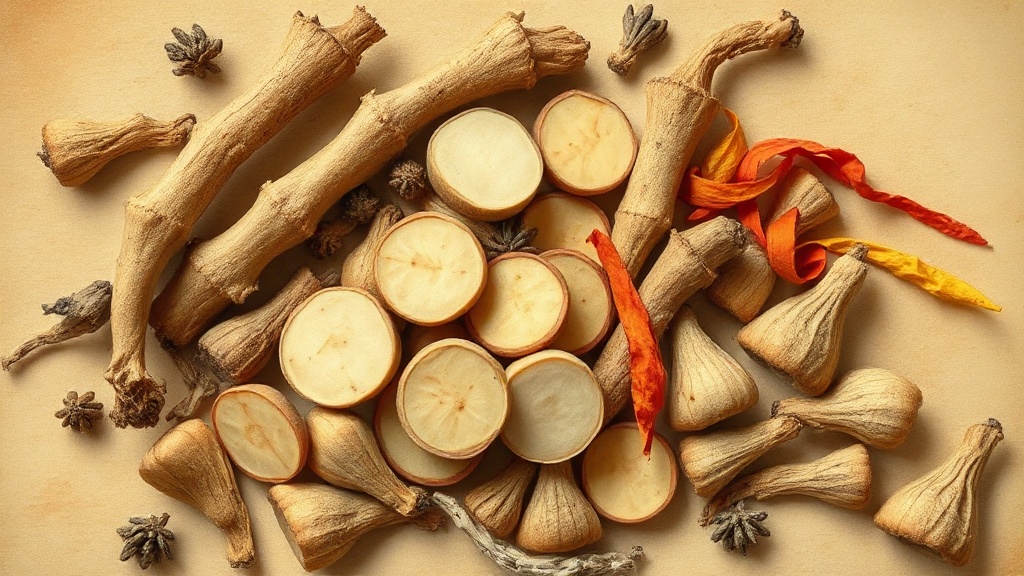

The PCOS diagnosis describes what the labs show — not what is causing it. Classical Chinese medicine has been mapping the constitutional terrain beneath hormonal dysfunction for centuries. Here is what it reads, and how custom herbal medicine addresses the roots rather than the downstream output.
You’ve probably encountered the PCOS acronym enough times that it has lost some of its weight. Polycystic ovary syndrome — the catch-all diagnosis handed to millions of women whose hormones won’t follow the script. But “PCOS” describes a set of findings on a lab report and an ultrasound. It doesn’t explain why your follicles aren’t maturing, why your cycles run sixty or ninety days if they arrive at all, or why every attempted dietary intervention feels like pushing a boulder uphill. That is where the medicine becomes interesting — and where classical Chinese herbal medicine has developed genuinely sophisticated frameworks for understanding what is happening beneath the lab values.
This post applies the classical lens to PCOS: four overlapping constitutional patterns, each pointing toward a different herbal strategy, each illuminating a piece of the picture that a Rotterdam criteria checklist cannot reach. The intake at Rootworth begins with this pattern differentiation — not the diagnosis label — because the herbal formula that follows is only as precise as the assessment that precedes it.
The Western Picture: Rotterdam Criteria and the Standard Model
PCOS is diagnosed when at least two of three Rotterdam criteria are met: oligo- or anovulation (irregular or absent ovulation), clinical or biochemical hyperandrogenism (elevated androgens on labs, acne, hirsutism, hair thinning), and polycystic ovarian morphology on ultrasound. It is the leading cause of anovulatory infertility and carries long-term metabolic consequences — elevated risk of type 2 diabetes, cardiovascular disease, and endometrial malignancy if the underlying hormonal environment is left unaddressed.
Standard conventional management centers on oral contraceptives to regulate cycles and lower androgens, metformin for insulin resistance, and clomiphene or letrozole to induce ovulation when pregnancy is the goal. These tools matter and they help — but they don’t resolve the underlying hormonal dysregulation. Many patients cycle normally on birth control and return to their prior pattern the moment they stop. Others tolerate metformin poorly. The question “what is actually driving this?” often goes unanswered. That gap is where the classical Chinese herbal framework and the functional medicine insight it carries tend to enter the conversation.
The Functional Medicine Angle: Insulin Resistance as the Root Driver
Functional medicine positions insulin resistance as the upstream disruptor in the majority of PCOS presentations. The mechanism: insulin excess upregulates a key enzyme pathway in the ovarian theca cells, driving overproduction of androstenedione and testosterone. Elevated androgens then inhibit the conversion pathway from androgens to estradiol, leaving follicles unable to mature past the antral stage. This is why the “cysts” visible on an ovarian ultrasound in PCOS are not true cysts — they are antral follicles arrested in development, accumulating because the hormonal environment won’t allow them to progress.
The functional medicine complement for Earth-type PCOS works on this insulin-androgen axis directly — insulin-pathway support that addresses the upstream disruptor rather than managing its downstream hormonal consequences. For Wood-type PCOS driven by androgen excess and estrogen dominance through the Liver-regulatory sphere, the functional complement shifts toward estrogen-metabolism support and hepatic-clearance enhancement. One important distinction across all approaches: androgen-precursor supplementation is contraindicated in PCOS. These patients already have up-regulated androgen pathways, and any supplement that adds to the androgen pool exacerbates hyperandrogenism and worsens the clinical picture. This is the direct inverse of the protocol for diminished ovarian reserve, and the distinction matters clinically.
In the classical materia medica, White Peony (Bái Sháo, 白芍) and Licorice (Gān Cǎo, 甘草) are among the herbs with well-established androgen-modulating properties — they address androgen excess from the classical herbal side through mechanisms that align precisely with what functional medicine identifies as the relevant enzyme targets in PCOS androgen synthesis. The classical and functional perspectives, approached from different angles, tend to converge on the same terrain.
How Chinese Medicine Sees PCOS: Four Patterns, One Obstruction
Classical Chinese medicine’s framework for PCOS is a story about the Bao Mai (Bāo Mài, 胞脈) — the uterine vessel — and what it takes for a follicle to complete its journey. The classical framework doesn’t use the word “anovulation,” but it describes exactly the same phenomenon: the potential for new life that forms but cannot transform, accumulates but cannot release. Four overlapping patterns account for most PCOS presentations, and they commonly appear in combination.
Kidney Yang Deficiency (腎陽虛, Shèn Yáng Xū)
Kidney Yang is the warming, activating force behind the entire reproductive cycle. In PCOS, Kidney Yang deficiency means the fire underneath the process is insufficient — follicles form, but the energetic trigger for ovulation never arrives. Clinically this presents as consistently low basal body temperature throughout the cycle (the characteristic temperature shift at ovulation, which should rise 0.4–1.0°F, is absent or minimal), cold limbs, low libido, possible low back ache or knee weakness, and cycles that are long, delayed, or absent entirely. The LH surge — in Chinese medical terms, the Yang culmination moment — simply doesn’t gather enough force to complete.
Phlegm-Damp Obstruction (痰濕阻滯, Tán Shī Zǔ Zhì)
This is often the most structurally significant pattern in PCOS. When the Spleen’s transformative function is impaired — whether by constitutional factors, dietary habits, or the dampening effect of Kidney Yang deficiency — Phlegm-Damp accumulates. In the context of the ovaries, accumulated Phlegm-Damp is visible: those arrested antral follicles, unable to drain or transform, are the physical expression of Phlegm obstructing the Bao Mai. The pattern commonly presents with weight that is difficult to lose, copious or sticky cervical mucus (or paradoxically absent mucus, as the Damp is thick and blocking), a swollen pale tongue with a greasy coat, and a slippery or slow pulse. This is the “Earth type” in Five-Phase functional medicine language — the patient who tends toward fatigue, subdued affect, digestive bloating, and may be completely anovulatory for months at a time.
Liver Qi Stagnation (肝氣鬱結, Gān Qì Yù Jié)
The Liver in Chinese medicine governs the smooth flow of Qi throughout the body — including through the Chong Mai (Chōng Mài, 衝脈, Penetrating Vessel), which supplies the uterus and drives the menstrual cycle. When Liver Qi stagnates — under chronic stress, emotional suppression, unresolved frustration — the cyclical movement of Qi and Blood through the reproductive terrain becomes irregular and hesitant. Cycle lengths vary wildly from month to month. PMS is often significant: breast distension, irritability, mood swings in the premenstrual window. This overlay frequently appears on top of either Kidney Yang deficiency or Phlegm-Damp, and treating the root without addressing the Liver layer often produces incomplete results. The “Wood type” — more likely to be leaner, prone to cystic acne, sleep-onset insomnia, and responding poorly to hormonal birth control — often has Liver Qi stagnation as the primary energetic driver, with the Earth (insulin-glycemic) disruption as a secondary consequence.
Blood Stasis (血瘀, Xuè Yū)
Blood Stasis in PCOS tends to develop as a complication of the other patterns — particularly when Phlegm-Damp and Liver Qi stagnation persist over time and begin to impair the movement of Blood through the Chong Mai. The clinical picture includes dark menstrual blood with clots (when menses does arrive), possible fixed pelvic pain, a purple-tinted tongue or darkened tongue edges, and a choppy pulse. This pattern can also arise from the long-term hormonal environment of PCOS itself, where chronic anovulation and estrogen dominance — without the progesterone surge of ovulation — alters endometrial and vascular dynamics over months and years.
Reading PCOS Symptoms Through a TCM Lens
Why do the follicles stall? In TCM terms, the multiple small antral follicles of PCOS are accumulated Phlegm-Damp that cannot transform and release — the Spleen’s failure to govern transformation has allowed substance to accumulate in the reproductive terrain without the momentum to complete its cycle. The Kidney Yang deficiency underneath means there is insufficient warmth to drive the final stage of follicular maturation and ovulation. The ovary has potential — it can generate follicles — but lacks the energetic completion signal to move them through.
Why is weight loss so difficult? The Spleen governs transformation and transportation of nutrients. When Spleen Qi is weak and Phlegm-Damp is the dominant pathological product, every meal adds more raw material to the obstruction. Low-glycemic dietary changes and consistent movement are essential not as cosmetic interventions but as direct support for Spleen Qi — they reduce the Damp burden and begin to clear the terrain. This is why even modest weight reduction in PCOS — five to ten percent of body weight — produces measurable improvements in ovulation frequency across the clinical literature.
Why the cycle irregularity and mood fluctuations? Liver Qi stagnation disrupts the rhythmic movement of Qi through the body’s cyclical systems. The menstrual cycle is an expression of that rhythm — when the Liver cannot regulate flow, the cycle loses its timing. The emotional component is not incidental: in Chinese medicine, the relationship between emotional state and menstrual cycle is understood as two expressions of the same Qi dynamic. Treating the Liver is treating the cycle.
Herbal Medicine for PCOS: Pattern-Matched Formulation and Functional Support
The herbal strategy for PCOS follows the pattern differentiation precisely — and in PCOS, the pattern is almost never a single layer. Earth-type PCOS calls for herbs that resolve Phlegm-Damp and restore the Spleen’s transformative function: Black Atractylodes (Cāng Zhú, 蒼術) and Cyperus (Xiāng Fù, 香附) work together to dry Damp accumulation and move Qi in the lower burner, creating the conditions for the blocked terrain to begin clearing. Pinellia (Bàn Xià, 半夏) and Aged Tangerine Peel (Chén Pí, 陳皮) address Phlegm accumulation in the middle burner — the Earth-sphere foundation that must be strengthened before the ovulatory trigger can gather sufficient force. Kidney Yang-warming herbs complete the formula, providing the activating heat the ovulatory impulse requires.
Wood-type PCOS calls for a different emphasis: Liver Qi-coursing herbs and Blood-stasis-resolving agents that address the androgen excess from the classical side. Bupleurum (Chái Hú, 柴胡) moves Liver Qi through the Chong Mai; Moutan Bark (Mǔ Dān Pí, 牡丹皮) moves and cools Blood where heat has accumulated from chronic stasis; Safflower (Hóng Huā, 紅花) and Sichuan Lovage (Chuān Xiōng, 川芎) actively move Blood through the pelvic terrain. When significant Blood stasis has accumulated, a Blood-stasis-resolving herbal strategy addressing both the Qi and Blood layers may be indicated.
The functional medicine complement layers alongside the herbal formula: insulin-pathway support for Earth-type, estrogen-metabolism and hepatic-clearance support for Wood-type. Before either can be effective, however, the Spleen’s delivery function must be working. A compromised Spleen — presenting as bloating, fatigue after meals, loose stools — cannot adequately absorb and transport herbal compounds to the reproductive tissues where they are intended to act. The formula addresses this sequencing: Spleen function is part of the constitutional picture, not an afterthought, and it is attended to before the deeper pattern work can take hold.
The Phase Strategy: Adapting the Formula to the Cycle
One of the most clinically sophisticated aspects of Chinese herbal treatment for PCOS is the phase-based approach — adapting the herbal formula to the four phases of the menstrual cycle when cycles are present, or using the four-phase framework as a clinical template when they are not.
In the follicular phase, the formula emphasizes nourishing Yin and Blood while continuing to resolve Phlegm-Damp — creating the conditions for a dominant follicle to emerge from the accumulated pool. At the ovulatory transition — the moment PCOS most consistently fails — the formula pivots toward moving Qi and activating Blood, generating the momentum that the ovulatory release requires. In the luteal phase, Kidney Yang-warming herbal support holds the corpus luteum and sustains the progesterone phase. Lifestyle anchors the whole approach: a low-glycemic diet, consistent movement, and adequate sleep directly reduce the insulin burden driving androgen excess at the molecular level.
Fertility cases require closer clinical tracking during the first three months — the formula shifts cycle by cycle as the pattern responds. A cycle that was anovulatory in month one may show a weak ovulatory temperature shift in month two, which changes both the formula emphasis and the phase timing. What the body requires in month one of treatment is not what it requires in month four. This is not a static prescription — it is an active clinical relationship with the pattern as it moves. Patients navigating PCOS often find that the first three months reveal layers of the picture that the intake alone couldn’t fully surface.
PCOS and IVF: Considerations for ART Preparation
For patients navigating IVF, PCOS presents a specific clinical consideration: the high AMH and large antral follicle count that characterize the condition create significant ovarian hyperstimulation syndrome (OHSS) risk during stimulation. Insulin-pathway support may be relevant during stimulation protocols to modulate the hormonal environment; Yang-tonic herbs are generally paused during gonadotropin injections. Constitutional preparation in the months preceding a retrieval cycle — when the formula is addressing the metabolic root and building the follicular environment — is often the more meaningful window for herbal support in the PCOS-IVF picture.
All herbal protocols should be coordinated with your reproductive endocrinology team. The Rootworth intake captures your current clinical picture, IVF history, and any prior medications or procedures, and the formula is designed with those considerations accounted for.
If PCOS coexists with endometriosis or hormone imbalance — a combination that is not uncommon — the pattern priorities shift accordingly. The journal posts on endometriosis and Chinese herbal medicine and on the fertility framework address those intersections.
Begin your pattern assessment
The intake is online. The formula ships. The work begins with understanding your specific pattern — not a condition label.
A note on these statements
Rootworth herbal preparations are dietary supplements. These statements have not been evaluated by the Food and Drug Administration. These products are not intended to diagnose, treat, cure, or prevent any disease. Classical Chinese medicine pattern assessment is distinct from the diagnosis and treatment of disease as defined under United States federal law. Individual results vary. Always continue care with your physician, OB/GYN, or reproductive endocrinologist alongside any herbal support program.