
Fertility & Reproductive Health · Journal
Pain That Follows a Calendar: Chinese Herbal Medicine for Endometriosis
When pain arrives on schedule, builds across the cycle, and leaves a mark on fertility, classical Chinese medicine reads it as more than a hormonal problem. Nearly two thousand years of clinical observation have mapped this pattern precisely — and the herbal approach follows from that mapping, not from symptom suppression.
If you have endometriosis, you know a particular kind of pain: the kind that arrives on schedule, grinds through your cycle, and leaves you wondering whether what you’re experiencing is “just bad periods” or something that is quietly reshaping your fertility. For many women, the road to diagnosis is long — an average of six to ten years from first symptoms to confirmed laparoscopy. And once diagnosed, the standard toolkit — hormonal suppression, surgery, repeat — can feel like it addresses the fire without asking what keeps lighting the match.
Classical Chinese medicine has been thinking about this pattern for nearly two thousand years. The approach is different, and for some patients, the difference matters. The herbal treatment at Rootworth addresses endometriosis from the constitutional root — not by suppressing the hormonal signal, but by working on the underlying terrain that has allowed Blood stasis to establish and deepen over time.
The Western Picture: What We Know, and Where the Gaps Are
Endometriosis is defined by the presence of endometrial-like tissue outside the uterus — on the ovaries, peritoneum, pouch of Douglas, and sometimes the bowel, bladder, or diaphragm. Every menstrual cycle, this ectopic tissue responds to hormonal signals the same way endometrium does: it thickens, breaks down, and bleeds. But with nowhere for that blood to go, the result is cyclical inflammation, adhesion formation, endometriomas (“chocolate cysts”), and progressive anatomical distortion of the pelvic cavity.
The definitive diagnosis is laparoscopy — there is no accepted blood test, and imaging may miss smaller implants entirely. Disease stage does not reliably correlate with symptom severity; some women with minimal endometriosis have debilitating pain, while others with extensive disease are nearly asymptomatic. The classic symptom complex includes progressive dysmenorrhea, dyspareunia, chronic pelvic pain, painful bowel movements around menses, and subfertility. When fertility is affected, the mechanisms are multiple: pelvic adhesions, tubal blockage, ovarian disruption from endometriomas, inflammatory cytokine burden disrupting follicle development, progesterone resistance, and increased miscarriage risk.
Conventional management focuses on hormonal suppression or surgical excision. These approaches reduce symptoms and can improve fertility outcomes — but suppression does not address disease root, and endometriosis recurs in the majority of surgically treated patients within five years. Many women seek herbal support specifically because they want to know what can be done in the spaces between surgical procedures, while waiting for IVF, or because hormonal suppression is not the right fit for where they are right now.
The Functional Medicine Lens: Inflammation, Estrogen, and the Gut
Before examining how Chinese medicine reads endometriosis, it is worth noting what functional medicine adds to the picture. Endometriosis is now understood as a condition with a strong inflammatory cytokine signature, immune dysregulation (natural killer cell failure to clear ectopic implants), and a problematic relationship with estrogen metabolism. Elevated inflammatory markers, impaired hepatic clearance of estrogen, and depleted antioxidant reserves form a mutually reinforcing cycle: more inflammation means more estrogen exposure, which feeds ectopic tissue growth, which drives more inflammation.
The gut plays a surprisingly direct role. Chronic bowel dysregulation — constipation, IBS patterns, increased intestinal permeability — reduces the body’s ability to clear estrogen through the digestive tract. Instead, estrogens are reabsorbed through enterohepatic recycling back into portal circulation, compounding the hepatic clearance burden. This is why the functional medicine approach to endometriosis almost always includes gut support alongside anti-inflammatory strategies.
The functional medicine complement for endometriosis works on four categories in parallel: antioxidant and glutathione-building support for the oxidative stress signature; prostaglandin-modulating anti-inflammatory support at the systemic level; fibrinolytic enzymatic support for adhesion management and pelvic inflammation; and estrogen-metabolism support to address the Wood-sphere hepatic-regulatory problem driving estrogen dominance. Dietary changes that reinforce this work include eliminating common inflammatory foods, stabilizing blood sugar with protein-anchored meals, and prioritizing hydration. These functional categories are determined by the pattern assessment — they do not constitute a generic supplement stack.
How Chinese Medicine Sees Endometriosis
Classical Chinese medicine doesn’t have a concept of “ectopic endometrial implants,” but it has a very clear concept of what produces fixed, stabbing, cyclical pelvic pain with dark clots, tender masses, and progressive worsening over years. The classical diagnosis is Blood Stasis (Xuè Yū, 血瘀) in the lower jiao (jiāo, 焦) — the pelvic and lower abdominal region — and endometriosis is widely regarded as the archetypal Blood Stasis disorder in TCM gynecology.
The classical principle that frames the entire treatment approach comes from Zhang Zhongjing, the Han-dynasty physician whose clinical texts remain foundational to Chinese gynecology: 緩以圖之 — huǎn yǐ tú zhī — “slowly dissolve what slowly formed.” Chronic Blood stasis in the uterine collaterals accumulates over years; it requires sustained, steady treatment, not aggressive purgation. This is why endometriosis herbal treatment is measured in months, not weeks — it is matching the pace of the problem.
Blood Stasis is rarely the whole picture on its own. Pattern differentiation identifies several distinct sub-patterns that shape how treatment is individualized.
Pattern 1: Cold Accumulation with Blood Stasis (Hán Níng Xuè Yū, 寒凝血瘀)
The distinguishing feature here is thermal relief: pain that significantly improves with a heating pad, hot water bottle, or warm bath. The flow is dark and clotted, the limbs may feel cold, and the tongue is pale-purple or bluish-purple with a thin white coat. The pulse is deep and tight. Cold contracts and congeals — when cold enters the uterine channels, blood cannot move freely. The accumulation forms what classical texts call “concretions and accumulations” (zhèng jiǎ, 癥瘕). This pattern is especially common in patients with a history of prolonged exposure to cold — habitual cold food and drink, cold abdominal exposure — and it often responds well to warming herbal strategies that penetrate the cold congealing the Blood.
Pattern 2: Liver Qi Stagnation with Blood Stasis (Gān Qì Yù Jié Xuè Yū, 肝氣鬱結血瘀)
Liver Qi stagnation is the “entry-level” disharmony that, over time, evolves into Blood Stasis. Here the picture includes strong PMS — breast distension, irritability, mood swings before the period — followed by cramping that begins as a dull ache before the flow and becomes stabbing as the period arrives. The tongue is purple with stasis spots, and the pulse is wiry. Emotionally, these patients often report that their pain is worse with stress. The Liver governs the free flow of Qi, and when Qi cannot circulate, Blood follows — stagnating in the uterine vessels. From a functional medicine perspective, this maps onto the “Wood-root” endometriosis type: hepatic-regulatory sphere running under strain, estrogen dominance driven in part by the liver’s reduced ability to clear estrogen metabolites.
Pattern 3: Blood Stasis with Kidney Deficiency (Xuè Yū Shèn Xū, 血瘀腎虛)
This is the pattern that most often emerges in long-standing disease — especially when fertility is the chief concern. Years of chronic Blood Stasis deplete the Kidney Essence (Jīng, 精) that underlies reproductive vitality. The presentation adds exhaustion, low back ache, poor response to ovarian stimulation, and thin or scanty flow alongside the stasis signs. The tongue may be pale-purple; the pulse wiry-thin or choppy. This is the pattern most commonly associated with diminished ovarian reserve in the context of endometriosis — and treatment must address both the obstruction and the depleted constitutional root simultaneously.
Reading the Symptoms Through a TCM Lens
The specific character of endometriosis pain carries TCM diagnostic signal. Fixed, stabbing pain is the hallmark of Blood Stasis — pain that moves is Qi stagnation; pain that does not move is Blood Stasis. Dark, clotted menstrual blood confirms the picture: blood that has been sitting, congealing, not flowing freely. Pain relieved after clots pass is the classic “passage equals relief” sign — once the stagnant blood exits, the immediate obstruction temporarily clears. Pain worse with cold and better with heat points specifically to the Cold-congealing sub-pattern. Pain worse before the period and slightly better once flow begins points toward Qi stagnation as the primary driver.
The timeline matters: endometriosis’s hallmark of progressive worsening is exactly what TCM would predict from chronic Blood Stasis building on itself year over year without being resolved. The classical term is 久病入絡 — jiǔ bìng rù luò — “long disease enters the collaterals.” The longer stasis persists, the deeper it penetrates the channels — and the longer, correspondingly, that sustained treatment is required to reach it.
When fertility is affected — irregular cycles, poor egg quality, implantation difficulty — TCM understands this as the downstream consequence of an environment too obstructed and too deficient to support conception. The uterus cannot receive and nourish new life when its own circulation is compromised.
The Herbal Approach and Functional Support: Dissolving What Accumulated
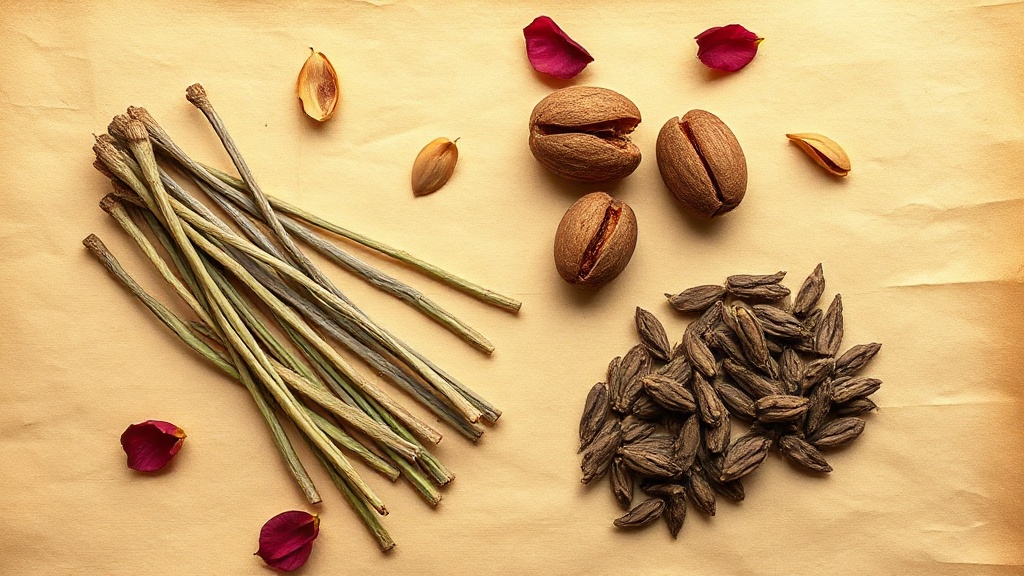
The primary herbal strategy for endometriosis is sustained Blood-stasis-resolving treatment — following Zhang Zhongjing’s principle that what formed slowly must be dissolved slowly. The classical materia medica for Blood stasis in the uterine collaterals includes herbs that work on this terrain with genuine specificity: Cinnamon Twig (Guì Zhī, 桂枝) warms and unblocks the uterine channels, driving circulation into the cold, stagnant spaces where blood has congealed; Moutan Bark (Mǔ Dān Pí, 牡丹皮) moves and cools Blood, clearing the heat that chronic stasis generates over time; Peach Seed (Táo Rén, 桃仁) is the direct mass-breaking force in the formula — its oily, lubricating nature penetrates hardened stasis; Red Peony (Chì Sháo, 赤芍) moves Blood and mildly cools; Poria (Fú Líng, 茯苓) drains Damp and creates a pathway for dissolved stasis to exit. For cold-dominant presentations, the formula shifts to warming Blood-movers: Dried Ginger (Gān Jiāng, 乾薑) and Fennel Seed (Xiǎo Huí Xiāng, 小茴香) aggressively warm the uterine channels alongside the stasis-resolving herbs. For Liver Qi-driven presentations, Bupleurum (Chái Hú, 柴胡) courses the Liver while Blood-moving herbs address both layers simultaneously.
The functional medicine complement works in parallel: the inflammatory axis and estrogen-metabolism sphere are addressed through the relevant functional categories — glutathione-building, prostaglandin-modulating, fibrinolytic, and hepatic-clearance support. These do not replace the primary Blood-stasis herbal work; they address the biochemical environment in which the stasis persists.
Before either the herbs or the functional categories can reach the uterine collaterals effectively, the Spleen must have adequate transformative function to process and deliver the formula. Gut dysbiosis — the same factor driving estrogen enterohepatic recycling in endometriosis — also impairs this absorption and transportation. Spleen support is built into the formula where indicated, ensuring that the delivery infrastructure is working before the deeper Blood-moving strategy is fully deployed.
The Depth of Stasis and the Long View
The correlate of “long disease enters the collaterals” in the treatment direction is this: the depth of the stasis correlates with the treatment duration required to reach it. Endometriosis that has been present and symptomatic for a decade is a different clinical picture from endometriosis diagnosed two years ago — not because the herbs are less effective, but because the stasis has had more time to establish in deeper layers of the channel system.
Three months is the minimum clinical window for meaningful pattern shift. The first month establishes whether the formula is correctly matched to the pattern. The second month begins to show whether the stasis is moving — often evidenced first by changes in the menstrual flow (less clotting, less darkness, or conversely, an initial passage of accumulated old blood as the obstruction begins to clear). The third month consolidates those changes and often reveals secondary pattern layers — Kidney deficiency that was masked by the dominant stasis picture, or a Liver Qi component that becomes clearer as the primary obstruction lightens.
Fertility cases require closer clinical tracking during the first three months — the formula shifts cycle by cycle as the pattern responds. The endometriosis-fertility picture in particular tends to have multiple layers moving at different rates: the Blood stasis may be lightening while the Kidney depletion underneath becomes the more prominent clinical feature. Tracking these shifts and adjusting the formula accordingly is the difference between sustained clinical management and taking herbs and waiting. The Rootworth intake initiates that tracking relationship.
For patients navigating IVF alongside endometriosis, the pre-retrieval and pre-transfer windows are the most meaningful for herbal support — supporting the follicular environment and the endometrial terrain before the critical moments in the ART cycle. This is discussed in more detail in the journal post on diminished ovarian reserve, which often intersects with the endometriosis-fertility picture, and in the fertility hub.
Begin your pattern assessment
The intake is online. The formula ships. The work begins with understanding your specific pattern — not a condition label.
A note on these statements
Rootworth herbal preparations are dietary supplements. These statements have not been evaluated by the Food and Drug Administration. These products are not intended to diagnose, treat, cure, or prevent any disease. Classical Chinese medicine pattern assessment is distinct from the diagnosis and treatment of disease as defined under United States federal law. Individual results vary. Always continue care with your physician, OB/GYN, or reproductive endocrinologist alongside any herbal support program.