Custom Herbal Formulas for Dry Eye and Macular Support, Built From a Telehealth Intake
A licensed herbalist can design a custom granule formula for dry eye and macular support through telehealth alone, using an intake questionnaire, tongue photo, symptom history, and any ophthalmology records or OCT imaging on file — reading the eyes as one expression of a whole-body Liver, Kidney, and Spleen pattern rather than treating them as an isolated organ.

- Classical Chinese medicine reads dryness and macular changes as expressions of how blood, fluids, and essence reach the eyes, not as isolated local findings.
- A telehealth intake for eye concerns typically gathers a tongue photo, symptom history, sleep and screen habits, and any existing ophthalmology records or OCT results.
- Custom granule formulas are compounded to the individual pattern, shipped as single-dose packets, and adjusted over follow-up visits alongside ongoing ophthalmology care.
In classical Chinese medicine, the eye was never read as a structure on its own. It was read as a place where the body’s deeper resources — blood, fluid, and essence — either arrive in full supply or fall short. A dry, gritty eye at the end of a long day and a slowly shifting macula decades later can, in this framework, share the same roots: depleted yin, thinning blood, or a Spleen too tired to lift fluid up to where it’s needed. A telehealth herbal intake is built to find that root, not simply to name the symptom.
This is why a classical practitioner’s questions can wander far from the eyes themselves — into sleep, digestion, menstrual history, low back aching, or how the body recovers from stress. The five-wheel doctrine of classical ophthalmology maps different zones of the eye to different organ systems, but the more useful clinical habit is simpler: treat the whole terrain that feeds the eye, and the local symptom tends to settle as part of that larger shift.
The tear film and the tissue at the back of the eye are both, in classical terms, places where blood and fluid either arrive in abundance or come up short.
What does a telehealth intake for eye concerns include?
- A clear tongue photo taken in natural light — tongue color and coating are a core diagnostic signal
- A symptom timeline: when dryness is worst, whether vision changes are new or gradual, any floaters or distortion
- Existing ophthalmology records, exam notes, or OCT imaging, if available
- Sleep, screen time, hydration, and diet habits — all of it bears on how fluid moves through the body
- Current medications and supplements, so the formula is written with the full picture in view
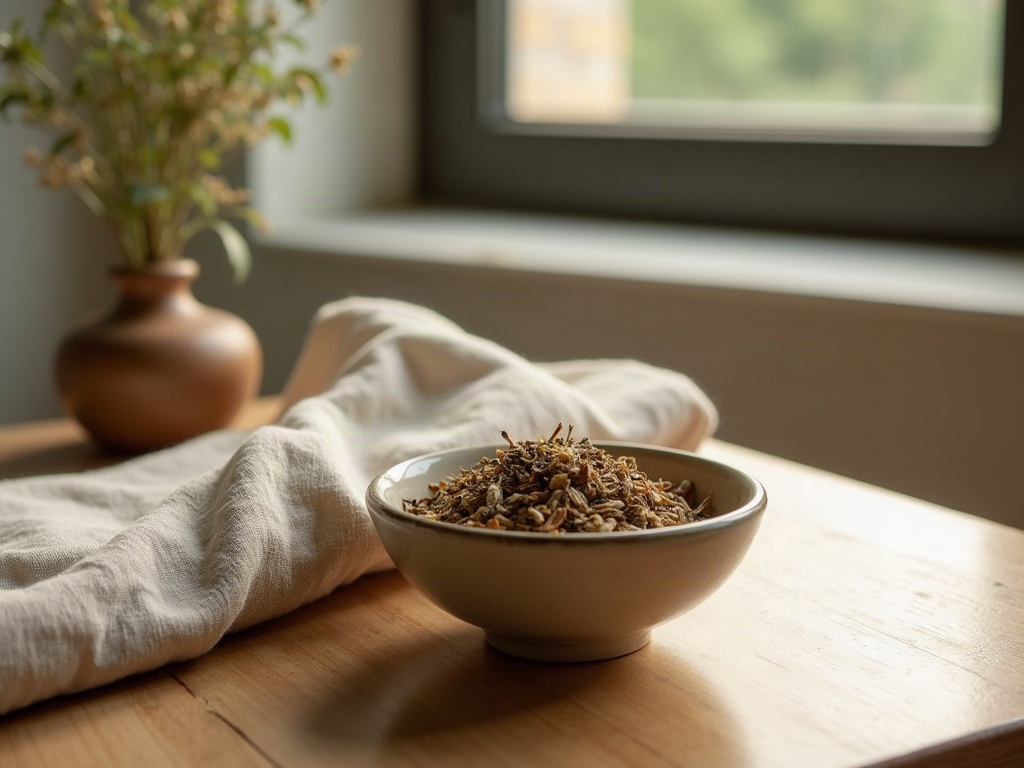
Granule formulas are compounded to the individual intake — never sold as a fixed blend.
From that intake, the practitioner works out which pattern is driving the presentation. Dryness paired with a thin, cracked-looking tongue and evening restlessness points toward depleted yin failing to moisten the eye’s surface. A duller, heavier presentation — swollen lids, fatigue, a puffier tongue body — points more toward Spleen qi struggling to lift clear fluid upward. Macular changes are often approached through the lens of Kidney essence and the smooth movement of blood through the eye’s finer vessels, since classical medicine treats vision itself as something the Kidney supplies and the Liver directs. A formula is then built from a classical base suited to that pattern and adjusted with additional herbs for the specific complaint, never reached for off a shelf.
How is the formula compounded and shipped?
Once the formula is written, it’s compounded into concentrated granules — a modern preparation of traditional decoction herbs — and packed into single-dose packets with clear instructions for dissolving and taking them. The packets ship directly, so no travel to a physical apothecary is ever required. Formulas are never meant to be static: follow-up telehealth check-ins, often every few weeks, let the practitioner track how symptoms are moving and refine the herbs as the pattern shifts. Dryness that’s responding well may call for a lighter maintenance version; a pattern that isn’t moving may call for a different combination altogether.

Formulas are reviewed and adjusted at ongoing telehealth follow-ups.
How does this fit alongside an ophthalmologist?
Herbal support in this model runs alongside conventional eye care, never in place of it. Any OCT monitoring, scheduled exams, or treatments an ophthalmologist has recommended should continue exactly as directed, and it’s worth telling the eye specialist that herbal support is part of the picture. The herbal side is not diagnosing or staging what’s happening structurally in the eye — that stays with the specialist equipped to image and measure it. What the herbal formula addresses is the broader pattern in the body that classical medicine has long linked to how well the eyes are nourished, aiming to support comfort and the internal conditions the eyes depend on over time.
Read this way, a dry eye complaint and a macular finding are not two unrelated problems to chase down separately. They’re two points where the same underlying pattern is surfacing, and a telehealth intake exists to find that pattern clearly enough to write a formula around it — one built for the person describing it, not for the diagnosis alone.
Frequently Asked Questions
Can Chinese herbal medicine be prescribed for dry eye without an in-person visit?
Yes. A video intake with a tongue photo and detailed history gives a trained practitioner most of what’s needed to identify the underlying pattern and compound a formula, which then ships directly to the patient.
What does a telehealth intake for eye concerns actually include?
A tongue photo, symptom timeline, sleep and screen-time habits, and any ophthalmology records or OCT reports the patient can share. These details help place the eye symptom within a broader body pattern.
Will herbal treatment replace my ophthalmologist?
No. Herbal support is designed to work alongside eye-care specialists, not instead of them. Routine exams, OCT monitoring, and any prescribed eye treatments should continue as directed by the ophthalmologist.
How are the granule formulas made and shipped?
Herbs are compounded into concentrated granules at a pharmacy, packaged into single-dose packets with dosing instructions, and mailed to the patient. Formulas are commonly reviewed and adjusted at follow-up telehealth visits.
Can one formula address both dry eye and macular changes at the same time?
Often the same underlying pattern — such as depleted Liver and Kidney yin or sluggish blood flow to the eye — contributes to both, so a single formula can be built to address that shared root.
Begin your telehealth herbal intake
Share your history and a tongue photo, and receive a formula built around your pattern — from anywhere.