
Fertility & Reproductive Health · Journal
The Fourth Trimester: Classical Chinese Herbal Support for Postpartum Recovery
Childbirth is one of the most extraordinary physiological expenditures a body makes. Classical Chinese medicine has spent two thousand years understanding what rebuilding from it actually requires — and what happens when that rebuilding is left incomplete.
You made it. The birth went well — or as well as births go — and now you’re home with a baby, running on fractured sleep, leaking from places you didn’t expect, and wondering why nobody mentioned that recovery would feel this hard. Western medicine generally hands you a prescription pad, a pamphlet on postpartum depression screening, and a follow-up appointment six weeks out. Six weeks. That gap is not a medical oversight; it is a structural blind spot — and Chinese medicine has spent two thousand years filling it.
The concept of the fourth trimester is not new vocabulary in classical Chinese medicine. The traditional postpartum period is described in classical texts through the practice of zuò yuè zi (坐月子) — “sitting the month” — a structured recovery protocol built around the understanding that childbirth is one of the most extraordinary physiological expenditures a body can make. You don’t bounce back from extraordinary expenditure. You rebuild from it, carefully, with the right support. The herbs, the rest, the foods, the warmth — these are not cultural customs invented without reason. They are a response to what classical medicine observed happening to women whose postpartum recovery was left unattended.
The intake is online. The formula ships. The fourth trimester has always deserved a clinical partner — and this one doesn’t require an office visit.
What Western Medicine Gets Right — and Where It Hits Its Limits
The six-week postpartum checkup is a real clinical tool. It screens for wound healing, uterine involution, hemorrhage signs, and postpartum depression — important things to assess. But one structured visit in six weeks addresses a very narrow slice of what is actually happening in a postpartum body: pelvic floor dysfunction, diastasis recti, profound fatigue, lochia that lingers or stops too soon, insomnia despite exhaustion, mood instability, low milk supply, night sweats, and a general sense of being unraveled.
Postpartum depression affects approximately one in five new mothers — and that figure captures only the cases that meet a clinical threshold. Subclinical mood disruption, anxiety, and emotional lability are far more prevalent and rarely receive sustained attention. Meanwhile, physical recovery — pelvic floor rehabilitation, iron repletion, thyroid monitoring — is largely left to the patient to pursue independently. This is where a structured classical herbal postpartum framework offers something genuinely different: a system designed from the ground up to support recovery as an active process, not a passive waiting period.
Functional Medicine Considerations in the Fourth Trimester
Before exploring the classical pattern picture, it is worth naming several functional medicine terrains that show up in postpartum recovery. Postpartum thyroiditis affects an estimated five to ten percent of women in the first year after delivery — it often presents as transient hyperthyroidism followed by hypothyroidism, and its symptoms (fatigue, mood changes, weight fluctuation) overlap heavily with normal postpartum recovery, making it easy to miss. A thyroid check and ferritin evaluation at six to twelve weeks is a reasonable conversation to have with your postpartum care provider.
Vitamin D and omega-3 fatty acids — particularly DHA — both support mood and physical recovery in the postpartum period. DHA is preferentially transferred to breast milk during nursing, often at the expense of maternal stores; replenishing this category of fatty acid is a meaningful nutritional priority for nursing mothers. Gut microbiome support through probiotic and prebiotic foods matters both for maternal recovery and for the infant immune seeding that happens through breast milk. Iron repletion following the blood loss of delivery is foundational; food-based sources alongside any iron support should be considered in the context of the whole digestive picture, because iron absorption depends on a functioning Spleen — the same Spleen that classical medicine identifies as the site of greatest strain in the postpartum period.
These functional medicine terrain considerations integrate readily with the classical herbal picture: Spleen Qi depletion flags the iron absorption concern; Kidney Yang depression points toward the thyroid picture; Liver Blood deficiency maps onto the mood and cognitive fog. The pattern assessment reads these terrains without requiring a lab order — and if you are working with a postpartum care provider who has ordered panels, that data complements rather than replaces the classical read.
How Classical Chinese Medicine Sees the Postpartum Body
Classical Chinese medicine frames childbirth as a massive, rapid expenditure of Qi (氣), Blood (血), and Kidney Essence (Jing, 精). The Chong Mai (衝脈) — the Sea of Blood — and the Ren Mai (任脈) have been fully mobilized for pregnancy and then rapidly depleted through labor and delivery. What follows is a body in a state of relative emptiness. The classical term is xu (虛) — vacuity. Understanding which specific vacuities are present, and whether stasis or stagnation has developed in the process, shapes the entire treatment picture.
Four patterns dominate the postpartum landscape in clinical practice.
1. Qi and Blood Deficiency — 气血两虚 (Qì Xuè Liǎng Xū)
This is the foundational postpartum pattern — it underlies virtually all others. Birth depletes both Qi and Blood simultaneously and dramatically. Qi deficiency shows up as profound fatigue, spontaneous sweating, shortness of breath, weak voice, and difficulty recovering from any physical exertion. Blood deficiency manifests as pallor, dizziness, scanty or irregular lochia, dry skin, hair loss in the months following delivery, poor sleep quality, and emotional fragility. Night sweats are common and straddle both: insufficient Yin substance to anchor Yang, which floats outward at night as surface heat. The Spleen — which manufactures Blood from food essence — is often depleted from the sustained demands of pregnancy, compounding the deficiency cycle. This is the terrain from which all other postpartum patterns emerge.
2. Blood Stasis with Deficiency — 血虚血瘀 (Xuè Xū Xuè Yū)
Not all postpartum presentations are purely deficient. The transition from pregnancy to non-pregnancy involves a rapid shift in uterine circulation. When that transition doesn’t flow cleanly — when old Blood lingers rather than discharging appropriately — Blood Stasis layers on top of the underlying deficiency. This is the pattern behind lochia that doesn’t move, that clots, that carries a dark purplish color or unusual odor, or that causes cramping and lower abdominal discomfort. It is also associated with a particular emotional quality — not the anxious, unsettled restlessness of Blood deficiency, but a more fixed, stuck, depressed heaviness that doesn’t lift. Classical treatment for this pattern must address the stasis and the deficiency simultaneously rather than sequentially.
3. Liver Qi Stagnation — 肝气郁结 (Gān Qì Yù Jié)
The Liver stores Blood and is nourished by it. When Blood is deficient postpartum, the Liver loses its smooth-flow quality — its capacity to circulate Qi freely through the body. Qi stagnates, emotions become volatile, irritability and frustration arise, and the enormous emotional weight of early parenthood meets a nervous system already running on empty. Postpartum mood disruption through the classical lens is often this combined picture: Blood deficiency leaving the Liver without its anchor, the Liver responding with stagnation. This is not a character flaw or a hormonal aberration to be suppressed; it is a deficiency state that responds to nourishment and movement.
4. Heart-Spleen Deficiency — 心脾两虚 (Xīn Pí Liǎng Xū)
The Heart houses the Shen (神) — the settled awareness and presence that allows a person to meet the world without being undone by it. Blood nourishes the Heart-Shen, so Blood deficiency postpartum often produces Heart signs: insomnia (difficulty falling asleep, easily startled awake), anxiety, palpitations, and the particular new-parent hypervigilance that won’t settle even when the baby is sleeping. The Spleen, simultaneously taxed, fails to generate adequate new Blood — which fails to nourish the Heart — and also fails to hold Blood in the vessels, contributing to heavy or prolonged lochia. An important downstream consequence: insufficient Spleen Qi and Blood is the classical explanation for insufficient milk supply, because breast milk in the classical framework is understood as a transformed expression of Blood.
Reading Postpartum Symptoms Through the Classical Lens
Understanding the organ dynamics decodes some of the most confusing postpartum symptoms. Extreme fatigue that doesn’t respond to sleep? Classic Qi and Blood deficiency — the resources to restore are depleted, so rest alone cannot compensate for what isn’t there. Night sweats in a non-feverish body? Yin substance is too depleted to hold Yang in place; Yang floats outward, producing surface heat and sweating. Hair loss at three to six months postpartum? Blood deficiency failing to nourish the hair — the Western explanation (telogen effluvium from the hormonal shift) and the classical one arrive at the same physical picture through different routes.
Lochia is particularly informative. Ideal postpartum discharge is initially red and steady, gradually lightening and slowing over ten to fourteen days, and resolving by four to six weeks. Lochia that is dark, clotted, or accompanied by cramping suggests Blood Stasis. Lochia that is very pale, thin, and stops too quickly suggests Blood deficiency so pronounced that the body lacks the substance to complete a clean discharge. Both are clinically meaningful signals, not simply normal variation.
Classical Herbal Medicine for the Fourth Trimester
Classical Chinese herbal medicine has a tradition of postpartum formulas that do something relatively unusual: they address multiple layers simultaneously rather than sequentially. This matters in the postpartum context because deficiency and stasis coexist — you cannot always clear the stasis first and then tonify, or tonify first and risk trapping the stasis. The formula design must hold both intentions at once, shifting emphasis as recovery progresses.
The First Week: Moving Old Blood While Building New
The early postpartum window calls for a specific herbal strategy: gently moving any old Blood that remains from the delivery while simultaneously beginning to build the Blood the body desperately needs. This is the temporal challenge of the first seven to ten days — the directions seem contradictory, but the right herbs hold both intentions at once.
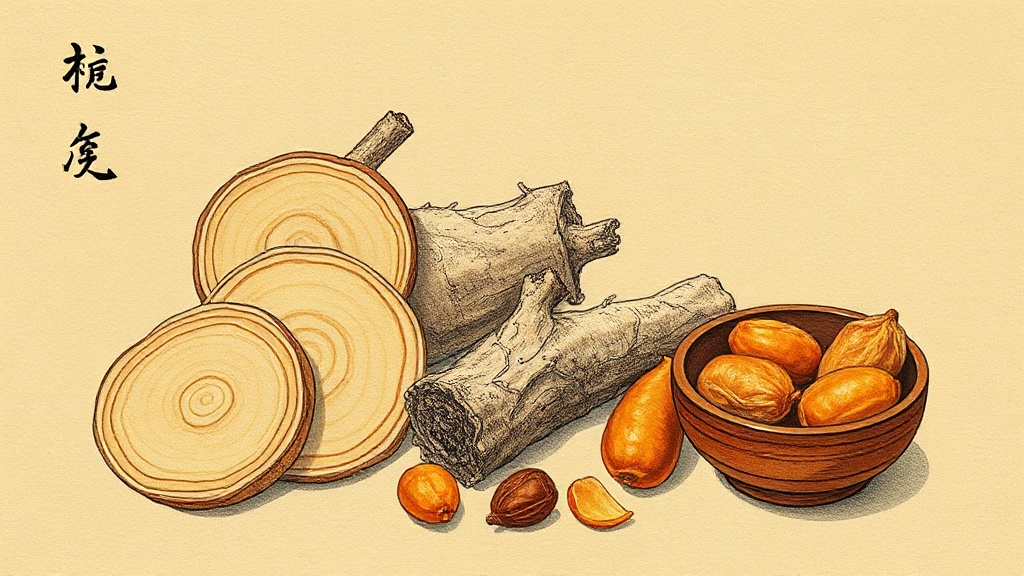
Chinese Angelica root (Dāng Guī, 当归) is the central herb of this phase: it both nourishes Blood and moves it, making it uniquely suited to the dual task. Sichuan Lovage rhizome (Chuān Xiōng, 川芎) invigorates Blood and circulates Qi, providing the activating quality that ensures the lochia discharge completes cleanly. Peach seed (Táo Rén, 桃仁) breaks Blood Stasis and assists uterine clearance where stasis has formed. Blast-fried ginger (Páo Jiāng, 炮姜) warms the uterine channels — paradoxically warming enough to move without injuring the fragile constitutional warmth of the early postpartum body. The formula architecture of this phase was refined so precisely in the classical tradition that it remains one of the most widely used postpartum formulas in East Asian countries today, sometimes given as a matter of course in postpartum wards. The timing is specific to this window; using blood-moving herbs beyond the first ten days, when stasis is no longer the clinical priority, requires a different prescription.
Weeks Two Through Eight: Rebuilding Qi and Blood Together
Once lochia is clearing appropriately, the clinical priority shifts from clearing to rebuilding. The foundational postpartum rebuilding pattern addresses Qi and Blood deficiency simultaneously — the two pillars of recovery that conventional care rarely addresses together in a single structured protocol.
Rehmannia root (Shú Dì Huáng, 熟地黄) nourishes Blood and Kidney Essence at the deepest level — the constitutional rebuilding that months of pregnancy and a delivery have drawn from. White Peony root (Bái Sháo, 白芍) nourishes Liver Blood and softens the emotional volatility that Blood deficiency generates. Codonopsis root (Dāng Shēn, 党参) — or the more expensive Ginseng (Rén Shēn, 人参) where indicated — directly tonifies Qi and supports the Spleen’s capacity to generate new Blood from food. White Atractylodes (Bái Zhú, 白术) strengthens the Spleen’s transformative function, ensuring that what is being eaten is actually being converted into nourishment rather than passing through an overwhelmed digestive system. Poria (Fú Líng, 茯苓) supports the Spleen, calms the Shen, and moderates the dampness that Spleen deficiency often generates. Chinese Angelica root (Dāng Guī, 当归) continues through this phase, shifting from its blood-moving role to its nourishing and regulating one. Together, this tier is the workhorse of weeks two through eight — addressing the fatigue, pallor, dizziness, emotional fragility, and poor sleep that persist after the initial recovery phase.
For Heart-Spleen Deficiency: Nourishing the Shen
When the Heart-Shen picture dominates — insomnia, anxiety, palpitations, excessive worrying, difficulty settling — the formula deepens into Heart-nourishing herbs alongside the Spleen support. Longan fruit (Lóng Yǎn Ròu, 龙眼肉) is the classical Heart Blood tonic: warming, sweet, and specifically indicated for insomnia and anxiety from Blood deficiency. Polygala root (Yuǎn Zhì, 远志) opens the Heart orifices and settles the Shen — easing the anxious loop of postpartum insomnia where exhaustion and hypervigilance coexist without resolution. These herbs woven into the rebuilding formula address both the Spleen root of the deficiency and the Heart downstream consequence simultaneously.
For Liver Qi Stagnation: Movement Within Nourishment
When mood disruption is prominent — irritability, tearfulness that shifts quickly, emotional instability, difficulty adapting to the enormous identity transition of new parenthood — the formula includes herbs that course Liver Qi while nourishing the Blood it is drawing from. Bupleurum (Chái Hú, 柴胡) spreads Liver Qi and resolves constraint. White Peony (Bái Sháo, 白芍) softens the Liver and nourishes Blood. Chinese Angelica (Dāng Guī, 当归) provides both nourishment and movement. This tier is the bridge between postpartum physical recovery and the emotional stabilization that conventional care most often leaves unaddressed — because in the classical framework, they are the same problem.
The classical view of postpartum mood disruption is straightforward: Blood nourishes the Heart; a Heart without adequate Blood nourishment cannot sustain settled, grounded awareness. The profound Blood expenditure of childbirth is, in classical terms, the substrate from which postpartum mood vulnerability emerges — not a mysterious chemical imbalance, but a constitutional deficiency with a constitutional response. Constitutional Blood nourishment is the long-standing classical approach to postpartum mood, and it is the same approach that addresses the physical depletion simultaneously. This framing is educational only. It does not constitute a claim that herbal medicine treats postpartum depression as defined under clinical or legal criteria. If you are experiencing postpartum depression, please continue care with your physician or mental health provider alongside any herbal support.
The Treatment Window and What to Expect
The fourth trimester is not a passive waiting period — and neither is the herbal support for it. The formula needs to track the pattern as it shifts week by week. What was Blood Stasis with deficiency in week one may be predominantly Qi and Blood deficiency by week three; the formula adjusts. What was Heart-Spleen deficiency with insomnia in week four may reveal a significant Liver Qi stagnation layer by week six as the immediate depletion begins to lift; the formula adjusts again.
The first three months postpartum are the most dynamic window — and the most consequential for the constitutional rebuilding that determines how well the body emerges from this phase of Jing expenditure. In the classical tradition, the month of rest and nourishment that zuò yuè zi (坐月子) prescribes is not a luxury; it is the minimum investment that prevents the depletion of this period from becoming a constitutional deficit carried for years. The herbal support is the clinical counterpart to that tradition — tracking the pattern month by month through the transition rather than handing you a standard postpartum protocol and stepping back.
A note on these statements
Rootworth herbal preparations are dietary supplements. These statements have not been evaluated by the Food and Drug Administration. These products are not intended to diagnose, treat, cure, or prevent any disease. Classical Chinese medicine pattern assessment is distinct from the diagnosis and treatment of disease as defined under United States federal law. Individual results vary. Always continue care with your physician, OB/GYN, midwife, or mental health provider alongside any herbal support program. If you are experiencing postpartum depression, please seek care from a qualified healthcare provider.